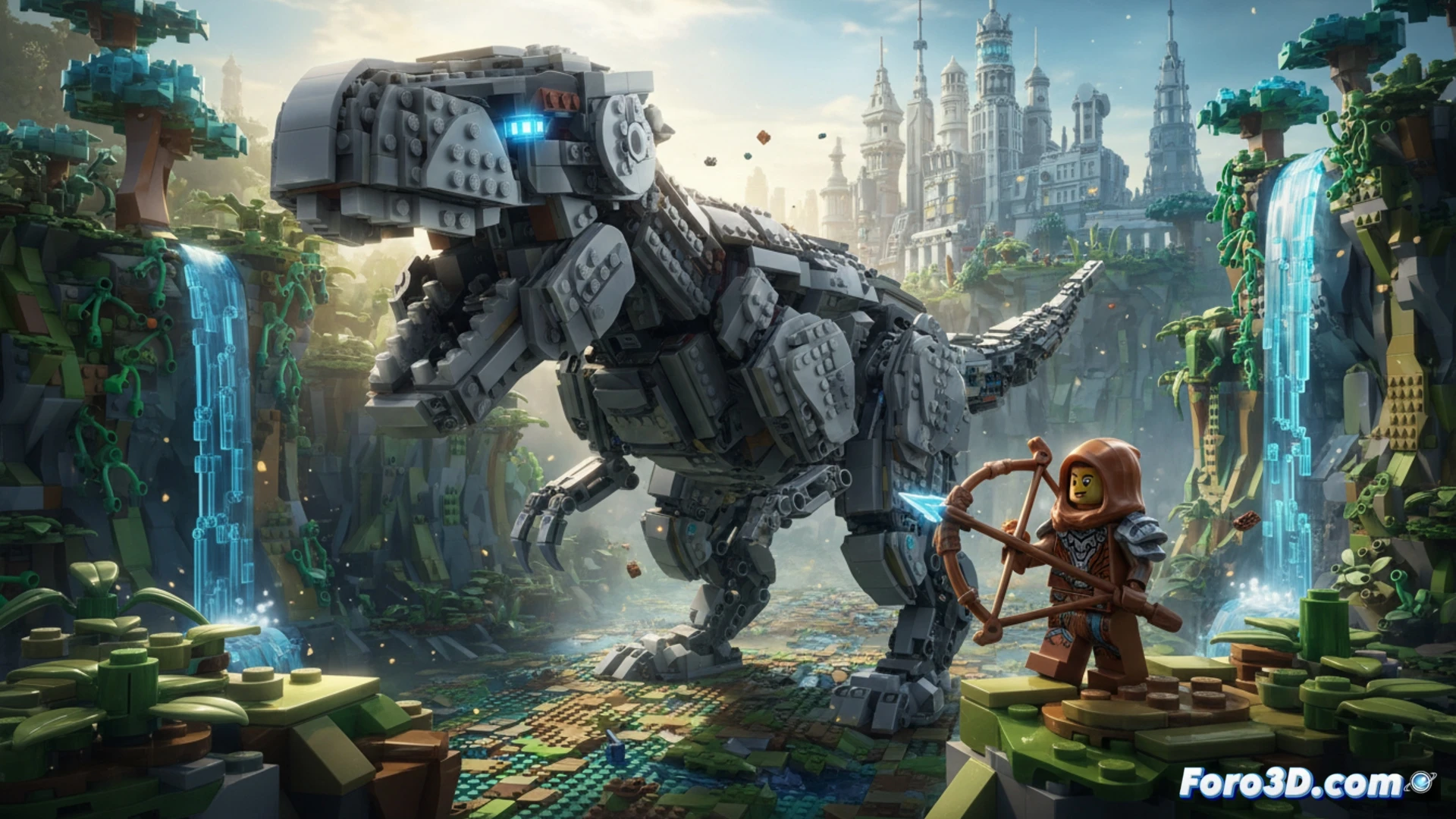
Lego Horizon Adventures is not just a playable adaptation; it is a technical feat in the photorealistic recreation of the LEGO universe. Developed in Unreal Engine 5, the game transcends the traditional toy aesthetic to endow each block with real plastic physical and visual properties. This analysis focuses on the development pipeline that combines the power of UE5 with procedural construction from Houdini, achieving a masterful balance between microscopic detail and the real-time performance demanded by an action adventure. 🎮
Plastic Shaders and Procedural Construction: The Technical Pipeline 🔬
The visual heart lies in advanced Unreal Engine 5 shaders that accurately simulate ABS plastic. They not only handle characteristic specular reflections but also micro-imperfections: scratches, wear marks, and that slight surface roughness of a used piece. Lumen's global illumination interacts with these materials, creating dynamic reflections and shadows that accentuate the real volume of each block. In parallel, Houdini acts as the procedural architect. Developers created systems that, following rules, automatically convert complex environment models into structures built with valid and physically plausible LEGO blocks. This integration greatly accelerates production and ensures visual coherence throughout the world.
Balance between Art and Performance: The Technical Lesson ⚖️
The greatest technical challenge was optimizing this density of details without sacrificing the essence. The solution lay in a very aggressive level of detail (LOD) hierarchy for distant constructions, combined with strategic use of nanite for key complex geometries. Smart textures, which pack dirt and wear into specific channels, avoid the cost of multiple unique textures. The result is a masterful lesson: visual fidelity does not depend on brute complexity, but on the precise simulation of key material properties and an automated pipeline that frees artists to refine, not to manually build each brick.
How does Lego Horizon Adventures combine photorealistic aesthetics with LEGO's plastic essence using Unreal Engine 5 and Houdini for procedural asset generation?
(P.S.: a game developer is someone who spends 1000 hours making a game that people complete in 2)