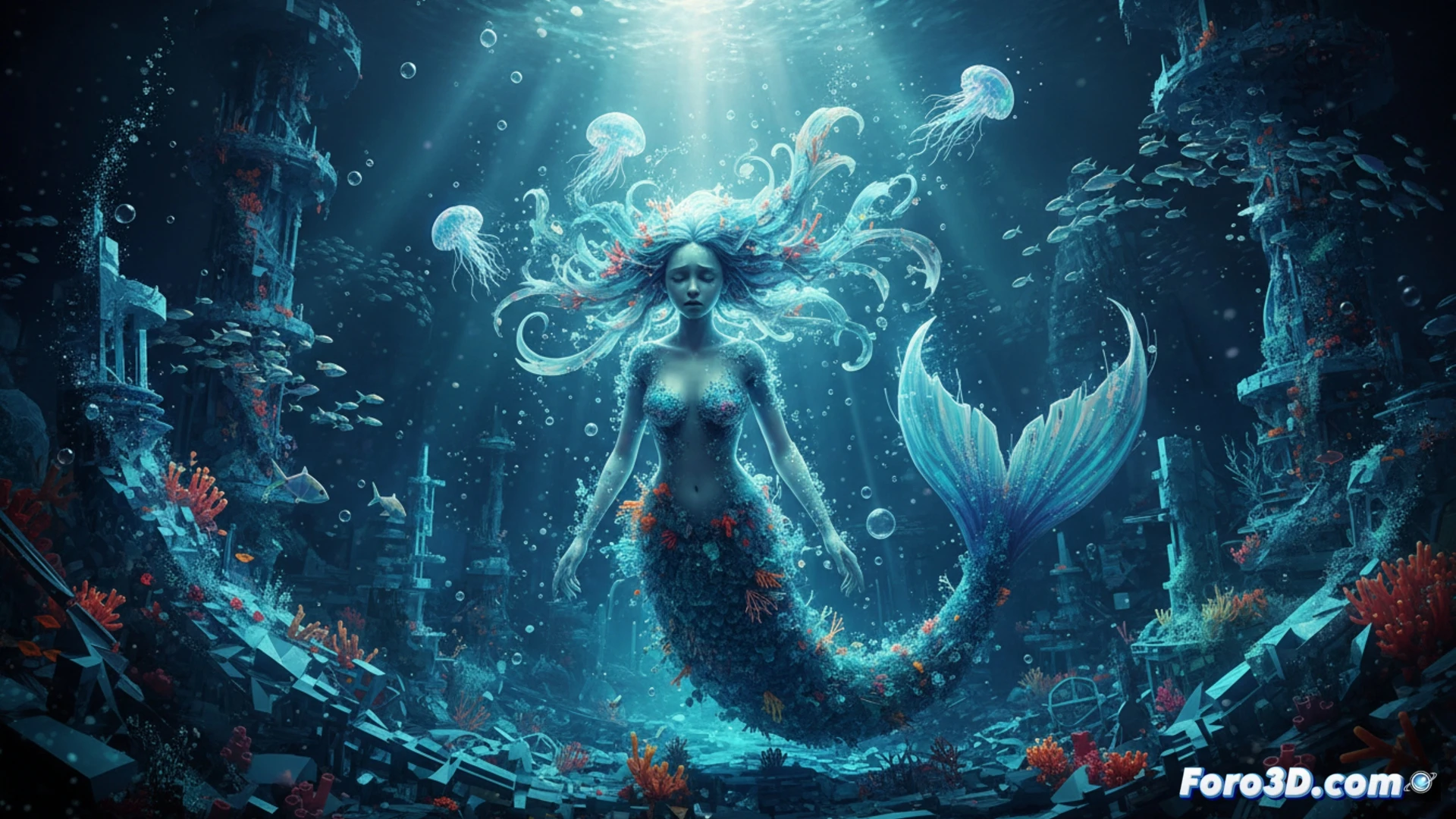
The legend of La Sirenuca, that young woman cursed with a fish tail whose song announces tragedies on the cliffs of Castro Urdiales, is pure visual narrative. Beyond its oral tradition, it represents a perfect creative brief for generative art. This niche, where algorithms and artificial intelligence give shape to the imaginary, can reinterpret the myth, transforming its key elements into 3D models, procedural textures, and digital atmospheres that capture its tragic and marine essence.
Creative Pipeline: From Prompt to 3D Model 🛠️
The process begins with prompt engineering for image AI like Stable Diffusion or DALL-E 3. Detailed prompts like melancholic siren on stormy cliff, ethereal tail, premonitory singing, dramatic lighting, photorealistic, dark fantasy generate conceptual bases. These images are used as reference for 3D modeling in Blender. The fish tail and anatomy can be sculpted with nodal geometry or subdivision surface. For the environment, Houdini is ideal: its procedural systems can simulate eroded cliffs and a turbulent sea with fluid dynamics, creating a dynamic scene full of movement that evokes the danger of the myth.
Digital Mythology: When Code Interprets Tradition 🧠
This exercise goes beyond visualization. Feeding a popular legend into a neural network or procedural system is an act of contemporary reinterpretation. Technology not only reproduces the story, but filters it through its own biases and capabilities, generating a new layer of meaning. Thus, La Sirenuca's warning song resonates in the noise of a shader or in the animation of a foam simulation, reminding us that both the sea and the algorithm have their own inscrutable rules and demand their creative tribute.
How can particle systems and procedural noise algorithms be used to simulate the hypnotic and tragic movement of La Sirenuca's hair and tail in a generative 3D environment?
(P.S.: Generative art is like having a child who paints by itself. And you don't even have to buy it paints.)