Thomas Jefferson's early letters and writings are not just historical relics; they are the source code of American democracy. In them, concepts such as liberty, citizen participation, and government structure are debated. Today, 3D technology offers us a powerful tool to unravel and make accessible this complex intellectual legacy, transforming dense texts into visual and interactive experiences for a new generation. 📜
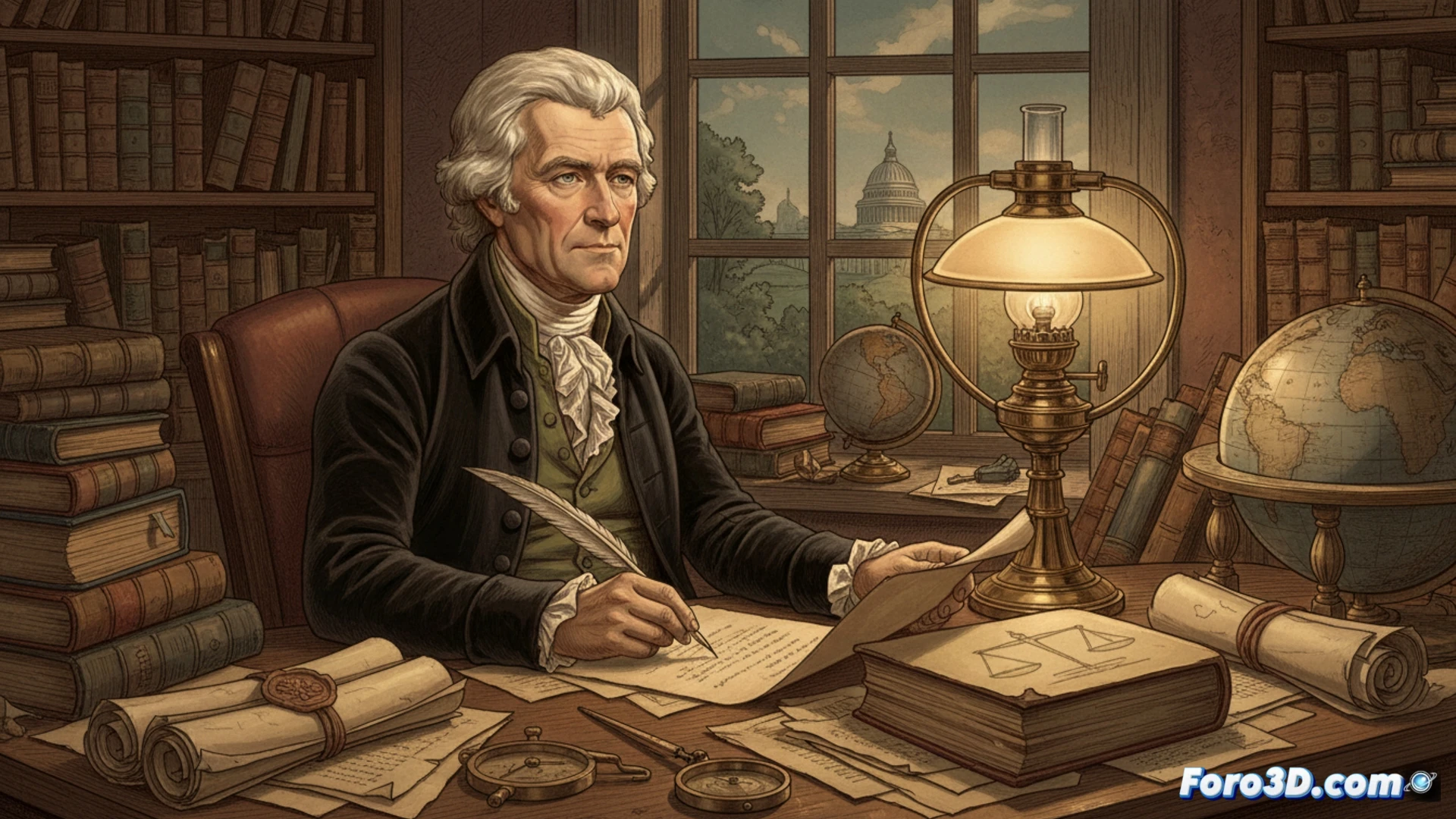
Digital Tools for Disseminating Foundational Ideas 🛠️
We can transcend the flat digitization of these documents. Imagine interactive 3D infographics where key concepts from a letter, such as the separation of powers or natural rights, are extracted and connected to form a navigable concept map. Immersive scenarios could be modeled to reconstruct the writing context, or 3D spatial timelines created to show the evolution of his ideas. Even text data analysis applied to his correspondence could generate visualizations of influence networks and recurring themes, offering a systemic understanding of his political and philosophical thought.
Connecting the Ink of the Past with the Pixels of the Future 🌉
This approach does not seek to replace reading, but to enrich it. By visualizing democratic foundations with modern tools, we create a bridge between the origin of institutions and today's digital citizenship. It is a way to democratize access to foundational knowledge, fostering more informed and critical participation. In essence, it is about using technology to preserve and revitalize the dialogue on democracy that Jefferson himself helped initiate.
How could we use interactive 3D models and data analysis to break down and visualize the democratic principles in Jefferson's foundational writings, and what current digital tools would allow for deeper citizen participation in the study and evolution of those principles?
(P.S.: simulating a scrutiny in 3D is more reliable than the real one, but less exciting)