iFixit has published its preliminary repairability analysis for the Samsung Galaxy S26 Ultra, assigning it a score of 5 out of 10. The study highlights an internal design with lights and shadows. On one hand, it praises the battery extraction mechanism and the ease of replacing the USB port. On the other, it identifies serious drawbacks that complicate common repairs, such as screen replacement or any camera module, increasing the risk and intervention time.
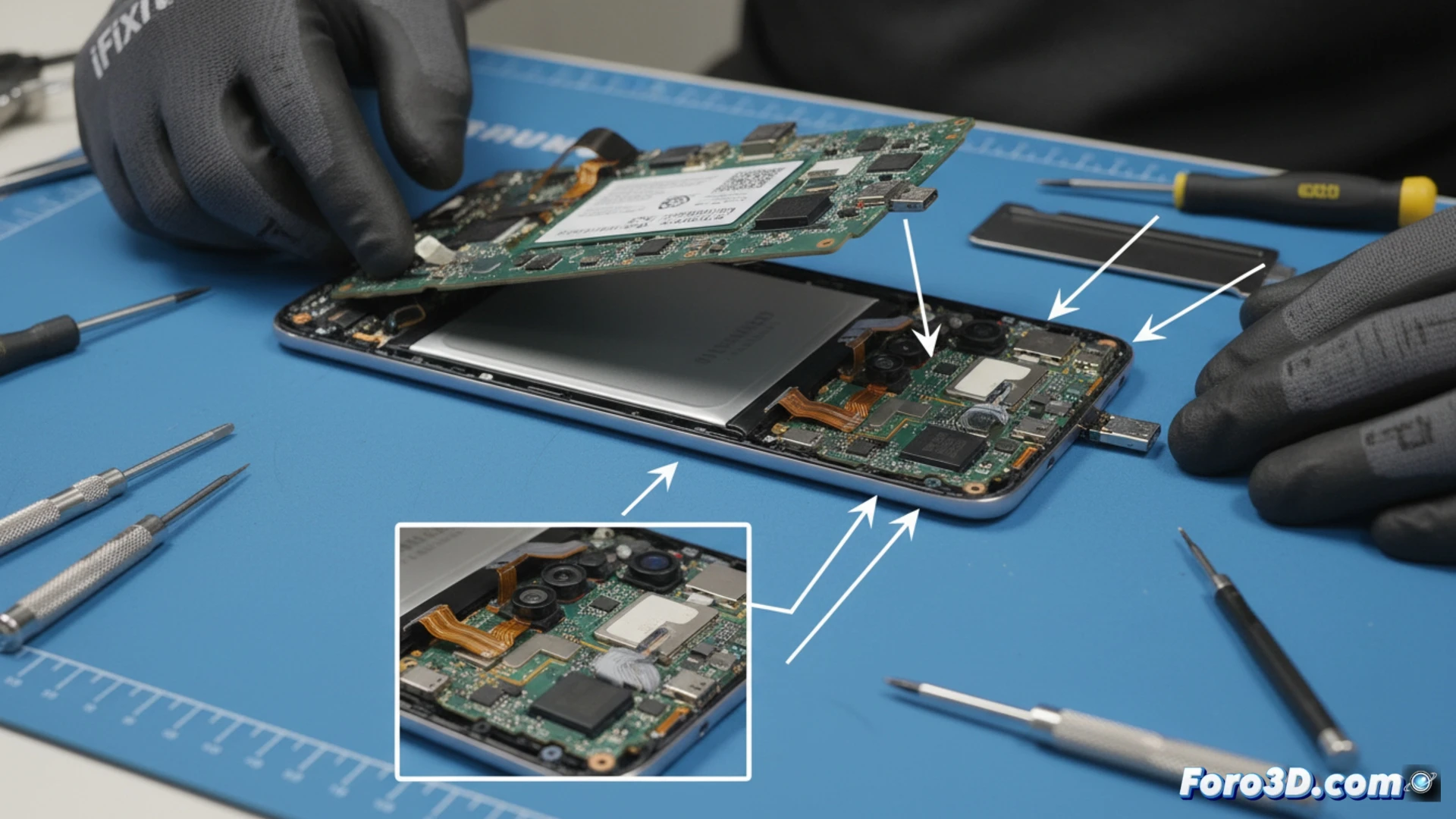
Internal Design and Critical Access Points 🔧
The technical analysis reveals two major design obstacles. To access the screen connector, it is necessary to disassemble almost the entirety of the phone, a laborious process that increases the probability of collateral damage. Even more critical is that all rear camera modules are connected under the motherboard. This means that to replace any optical sensor, the motherboard must first be removed, a high-complexity operation. The front camera also presents complicated access. These decisions prioritize compactness over maintainability.
Repairability as a Hardware Evaluation Criterion ⚙️
This case underscores repairability as an essential technical parameter when evaluating hardware. A design that hinders maintenance directly impacts the longevity, total cost of ownership, and sustainability of the device. iFixit suggests that, with a robust supply of official parts, the score could improve to a 6, demonstrating that component availability is as crucial as the internal design for the technical and repair community.
How does the low repairability score of the Samsung Galaxy S26 Ultra affect 3D modeling and rendering studies that rely on mobile devices as a secondary tool or for capture?
(P.S.: remember that a powerful GPU won't make you a better modeler, but at least you'll render your errors faster)