The Coradia iLint, the first passenger train with a hydrogen fuel cell, marks a technological milestone. Its relevance to the automotive industry is direct: it shares the essential architecture of hydrogen vehicles. The complexity of integrating the fuel cell, high-pressure tanks, support battery, and electric motors demands advanced engineering solutions. This is where 3D modeling and simulation become indispensable tools for the development of this alternative propulsion.
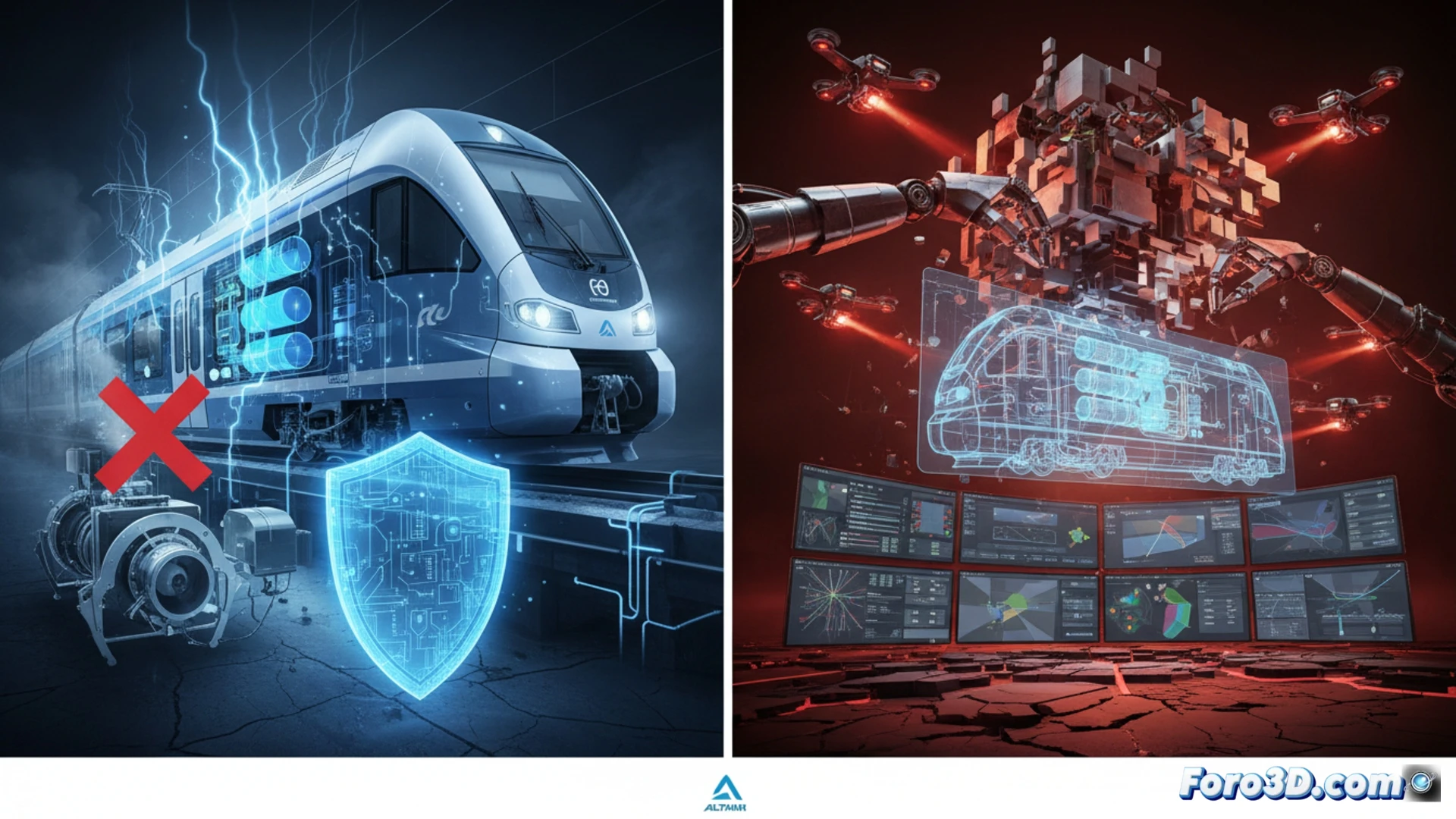
3D Simulation: Virtual Laboratory for Hydrogen Systems 🔬
Before manufacturing a physical prototype, the design is validated in a comprehensive digital environment. 3D CAD and CAE tools allow precise modeling of the fuel cell layout, hydrogen conduit routes, and thermal management system. Computational fluid dynamics simulation (CFD) analyzes gas flow and heat dissipation, while finite element analysis (FEA) verifies the structural integrity of the tanks. Additionally, the complete electrical network is modeled to optimize energy flow between the fuel cell, battery, and motors, predicting performance and range under various operating conditions.
From Bits to Water Vapor: Digital Validation 🌉
This virtualization process drastically shortens development cycles and reduces costs. It allows exploring thousands of configurations, identifying critical stress points or potential leaks, and optimizing the overall system efficiency in a safe virtual space. Thus, the transition from automotive to rail, and vice versa, is accelerated. 3D modeling is not just a design tool; it is the fundamental bridge between the concept of clean mobility and its reliable physical implementation.
How can 3D modeling and CFD simulation optimize the integration of hydrogen fuel cell systems in vehicles to maximize safety and efficiency?
(P.S.: ADAS systems are like in-laws: always watching what you do)