Drone recordings have revealed the astonishing precision with which humpback whales cooperate to create bubble spirals and trap prey. This behavior, a complex natural tool, poses an analysis challenge. This is where scientific visualization and 3D modeling become indispensable, transforming simple recordings into dynamic models that allow unraveling the sophisticated technique of these marine giants.
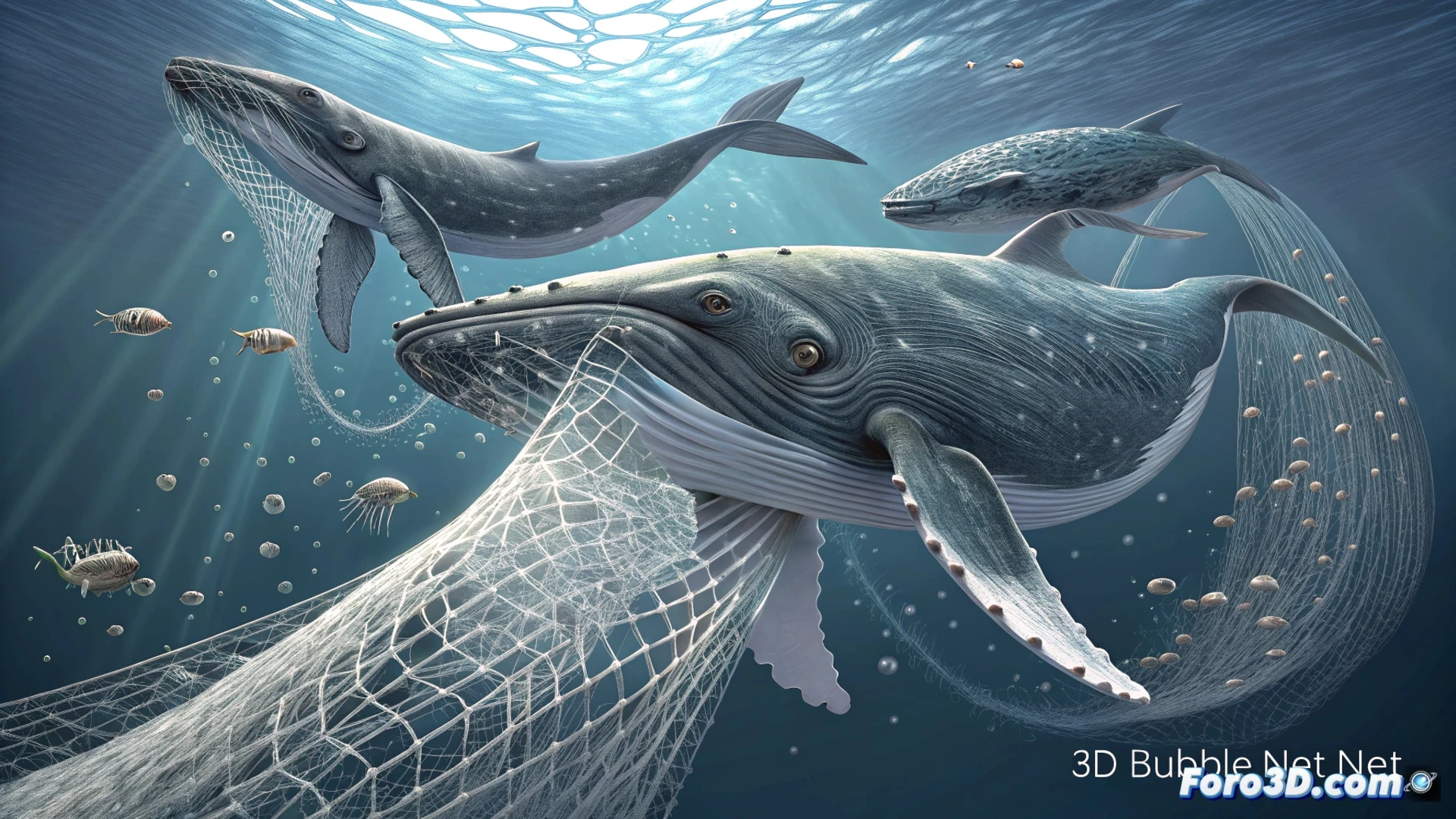
From drone data to 3D model: reconstructing behavior 🛸
Drone capture provides 2D video and position data. To understand the three-dimensionality of the phenomenon, photogrammetry and motion tracking techniques are used. Thus, the trajectory of each whale, the expansion dynamics of the bubble net, and the position of the school are reconstructed in 3D. This model allows precise measurement of angles, speeds, and volumes, analysis of group coordination, and simulation of variables like currents. It is a key tool for ethologists and oceanographers, going beyond observation to perform quantitative spatial analysis.
Visualize to understand and disseminate 📢
The true power of these 3D models lies in their communicative capacity. A 3D animation can show, from any angle and in real time or slowed down, an event that in nature is fleeting and chaotic. This is vital for documentaries and educational platforms, where a clear and attractive representation fosters public understanding of the complexity of animal behavior, closing the cycle between scientific research and dissemination.
How can 3D scientific visualization techniques be used to model and analyze the fluid dynamics and geometric structure of bubble nets created by humpback whales? 🐋
(P.S.: at Foro3D we know that even manta rays have better social bonds than our polygons)