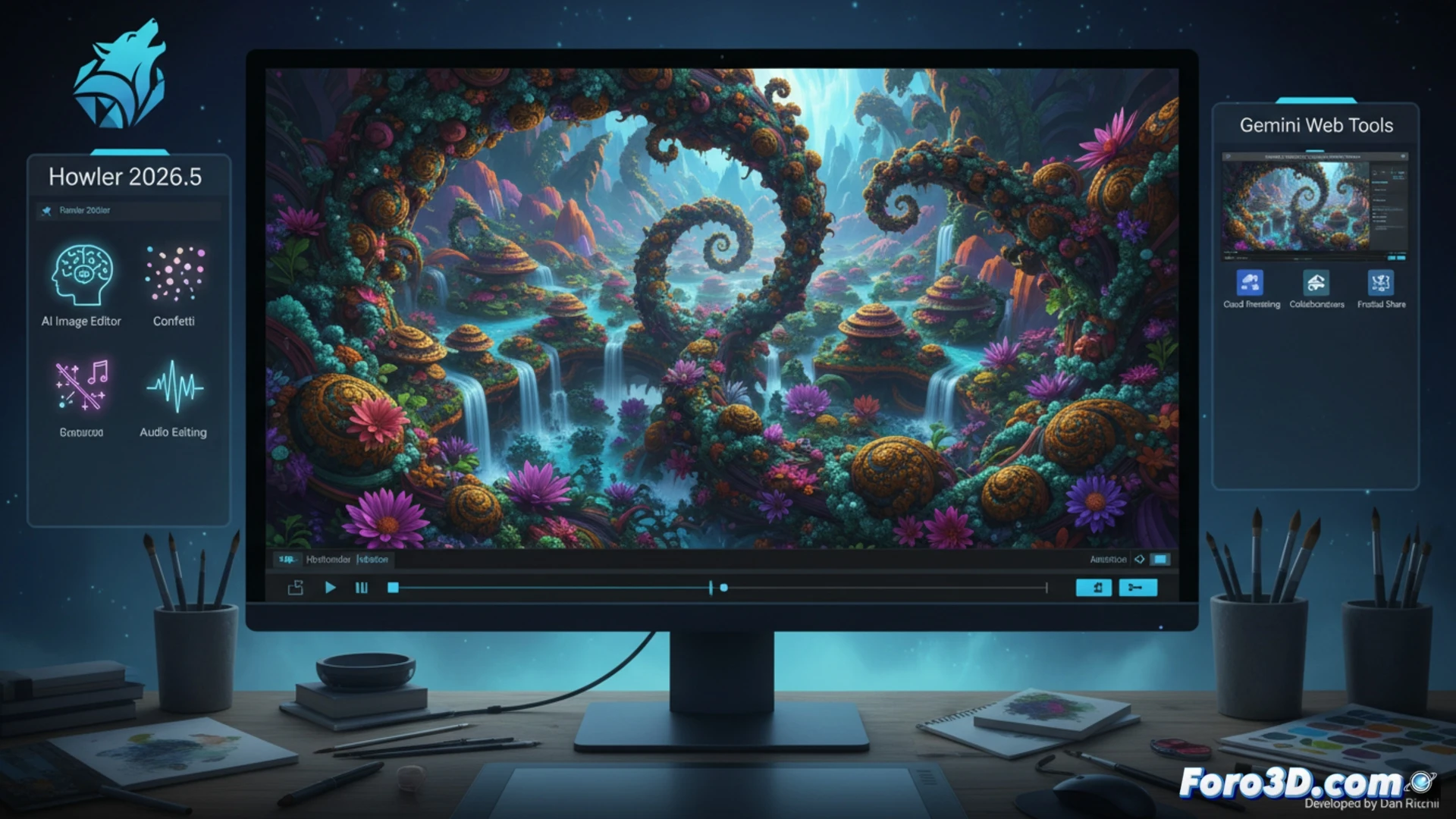
Howler, the veteran digital painting and animation tool, has just released its 2026.5 update with a clear focus on video game development. The star of this version is Fractal Garden, a powerful procedural 3D landscape generator. For indie studios and solo developers, this feature represents an opportunity to create complex terrains and scenarios quickly and accessibly, while also integrating natural painting, animation, and basic 3D tools into a single low-cost workflow.
Fractal Garden and the Indie Development Pipeline 🎮
Fractal Garden is not just a terrain generator; it's an asset creation engine ready for prototyping. It allows sculpting and texturing 3D landscapes through procedural algorithms, greatly accelerating the level and environment conceptualization phase. This capability, combined with the new Confetti particle tool for effects and the AI-powered image editor, positions Howler as a versatile suite. The inclusion of web-based tools powered by Google's Gemini further facilitates iteration and collaboration, offering a complementary ecosystem to traditional desktop software.
An All-in-One for Agile Creativity ⚡
The true value of Howler 2026.5 for video game developers lies in its integration. Instead of jumping between specialized programs to paint sprites, animate 2D characters, generate 3D terrain, and create particle effects, everything can be sketched and prototyped within the same environment. This unified approach, driven by the renewed active development from Dan Ritchie, reduces the learning curve and costs, democratizing the creation of visually rich assets and fostering faster, more organic experimentation during game design.
How does Howler's new procedural landscape generation tool in 2026.5 integrate into a real video game development pipeline, from prototyping to optimization for engines like Unity or Unreal?
(P.S.: shaders are like mayonnaise: if they break, you start all over again) 🎨