Thirty years ago, Honda unveiled the P2 prototype, a humanoid robot that marked a before and after. Its fundamental achievement was being the first to walk completely autonomously while actively maintaining balance, without falling. This advance was not mechanical, but algorithmic: a posture control system that constantly adjusted its position to counteract instabilities, imitating complex human balance. The P2 overcame the rigid gait of its predecessors, laying the direct technological foundations for ASIMO and modern bipedal robotics.
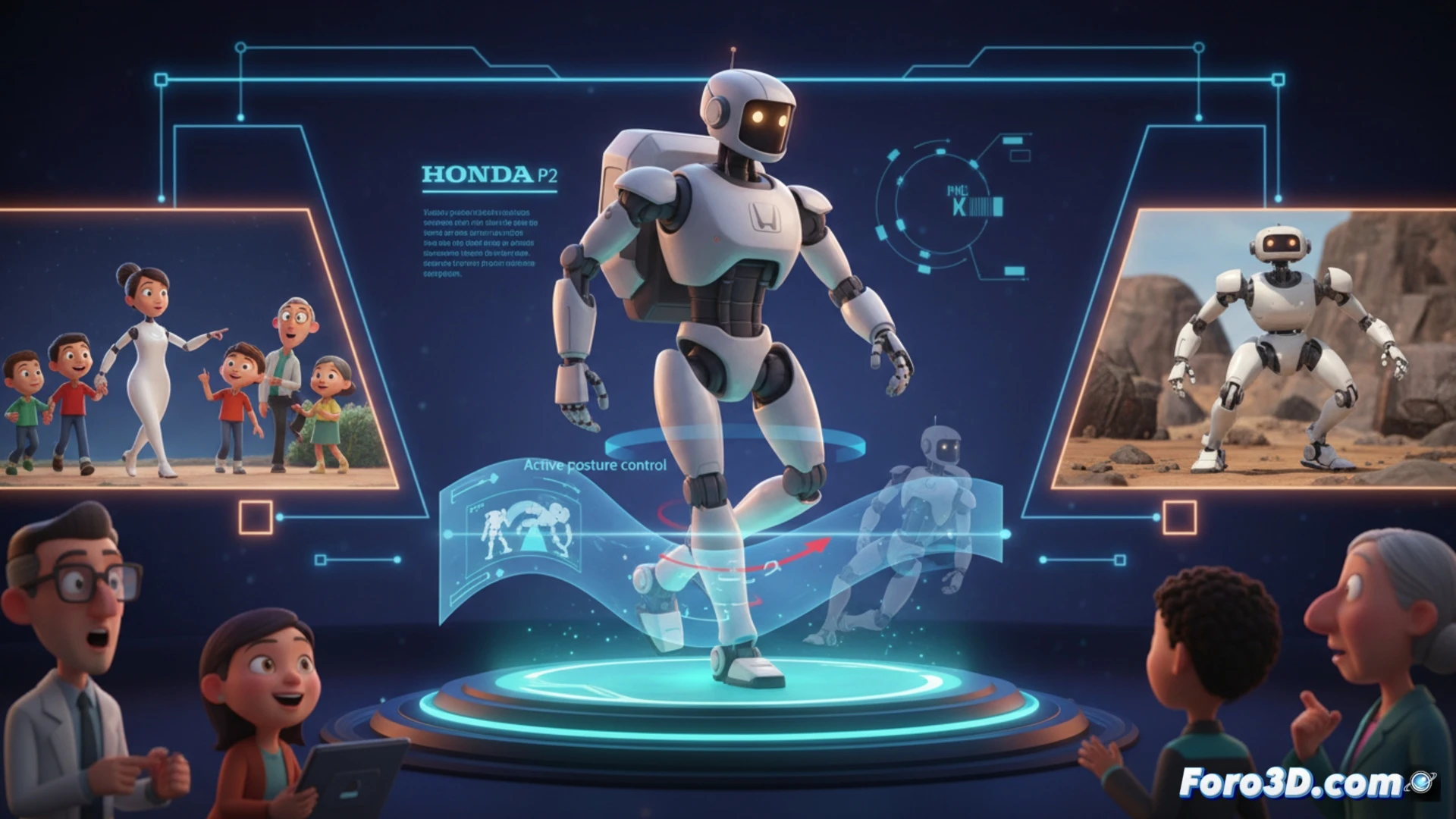
Active posture control: simulation as an essential testing ground 🤖
The heart of the P2 was its active posture control, a system that processed real-time sensor data to calculate and execute adjustments in its joints. Developing this algorithm without destroying physical prototypes required extensive prior modeling and simulation work. Although the tools of 1996 were limited, the principle is the pillar of current robotics: create a 3D dynamic model of the robot and its environment to test thousands of gait iterations and perturbations virtually. Today, software like ROS, Gazebo, or MuJoCo allows simulating these phenomena with physical precision, greatly accelerating development. The P2 demonstrated that a viable humanoid is not born in a workshop, but in simulation environments where dynamics and balance are mastered.
Simulated legacy: from P2 to current humanoids ⚙️
The P2's legacy endures in every bipedal robot that navigates a complex environment. Its fundamental principle, dynamic control based on sensory feedback and active correction, is now standard. The current difference lies in the power of 3D simulations, which allow training these systems with reinforcement learning in virtual worlds before physical implementation. The P2 was the proof of concept that validated an approach: human locomotion requires an internal model and constant adjustments, a paradigm that today is refined and scaled digitally, demonstrating that that first unsteady step was, in reality, a giant leap for robotics.
How did the Honda P2 solve the fundamental problem of real-time dynamic control for autonomous and stable bipedal locomotion? 🚀
(P.S.: Simulating robots is fun, until they decide not to follow your orders.)