The conflict in the Middle East has triggered a helium supply crisis, an inert but critical gas for the semiconductor industry. South Korea, home to giants like Samsung and SK hynix, depended on 64.7% from Qatar's exports, now interrupted. This shock has raised prices by 40% and exposes the extreme vulnerability of technology supply chains to geopolitics, threatening global chip production. 🔥
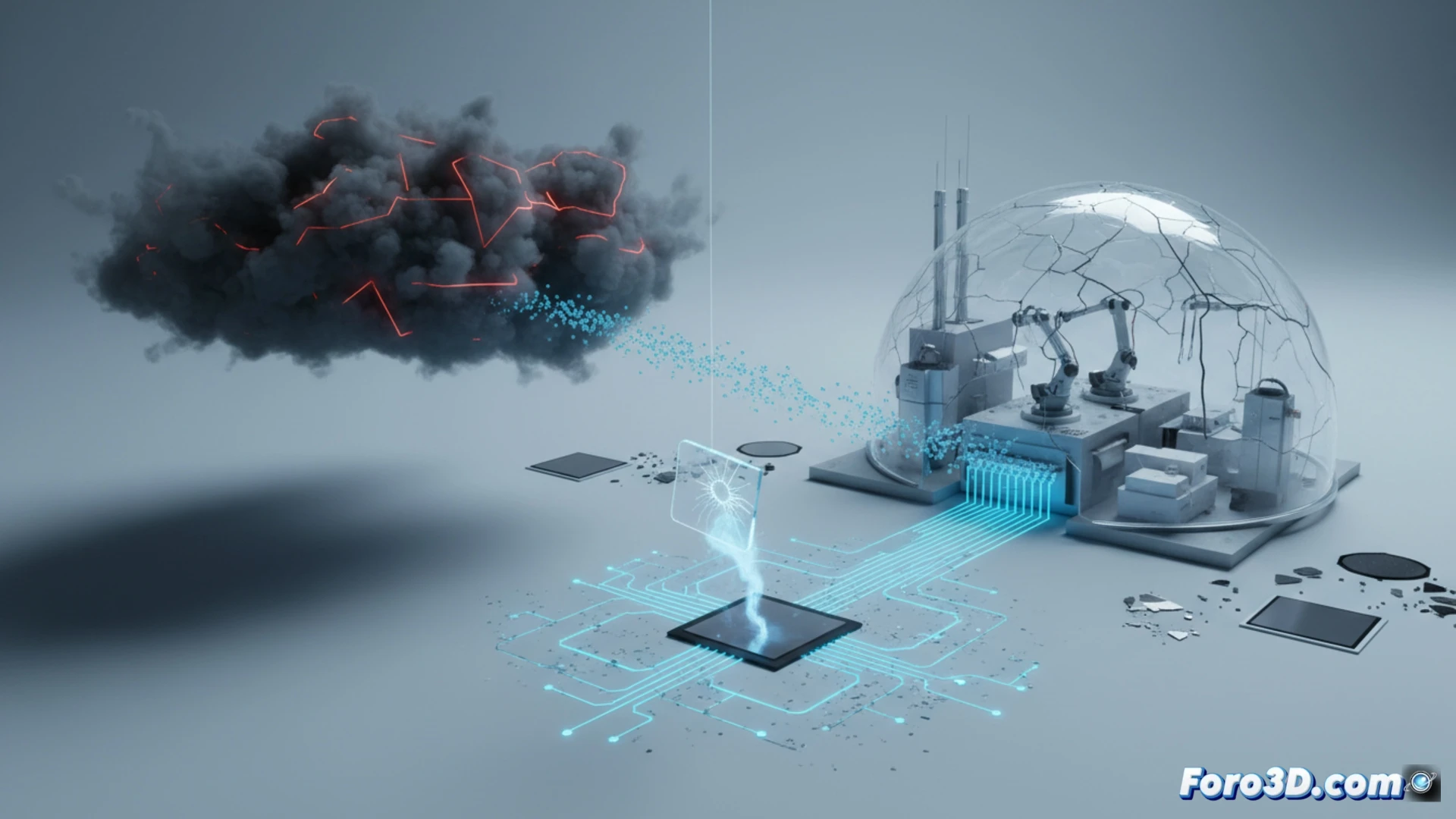
The critical role of helium in lithography and microfabrication ⚙️
In chip manufacturing, helium is irreplaceable due to its low liquefaction point and inert nature. Its key application is in immersion lithography chambers, where it is used to purge and maintain a particle-free environment and for cryogenic cooling of high-power laser lenses. A 3D model of this chamber would show how the constant flow of helium protects the light beam that etches nanometric patterns onto silicon wafers. Without this gas, the process would stop, generating massive defects.
Modeling resilience: lessons for the industry 📊
The visualization of the global supply chain reveals nodes of extreme dependence, such as the Korean case. In response, Taiwan and TSMC's strategy, with multiple suppliers and planned stockpiles, offers a model of greater resilience. Simulating a disruption in a virtual production line underscores the need to diversify sources, increase strategic reserves, and invest in helium recycling systems. The lesson is clear: the stability of microelectronics demands supply maps as complex and carefully designed as the chips themselves.
What tools would you use to simulate the internal architecture of a chip?