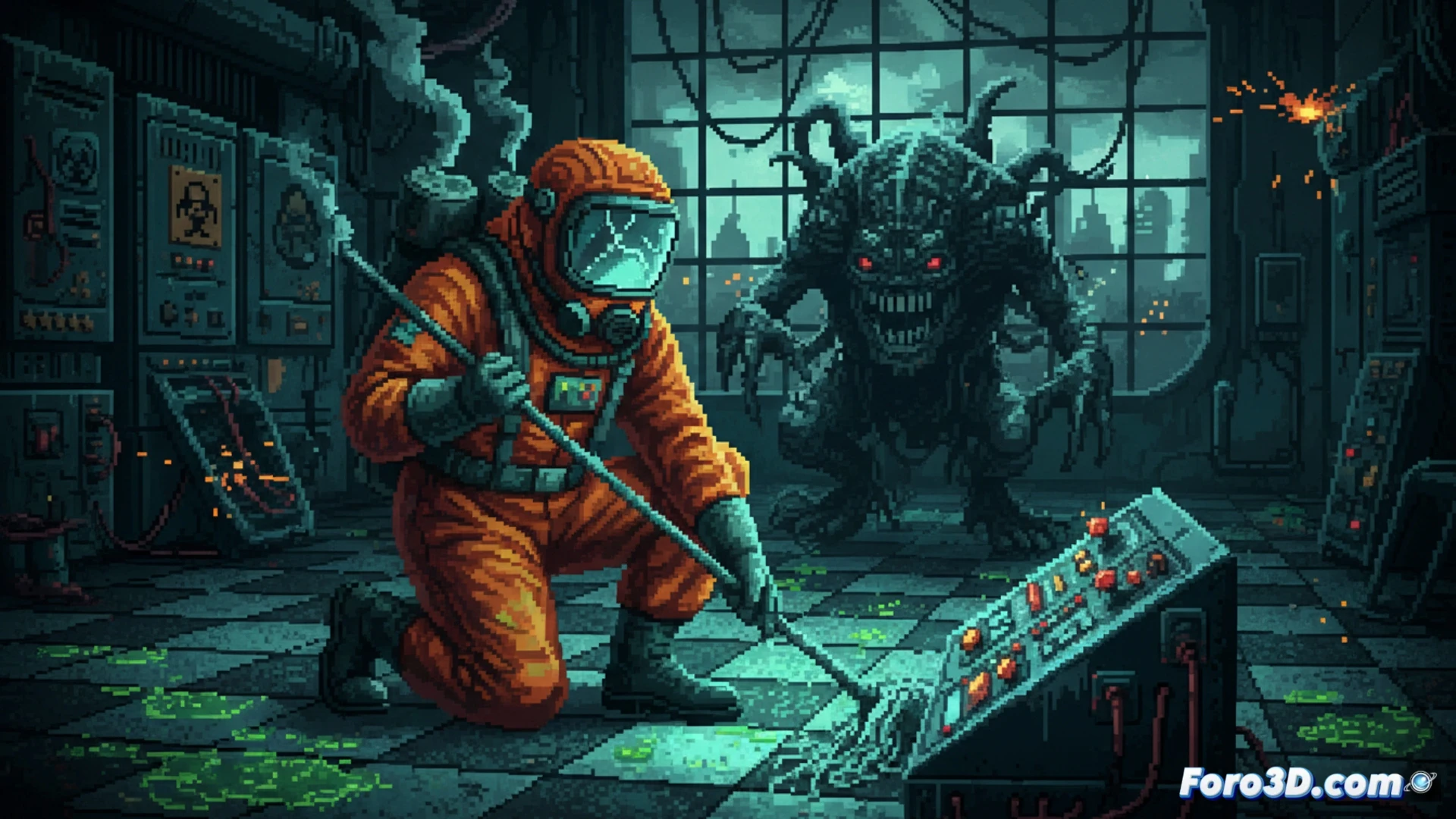
The independent studio Smitner Studio, published by Numskull Games, has announced the June release of Hazard Pay on PS5, Switch, and PC. A demo is already available on Steam. Set in 1982, the game puts us in the shoes of a government cleaner in a facility with a biological leak. What starts as a job to destroy evidence and get paid veers toward a conspiracy with horrible experiments. Its proposal combines block puzzles, cleaning mechanics, and tension from horror and stealth.
Mechanics and narrative: the technical fusion of genres 🎮
Hazard Pay stands out for integrating seemingly disparate gameplay systems. Push-box puzzles, a classic genre, are tensioned by horror and stealth elements. Mutant organisms are not only detected visually, but through sound and smell, adding layers of depth to the stealth. Technically, the pixel art is not just an aesthetic, but a tool to create an oppressive 80s atmosphere. The narrative with decisions that alter alliances and endings underscores the player's role between being complicit or whistleblower, a narrative mechanic that boosts replayability. The Steam demo is a key strategy to refine the balance between these systems with real feedback.
The indie development path and publishing 🚀
Projects like Hazard Pay exemplify the modern indie development path. A small studio innovates in genre fusion, uses a demo to calibrate its gameplay, and partners with a publisher like Numskull Games to reach multiple platforms. This support allows a niche idea, blending cerebral puzzles with ambient horror, to find its audience. The bet on a narrative with moral weight, beyond mere challenge, shows the maturity and ambition that the independent sector can achieve today.
How does Hazard Pay balance the tension of horror with the cerebral mechanics of puzzles without breaking the immersion of its pixel art aesthetic?
(P.S.: a game developer is someone who spends 1000 hours making a game that people complete in 2)