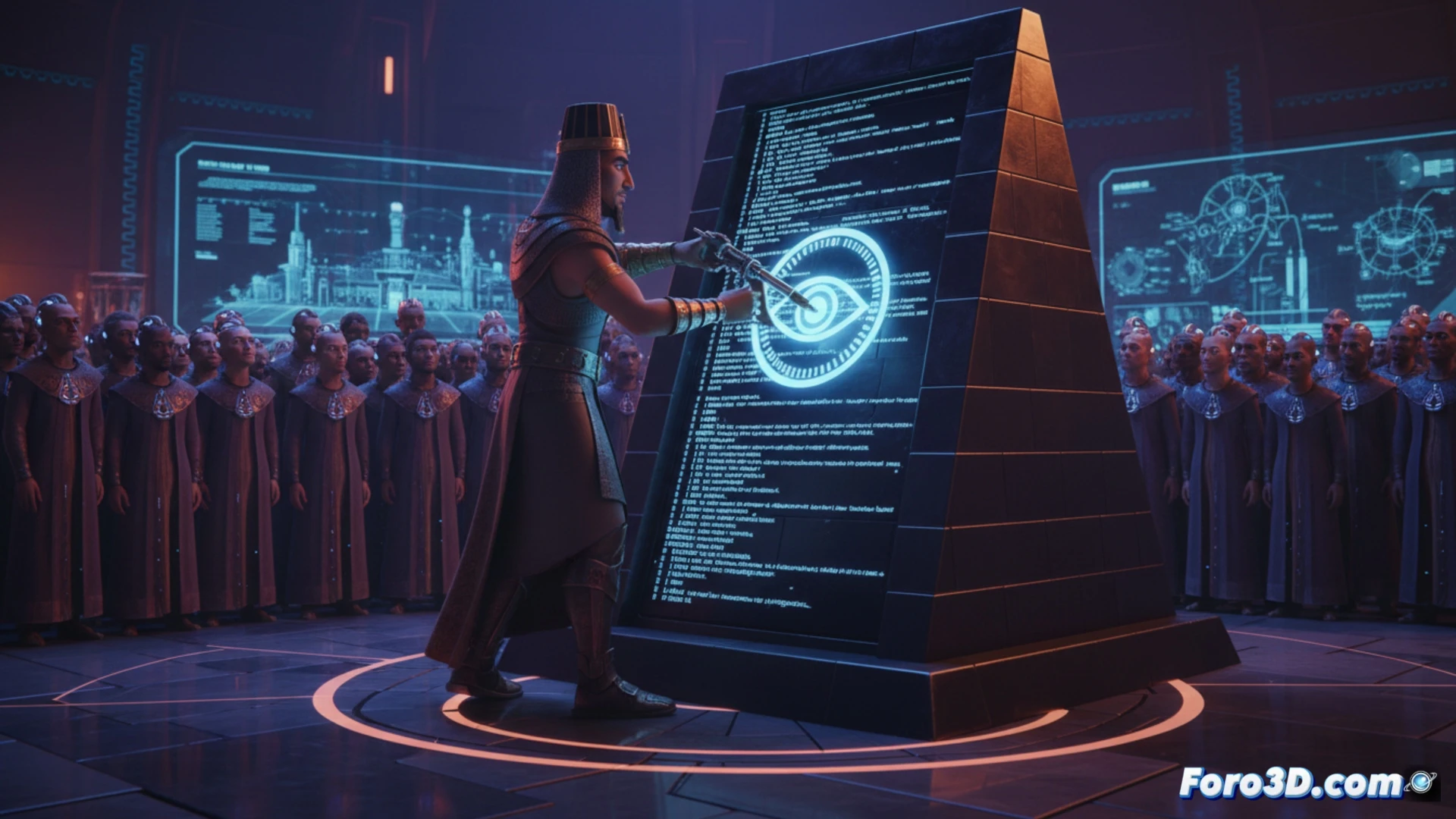
A script scene reimagines the origin of the Code of Hammurabi not as a stele of laws, but as the first quantum hard drive. In this dystopian narrative, the king does not write legal principles, but laser-engraves the Eye for an Eye algorithm onto a physical medium. This code, executed on chips implanted in citizens, automates justice and social behavior. The piece fuses ancient history and modern technophobia to question algorithmic surveillance systems.
From stone to silicon: the metaphor of totalitarian firmware 🧠
The central concept is powerful: translating an archaic legal code into irrevocable machine code. The Louvre stele transforms into a storage device, and the principle of reciprocity becomes automatic execution software. This metaphor directly critiques the opacity of algorithms governing social platforms, credit systems, or predictive surveillance. The firmware suggests a law inscribed at the hardware level, unmodifiable by the user, paralleling how social and technological norms are internalized until they become invisible. The visual scene of the laser engraving is a potent allegory of the power that writes its rules directly into the social body.
Digital art as a dystopian mirror 👁️
This narrative fits into the tradition of activist digital art, which uses speculative fiction to examine the present. By projecting contemporary technologies onto the past, it exaggerates their implications to make them visible. The work does not speak of Babylon, but of the datafication of life and automated justice. Its value lies in using technical language not to celebrate innovation, but to unveil its potential mechanisms of oppression, inviting critical reflection on who writes our source code social today.
Could the Code of Hammurabi, reinterpreted as a primitive social firmware, be considered the first example of activist digital art, where the code (legal) is both a tool of control, a work of propaganda, and a seed of resistance?
(P.S.: if your virtual reality installation doesn't change the world, at least don't lag)