Alexander Hamilton's letters are not just historical relics. They are the detailed blueprints of the American financial and political system. In his correspondence, concepts like the national debt or the central bank took shape. Today, 3D technology allows us to unravel that complexity, transforming dense text into interactive visual structures. This is the intersection where documentary heritage is revitalized for a digital citizenship.
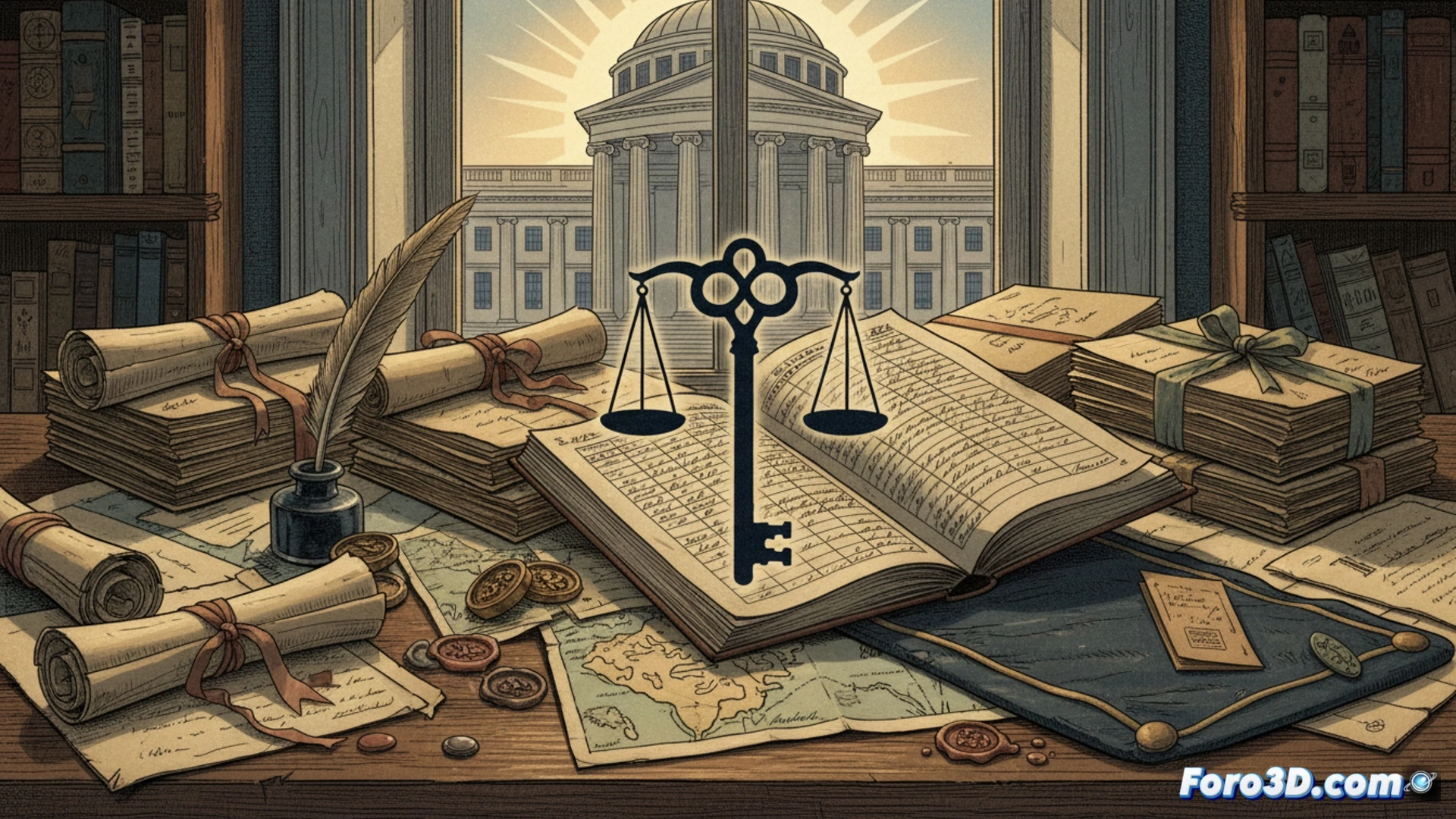
Technical Proposal: Interactive 3D Infographic of Hamilton's Reports 🗺️
We propose a navigable 3D model that functions as an architectural conceptual map. The national debt of 1790 would be visualized as a geolocalized structure, showing the obligations of each state. The mechanism of the First Bank of the United States would be an interactive diagram with pieces that, when selected, reveal excerpts from his letters explaining their function. Using software like Blender or Unity, information layers can be created: one for the original text, another for contextual explanation, and a final one showing its modern institutional equivalent, such as the Federal Reserve.
From Paper to Participation: History as Experience 🕹️
This visualization not only seeks to educate but to foster more informed participation. By understanding the material foundations and the ideological battles that raised them, current economic debates can be analyzed with greater depth. Turning Hamilton into an immersive experience is democratizing access to the principles that govern the system, inviting active reflection on their relevance and evolution in our digital era.
How could we use interactive 3D models and digital participation environments to break down and democratize the analysis of complex foundational documents, such as Hamilton's letters, allowing a collective understanding of current political and economic systems?
(P.S.: 3D electoral panels are like promises: they look very nice but we have to see them in action)