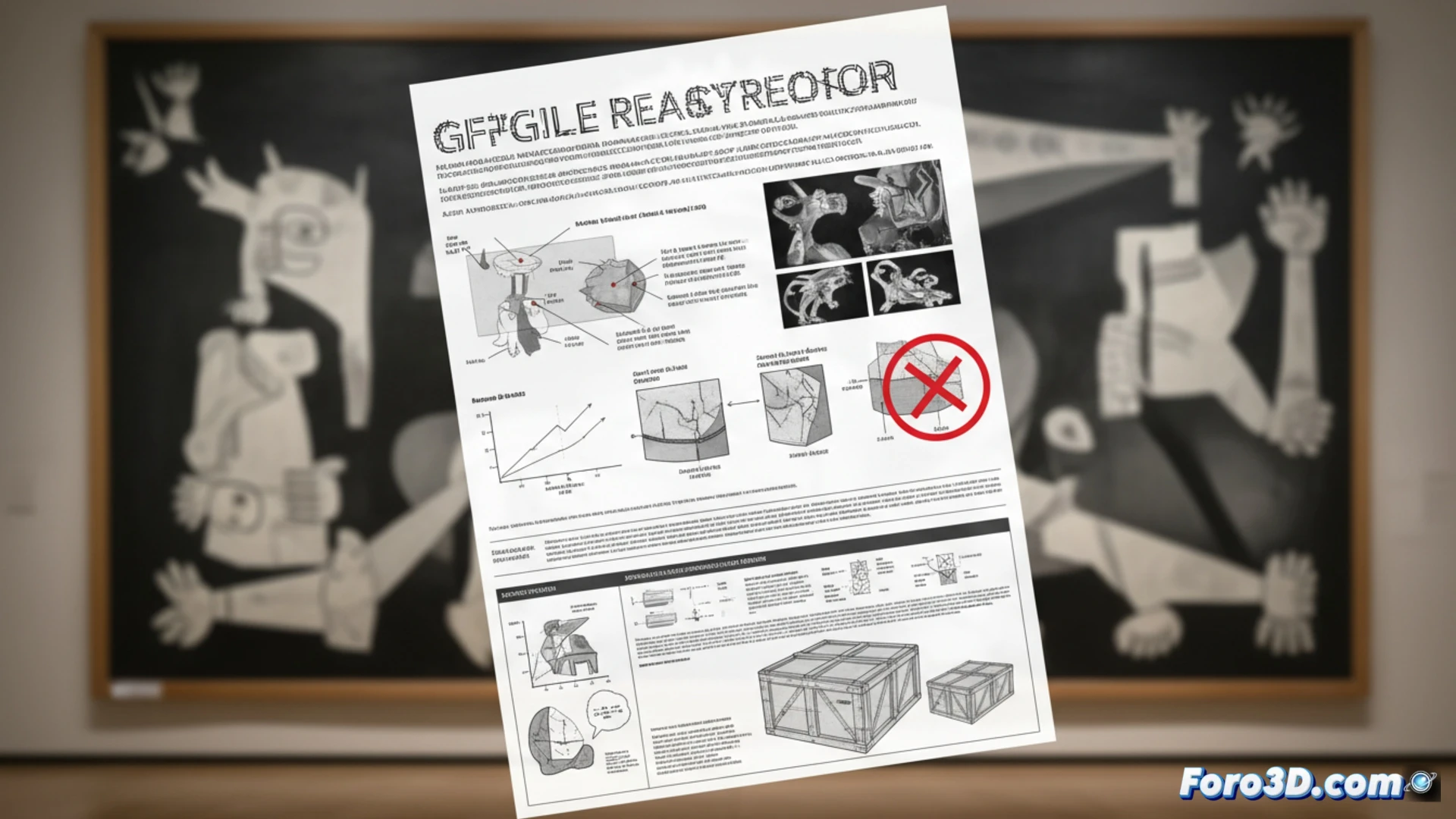
The Reina Sofía Museum's refusal to move the Guernica is based on a technical report detailing the extreme fragility of the work. The risks of vibration during transportation could cause irreversible damage to its complex structure. This case exemplifies a crucial museological dilemma: how to balance public access with the preservation of heritage. This is where 3D technology emerges not as an alternative, but as a fundamental tool for preventive conservation, allowing the work to be studied and disseminated without compromising its physical integrity.
Digital twins and simulation: contactless conservation 🛡️
A digital twin of the Guernica, created through high-resolution 3D scanning and photogrammetry, would be an invaluable asset. This model is not just a visual replica, but a metric and surface condition database. It would allow micron-level monitoring of any future changes, such as the propagation of existing cracks. Furthermore, computer simulation could model the effects of hypothetical vibrations or structural stresses, scientifically validating the arguments against transportation. These technologies offer a quantitative risk analysis, transforming the decision not to move the work from an institutional stance into a verifiable technical conclusion.
The original immobile, the experience expanded 🌍
The immobility of the original should not mean the end of its accessibility. A high-fidelity interactive 3D model can be the cornerstone of innovative educational and exhibition experiences, both in Bilbao and anywhere in the world. It facilitates the academic study of details inaccessible to the naked eye and allows the creation of exact physical replicas for outreach contexts. Therefore, 3D technology does not replace the Guernica, but protects it while amplifying its legacy, redefining conservation in the 21st century as a practice that integrates material preservation with digital dissemination.
How can 3D digitization and structural stress analysis become the definitive tool to justify the immobility of fragile masterpieces like the Guernica?
(P.S.: Virtual restoration is like being a surgeon, but without bloodstains.)