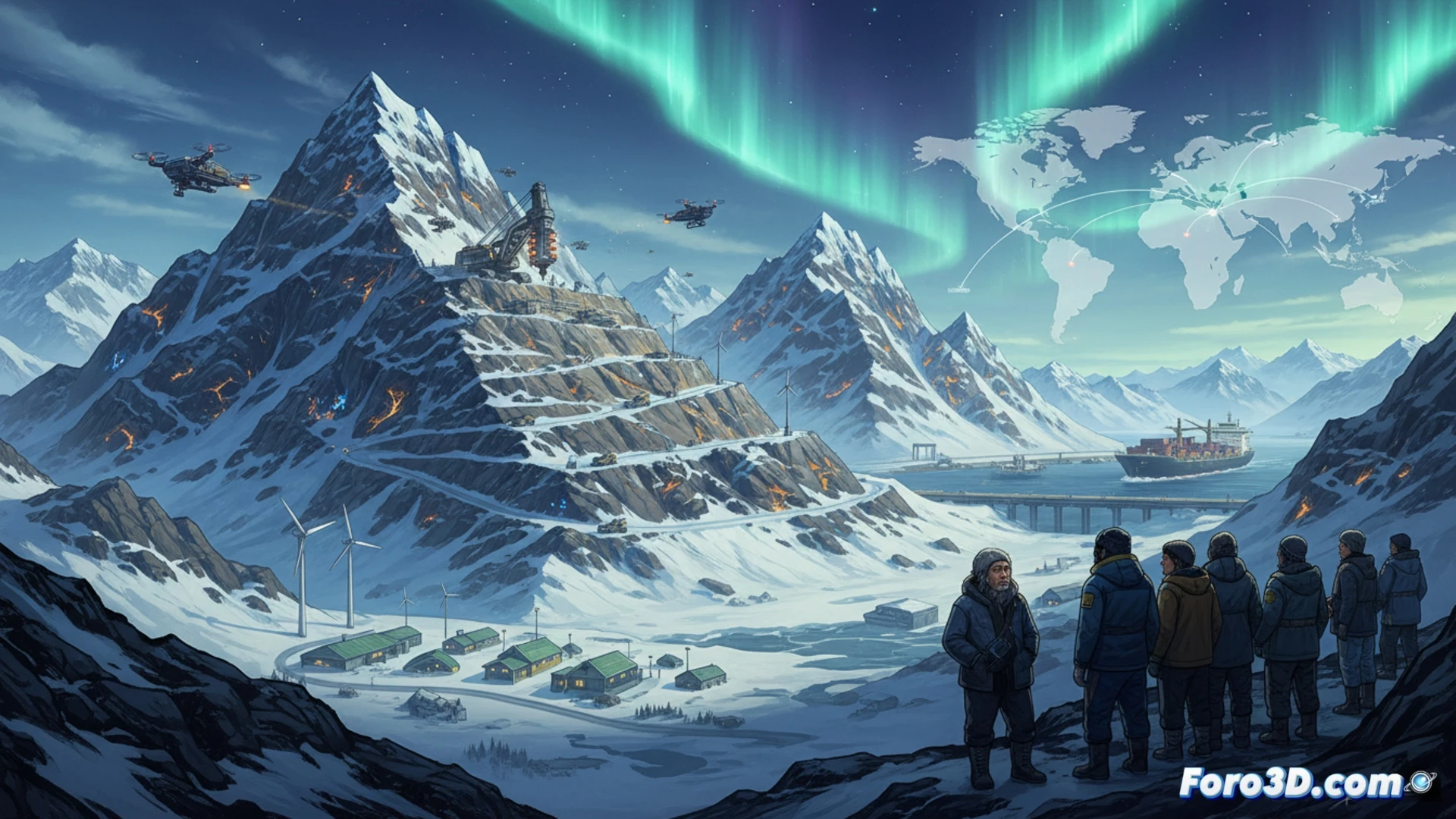
In southern Greenland, the Kvanefjeld deposit concentrates a strategic wealth: rare earth minerals essential for batteries, defense magnets, and space technology. With China controlling most of the global supply, this Danish autonomous territory, which hosts 25 of the 34 critical minerals for the EU, becomes a first-order geopolitical node. Its activation could reconfigure global supply chains, but it clashes with local independence aspirations, a fishing economy, and serious environmental concerns due to associated radioactivity.
Modeling the supply chain: dependency, bottlenecks, and alternatives 🔗
Visualizing the current chain in 3D reveals the system's vulnerability. The rare earth flow is overwhelmingly concentrated in China, from extraction to processing, creating a strategic bottleneck for the West. Modeling the route from Greenland involves simulating new port infrastructures, alternative maritime routes, and complex logistics chains in a hostile Arctic environment. Activating Kvanefjeld or the Amitsoq graphite mine would represent critical diversification nodes, reducing the risk of disruption. However, the model must incorporate the time factor: years and huge investments are needed for a deposit to become productive, a timeframe that the current technological and geopolitical competition does not easily allow.
The tension between local autonomy and the global game ⚖️
The true simulation must include the social variable. Greenland is not just a mineral deposit; it is a society seeking its independence and distrustful of extractive colonialism. A mineral flow model that ignores this layer is incomplete. The viability of these projects depends on a fragile balance: offering economic development without destroying the environment and local culture, while global powers exert pressure. The future of the green technology supply chain could be decided not only in boardrooms, but in Greenland's municipal assemblies.
How could the exploitation of rare earths in Greenland reconfigure power balances and global supply chains for technology and green energy?
(P.S.: at Foro3D we know that a chip travels more than a backpacker on a sabbatical year)