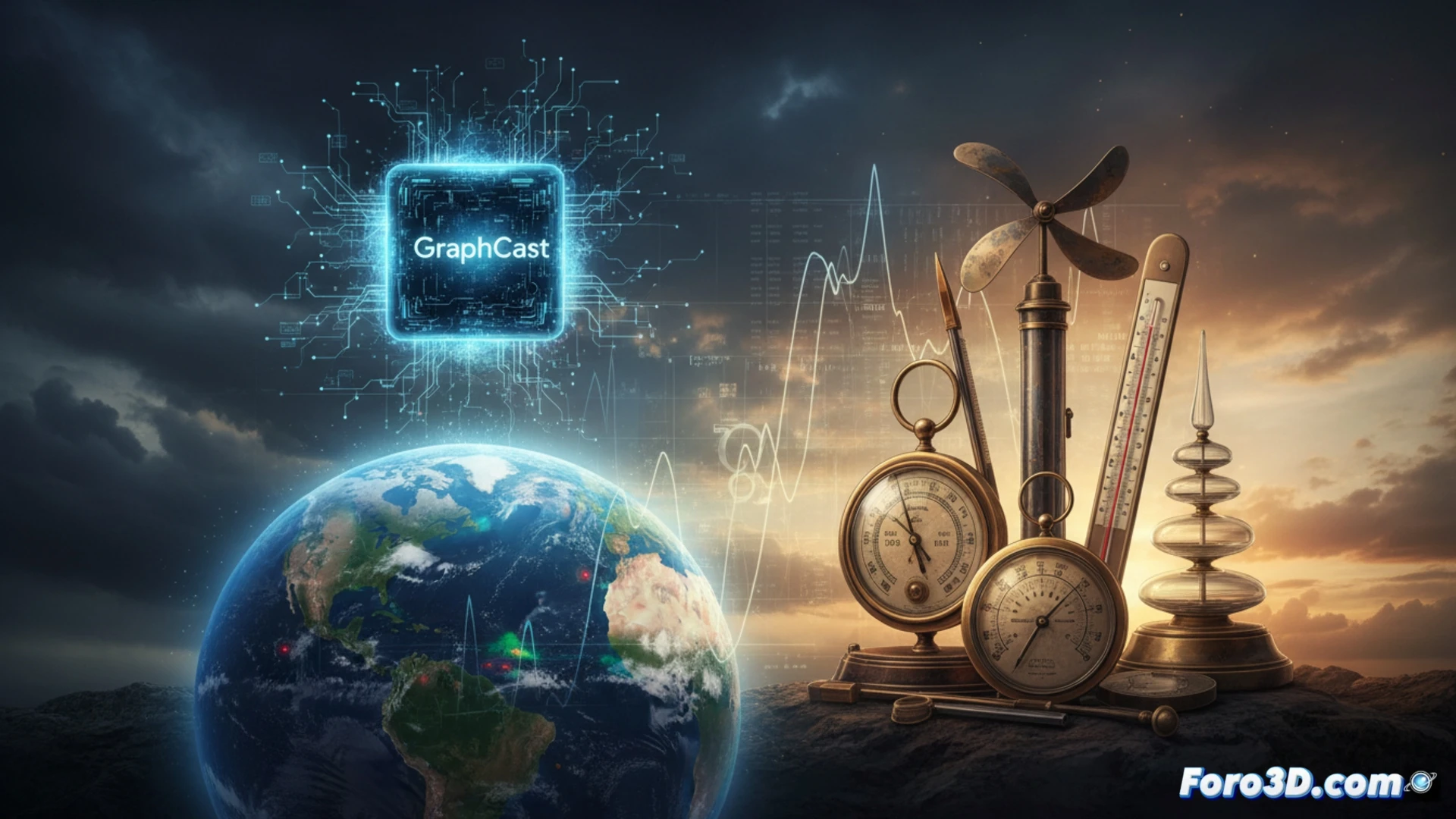
Google DeepMind has released GraphCast, an artificial intelligence model that performs global 10-day weather forecasts with greater accuracy than the best conventional numerical systems, and it does so in less than a minute. This technical revolution promises to democratize access to high-resolution forecasts, but it also shakes the foundations of an established scientific discipline, raising profound questions about our trust in black box systems and their impact on critical sectors of society. 🌪️
How GraphCast Works and Why It's Faster ⚡
Unlike the ECMWF's physical models, which solve complex mathematical equations on supercomputers for hours, GraphCast is a deep learning model based on graph neural networks. It was trained on decades of historical weather data. Instead of calculating atmospheric physics from scratch, it learns patterns and direct relationships between climate variables. Given a current weather state, it infers the future state in a sequence of six-hour steps. This data-driven approach, executed on a TPU, reduces computation time from hours to seconds, enabling broader and more accessible forecast ensembles.
Beyond the Technique: Trust and Social Disruption 🤔
GraphCast's true disruption is social. Its effectiveness challenges the hegemony of traditional systems, which could generate public distrust among contradictory models. Sectors like agriculture, logistics, or emergency management will have to navigate this new era of hyper-fast but opaque forecasts. The potential democratization clashes with the challenge of explaining why the AI is correct, a dilemma that will define the adoption of these tools and our future relationship with predictions that govern crucial decisions.
Can the predictive supremacy of AI models like GraphCast redefine our relationship with the weather, displacing not only traditional methods but also transforming decision-making in critical sectors like agriculture, logistics, and disaster management?
(P.S.: at Foro3D we know that the only AI that doesn't generate controversy is the one that's turned off)