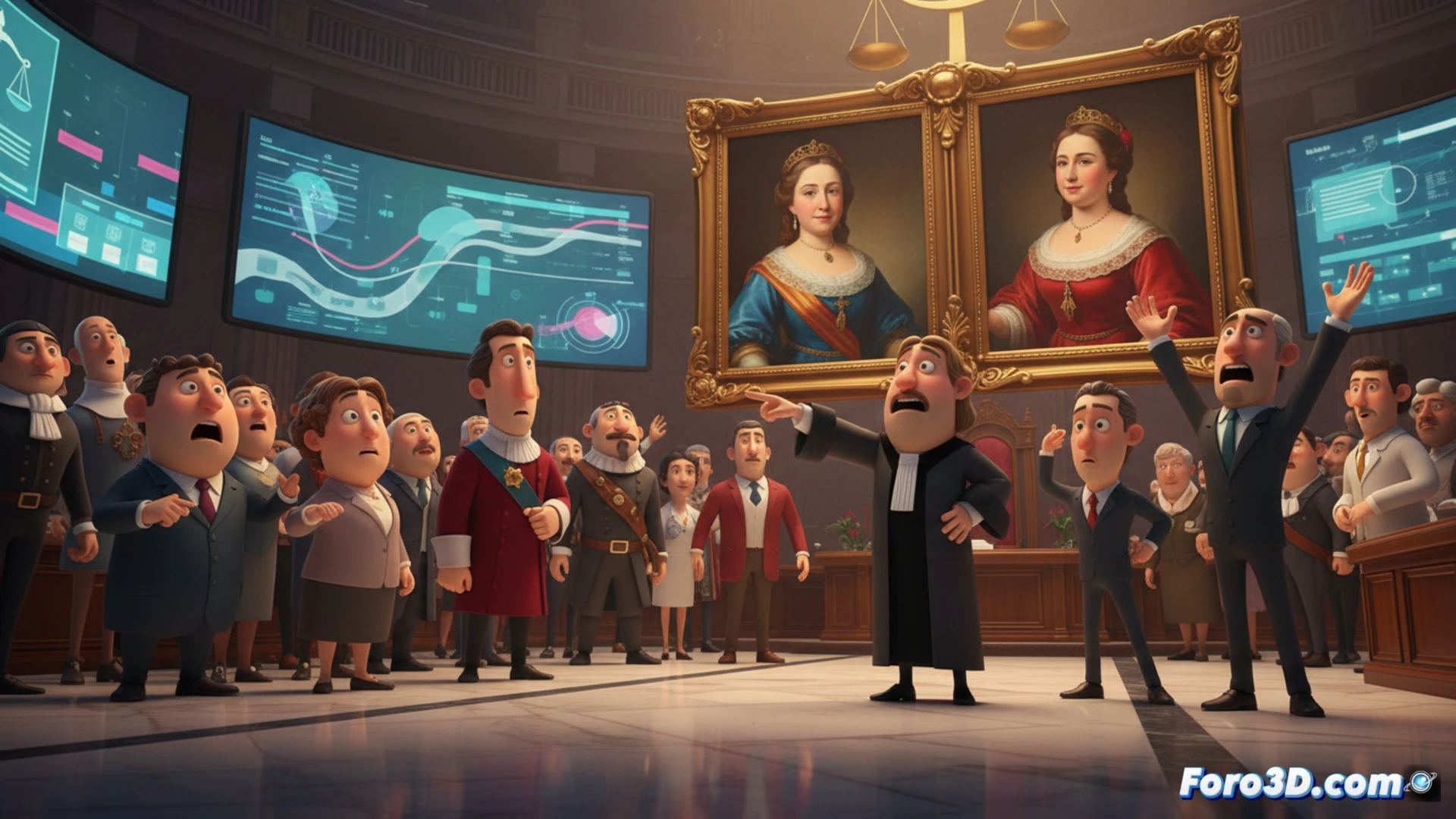
The recent Supreme Court ruling declaring the portraits of Carlos IV and María Luisa de Parma, painted by Goya, as State property, transcends the legal realm. It underscores a fundamental issue for conservation: the management and physical protection of irreplaceable cultural assets. In this context, 3D technologies emerge not as a luxury, but as an essential safeguarding tool, capable of creating a perpetual and unalterable record of the heritage, regardless of future disputes over its ownership.
3D Scanning and Photogrammetry: the Digital Notary of the Artwork 🖼️
Beyond the mere digital image, techniques such as high-resolution 3D scanning and photogrammetry provide exhaustive and metric documentation of the material state of a painting. They capture with millimeter precision the texture of the canvas, the craquelure of the paint, deformations of the support, and even previous interventions. This digital twin becomes an objective and invaluable testimony. In cases like this, a 3D file made before any transfer or change of custody would be crucial documentary evidence of its condition, serving both academic research and conservation management, ensuring transparency and integrity of the information.
Accessible Heritage, Protected Heritage 🌍
The ruling reaffirms that certain assets are inalienable and belong to the community. 3D digitization is the perfect ally to materialize this democratic principle. While the original is preserved in optimal conditions in an institution, its digital replica can be studied, measured, and manipulated virtually by restorers, historians, or the global public. Thus, technology not only protects the physical object but amplifies its social value, ensuring that the heritage, like these Goyas, truly belongs to everyone, today and for future generations.
How can high-resolution 3D digitization become a decisive legal and technical tool for documenting, authenticating, and managing disputed artistic heritage, such as Goya's portraits from the Supreme Court? ⚖️
(P.S.: Virtual restoration is like being a surgeon, but without bloodstains.)