The vision of truly ubiquitous connectivity is taking shape with the integration of satellite networks into the 5G ecosystem, defined in 3GPP Release 17. This advancement not only promises to close the digital divide but also constitutes the physical pillar for building a planetary-scale digital twin. It is the virtual and operational replica of the entire telecommunications infrastructure, a system that will enable simulating, monitoring, and optimizing coverage in real time, unifying terrestrial and non-terrestrial domains in a dynamic three-dimensional model.
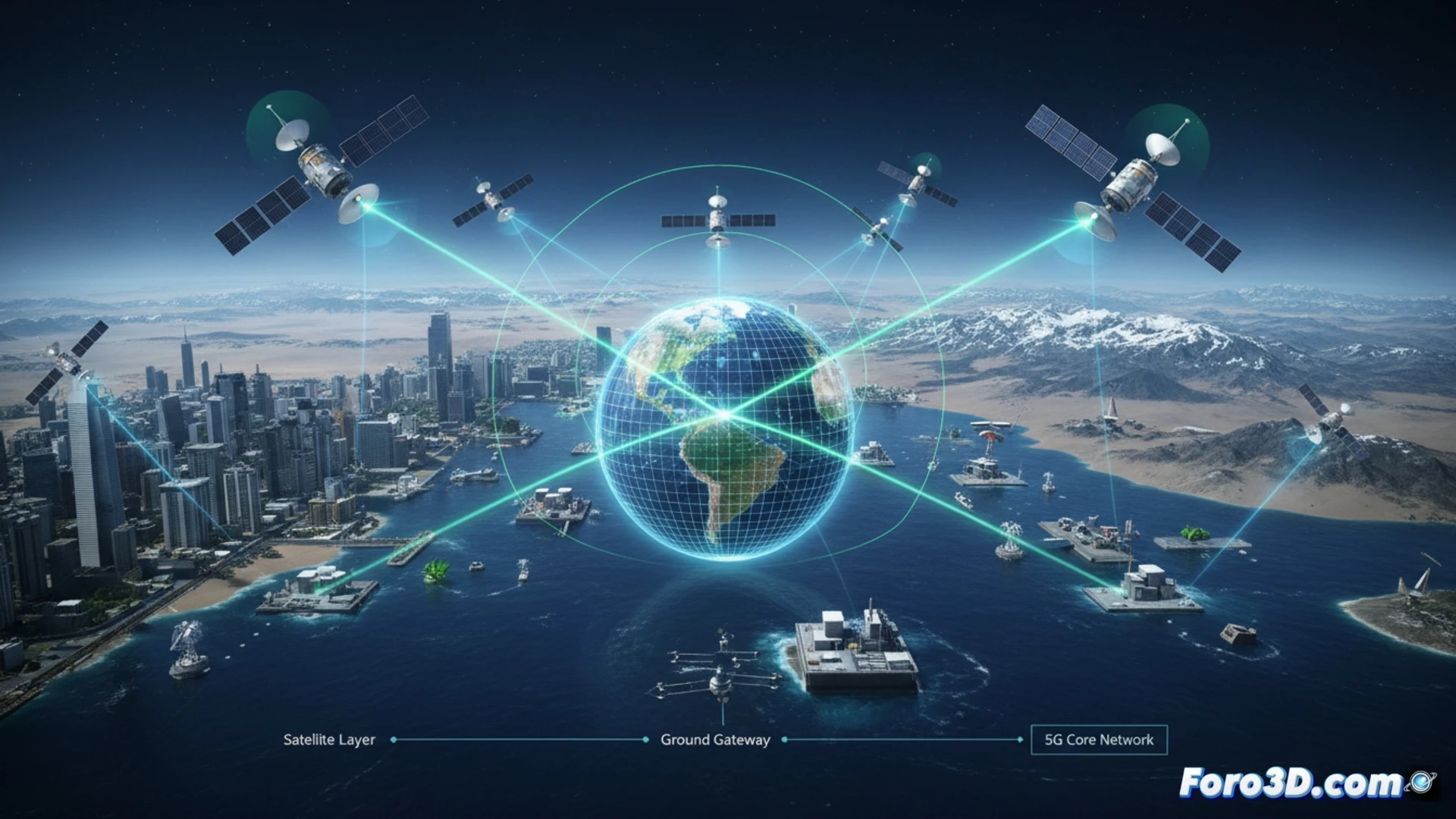
Disaggregated architecture and technical challenges: the foundations of the twin 🛰️
The fidelity of the digital twin depends on the precision of the physical model. The non-terrestrial 5G architecture, with its disaggregated functions between satellite, terrestrial gateway, and core network, defines the twin's data structure. Decisions such as orbit selection (LEO, MEO, GEO) directly impact key parameters of the virtual model: latency, coverage, and mobility. Overcoming real-world challenges, such as high path loss and Doppler effect, requires compensation strategies that must be accurately reflected in the twin. The adaptation of medium access protocols and resource control for satellite links, including timing advances and handovers, are essential algorithms that the digital twin must execute to simulate realistic scenarios and predict behaviors.
Towards a unified physical-digital system ⚙️
The ultimate goal transcends connectivity. The unified three-dimensional network is, in essence, a symbiotic system where the physical infrastructure and its digital counterpart coexist. The digital twin, powered by data from non-terrestrial networks, ceases to be a mere observer to become the management brain. It allows testing configurations, predicting failures, and optimizing global resources in a virtual environment before applying changes to the physical system, evolving towards an autonomous, resilient, and truly global network.
How can non-terrestrial 5G networks overcome the connectivity gap to make a real-time global digital twin viable?
(P.S.: My digital twin is currently in a meeting, while I'm here modeling. So technically, I'm in two places at once.)