Greta Alonso's new thriller, The Winter Killer, delves into a meticulous investigation where forensic medicine and police technique are key. This obsession with detail that Alonso brings to fiction finds a fascinating parallel in the real world: the documentation and 3D digital reconstruction of crime scenes. Technologies like laser scanning and photogrammetry have revolutionized forensic investigation, allowing the scene to be preserved and analyzed with previously unthinkable precision.
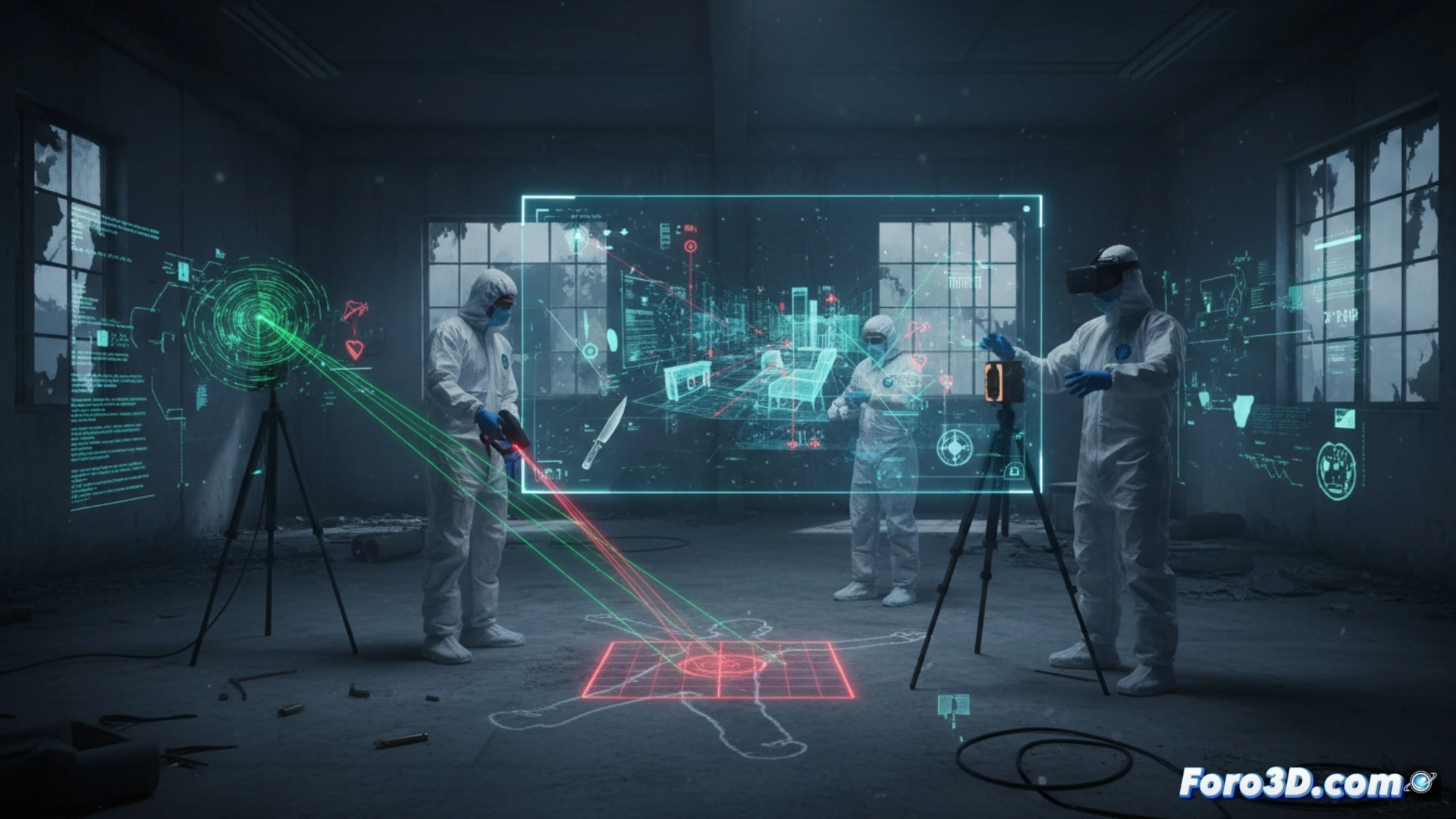
3D Technologies in Current Forensic Investigation 🔬
In reality, a crime scene is ephemeral. This is where tools like 3D laser scanning come in, which captures millions of data points in minutes, creating an exact point cloud of the location. Photogrammetry, on the other hand, generates textured 3D models from photographs. These techniques allow investigators to return virtually to the place time and again, take millimeter measurements, analyze bullet trajectories, or test hypotheses without altering the evidence. This contrasts with Alonso's fiction, where characters must rely on notes and static photos, while today forensic teams can recreate the entire scenario in a game engine for total immersion during investigation and trial presentation.
Digital Precision to Solve Complex Crimes 🕵️
The obsessive precision that Alonso attributes to her characters finds its ultimate expression in these digital techniques. 3D reconstruction not only documents but helps visualize complex spatial relationships and connect evidence, something crucial in intricate cases like the one posed by the novel, linking past and present. This digital fidelity ensures the permanent preservation of the scene, an incontrovertible testimony that, like the tenacity of fictional investigators, is fundamental to reaching the truth.
How is 3D photogrammetry and laser scanning transforming forensic investigation, going from a science fiction tool to a standard in crime scene reconstruction?
(P.S.: In scene analysis, every scale witness is an anonymous little hero.)