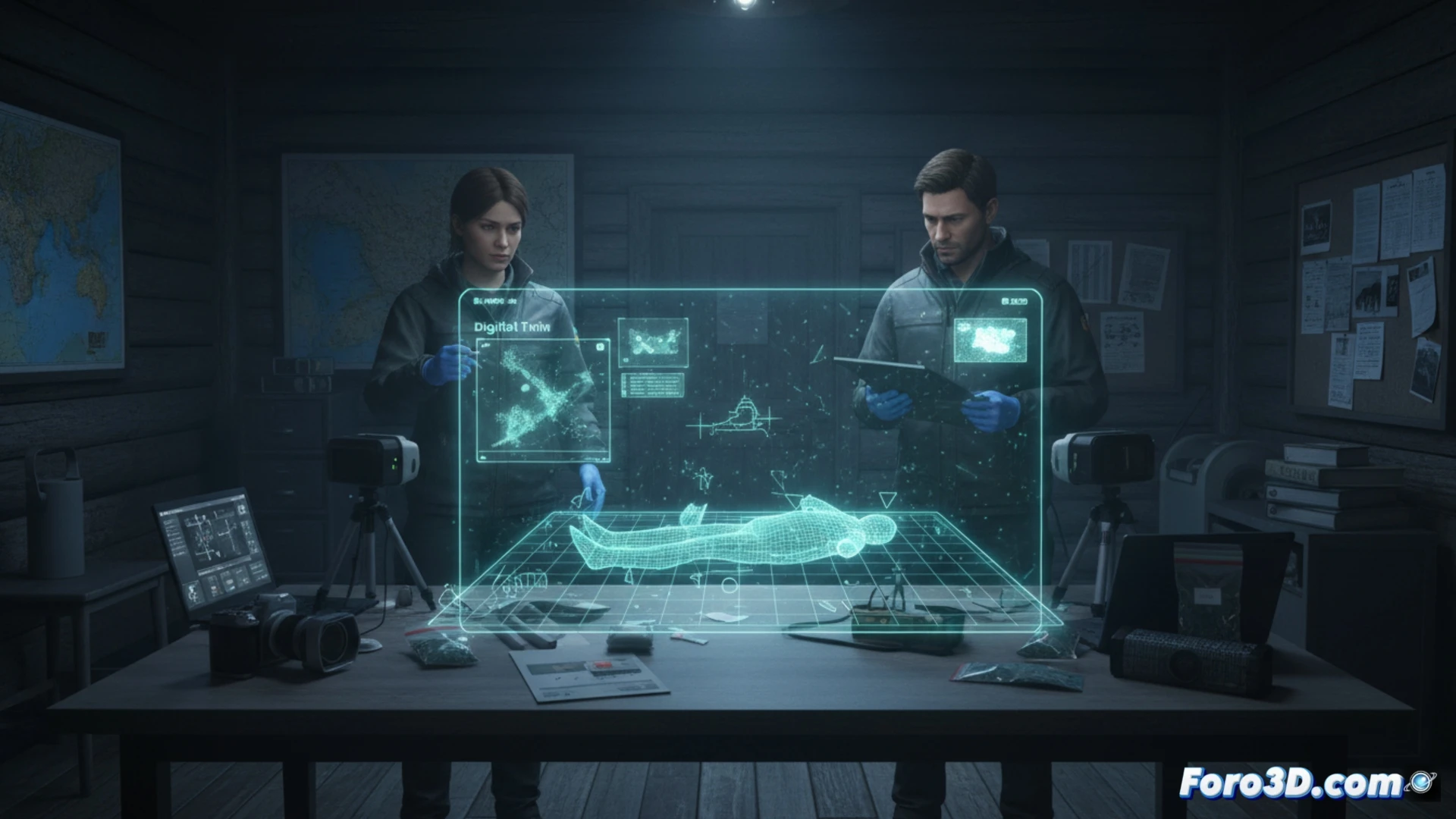
The second season of Deadloch, already a hit on Prime Video, immerses us in an investigation in Australia's Northern Territory. Detectives Collins and Redcliffe unravel a crime from human remains, a process that in today's reality is being revolutionized by 3D technology. This article explores how a digital forensic pipeline, with photogrammetry and laser scanning, would transform a scene like the one in the series into an interactive digital twin for investigation.
Photogrammetry and Laser Scanning: The Unalterable Documentation 🔍
In a case like Deadloch, the first technical step would be the exhaustive capture of the scene. Using photogrammetry from multiple angles and 3D laser scanners, a millimeter-precise point cloud of the environment and the bone remains would be generated. This model is objective and unalterable evidence that can be reviewed infinitely without degrading the discovery site. The bones, scanned individually, could be analyzed in 3D software to measure fractures, calculate biometric statistics, or even perform digital superimpositions to identify possible victims, all without physically manipulating the evidence.
The Digital Twin: Visualizing Hypotheses in 3D 🧩
The true power emerges when integrating all data into a digital twin of the scene. Investigators, like our fictional detectives, could test hypotheses directly in this virtual space. Simulating bullet trajectories, attack angles, or visibility from different points becomes tangible. This 3D reconstruction acts as a dynamic canvas to connect evidence, allowing for clearer and more persuasive visualization and dismissal of scenarios for trial, bringing detective intuition to a technical and demonstrable level.
Would you place scale witnesses before scanning?