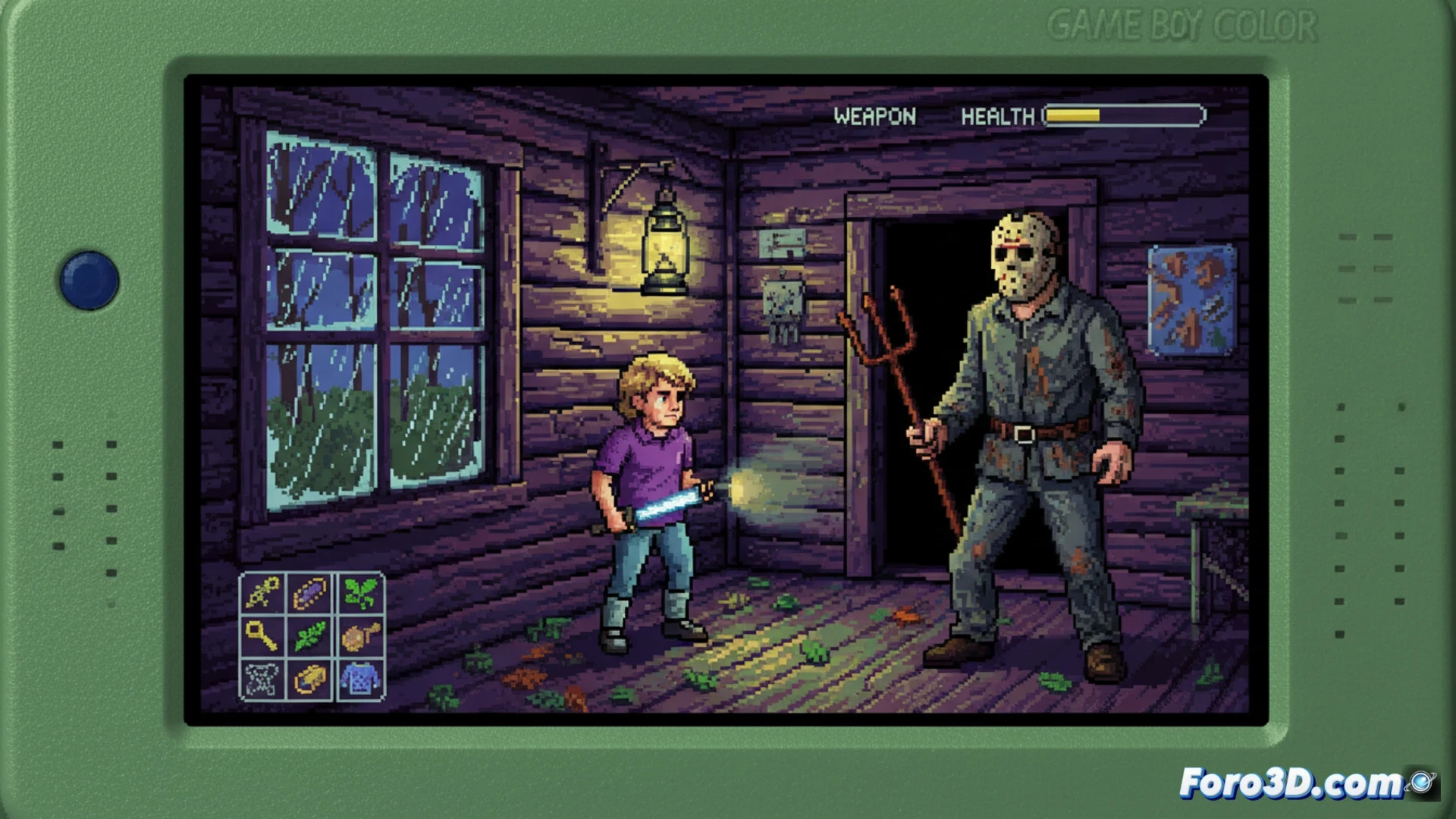
After 37 years since its original release, the infamous NES game Friday the 13th gets a second chance. Zeichi Games leads a fan project that rebuilds the title from scratch for Game Boy Color, aiming to rescue its eerie atmosphere while fixing its gameplay flaws. This unofficial remake substantially improves the original experience, considered objectively deficient, through more precise controls, an item swapping system, and the possibility, at last, of defeating Jason Voorhees.
Technical analysis: deconstruction and improvement of a failed classic 🕹️
Development from scratch for Game Boy Color involved rewriting the entire engine, allowing the creators to implement technical decisions impossible in 1989. The graphics, while faithful to the pixelated style, introduce layers of detail like reflections and vegetation visible through windows, adding depth. Gameplay is optimized with responsive controls and a new system where counselors swap items to obtain better weapons, a mechanic that encourages strategic exploration. The soundtrack, transformed into a metal chiptune, demonstrates advanced mastery of the platform's audio. However, the artistic decision to redesign Jason with a more cinematic look generates debate, highlighting the challenge of balancing nostalgia and modernization in a fan project.
Fan development as a case study: ethics, technique, and passion ⚖️
This project exemplifies independent development driven by passion, where creators act as archaeologists and code surgeons. Analyzing and improving a poorly received game requires a deep understanding of its base systems. However, it operates in legally ambiguous territory by modifying someone else's IP, a common risk in these initiatives. Beyond the technique, the remake raises a reflection on active preservation: not just emulation, but reinterpretation and correction of a design's historical errors, granting a cult classic the version it deserved.
How is the technical redesign of an infamous NES game approached for more limited hardware like Game Boy Color, and what optimization lessons can it offer to current indie developers?
(P.S.: a game developer is someone who spends 1000 hours making a game that people complete in 2)