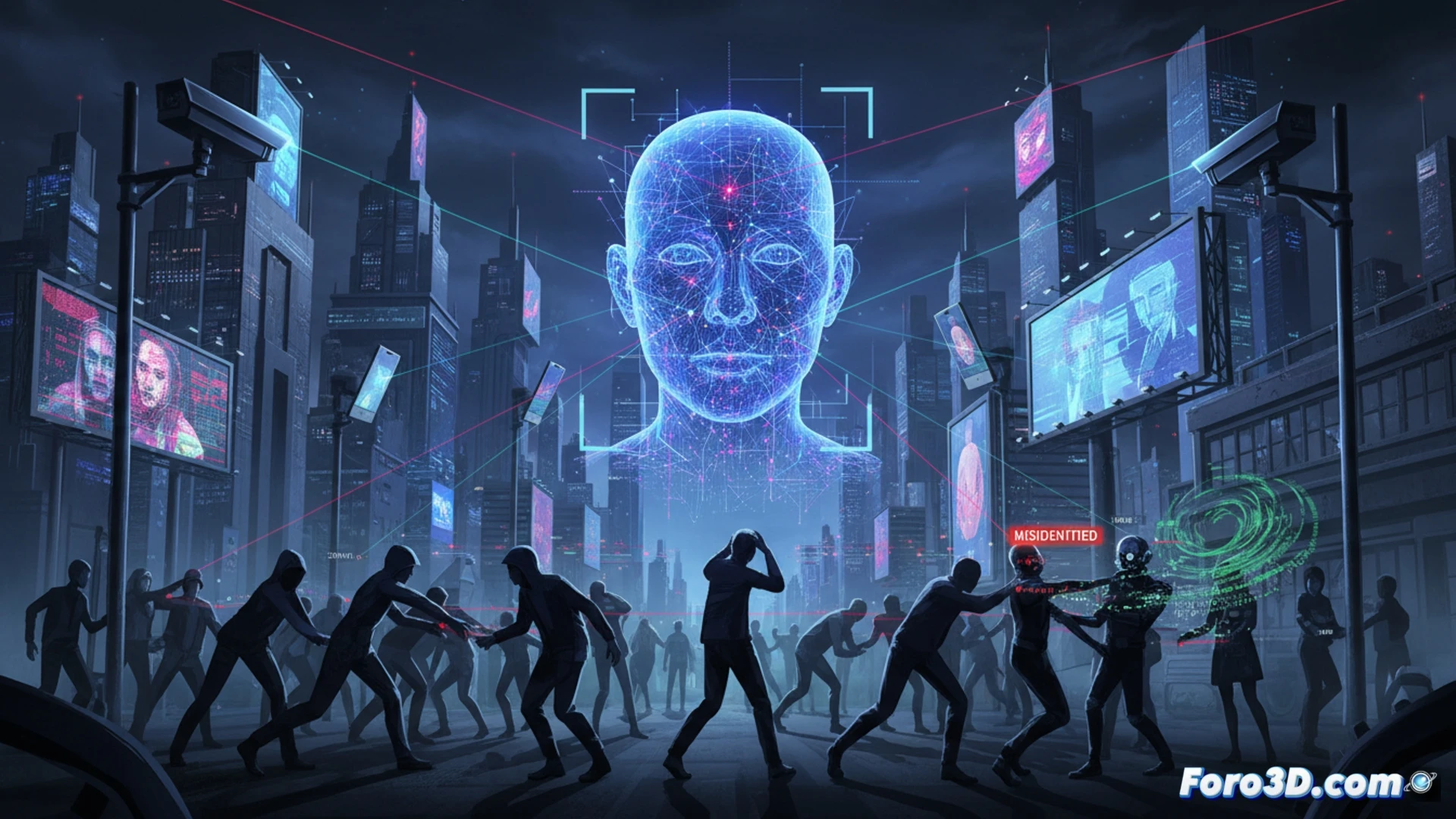
Facial recognition has gone from being a technological promise to an omnipresent tool for surveillance and control. Although its accuracy has improved, its massive and unregulated deployment is generating serious social problems. From erroneous identifications that have led to unjust detentions to the systematic erosion of privacy, this technology exemplifies the risks of implementing AI without a robust ethical and legal framework. Its impact is not neutral, and the data show that it disproportionately affects certain groups.
Beyond technical accuracy: algorithmic biases and field failures 🤖
The pivotal 2018 study on biases in facial recognition exposed a harsh reality: these systems failed significantly more with faces of women and people with dark skin. Although current algorithms have improved in laboratory tests, their application in real-world environments amplifies these errors. Variability in lighting, angles, and surveillance camera quality generates false positives. These failures are not mere percentages, but translate into police pursuits of innocents, access denials, and automated discrimination, perpetuating social injustices through code.
Control or freedom? A global regulatory debate is urgently needed ⚖️
The dilemma between security and privacy is false when the technology is inherently flawed and opaque. The lack of global regulation allows its arbitrary use by law enforcement and private companies, normalizing mass surveillance. The technical community has the responsibility to demand transparency, external audits, and moratoriums on sensitive uses. The future is not about banning the technology, but about designing safeguards that prioritize human rights and mitigate harms before its indiscriminate deployment.
To what extent are algorithmic biases in facial recognition perpetuating structural discrimination in our digital society?
(P.S.: trying to ban a nickname on the internet is like trying to cover the sun with a finger... but digital)