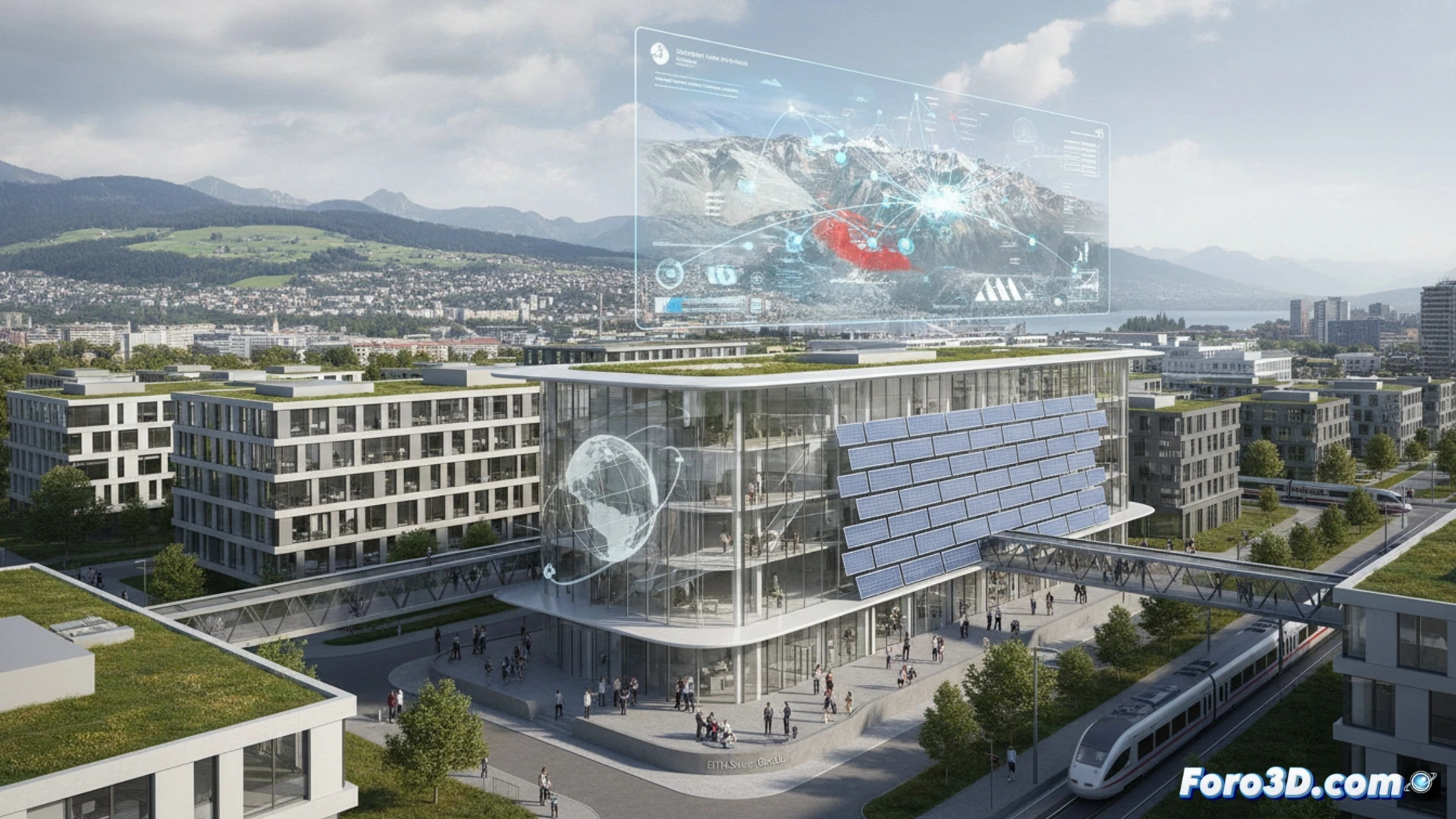
ETH Zurich announces the creation of the Swiss GeoLab, an Earth observation center that will open in 2026 in Root, Lucerne. Funded by a private donation, its mission will be to develop interdisciplinary solutions by fusing satellite, aerial, and terrestrial data with artificial intelligence. This laboratory will integrate into the local innovation ecosystem, collaborating from the start with startups and technology companies.
The fusion of 3D data streams and AI for geomatics 🛰️
The GeoLab will operate at the forefront of modern geomatics. Its approach is based on the synergistic integration of multiple 3D capture sources: satellite sensors, aerial platforms, and terrestrial scans. The innovative power lies in applying AI algorithms to this fused data mass to extract critical geospatial information. An initial pilot project demonstrates this: early detection of mass movements, such as rockfalls. This involves the automated processing of time series of LiDAR point clouds or photogrammetric models to identify millimeter-scale terrain deformations, a qualitative leap in risk monitoring.
An open innovation model for the topography of the future 🤝
Beyond technology, the GeoLab proposes a collaborative model. By locating itself in a business hub next to Technopark Luzern, it seeks to shorten the path between research and practical application. For geomatics and 3D professionals, this represents a direct channel to test new algorithms, validate workflows with massive data, and develop commercial tools. This laboratory will not only analyze the Earth but will also serve as an incubator for the methods that will define the next generation of topography and spatial analysis.
How will the integration of AI in Earth observatories like the Swiss GeoLab revolutionize precision and predictability in monitoring geological risks and 3D terrain deformations?
(P.S.: 3D topography is like making a treasure map, but the treasure is a precise model.)