The recent innovation of eSoil, a bioelectronic substrate that accelerates plant growth through electrical stimulation, opens up a fascinating field for 3D scientific visualization. Beyond the agricultural advancement, 3D technology presents itself as the ideal tool to unravel and communicate the complex biological processes occurring under this stimulus. Modeling the root architecture in three dimensions or simulating nutrient flow allows transforming experimental data into intuitive and powerful representations for research and outreach.
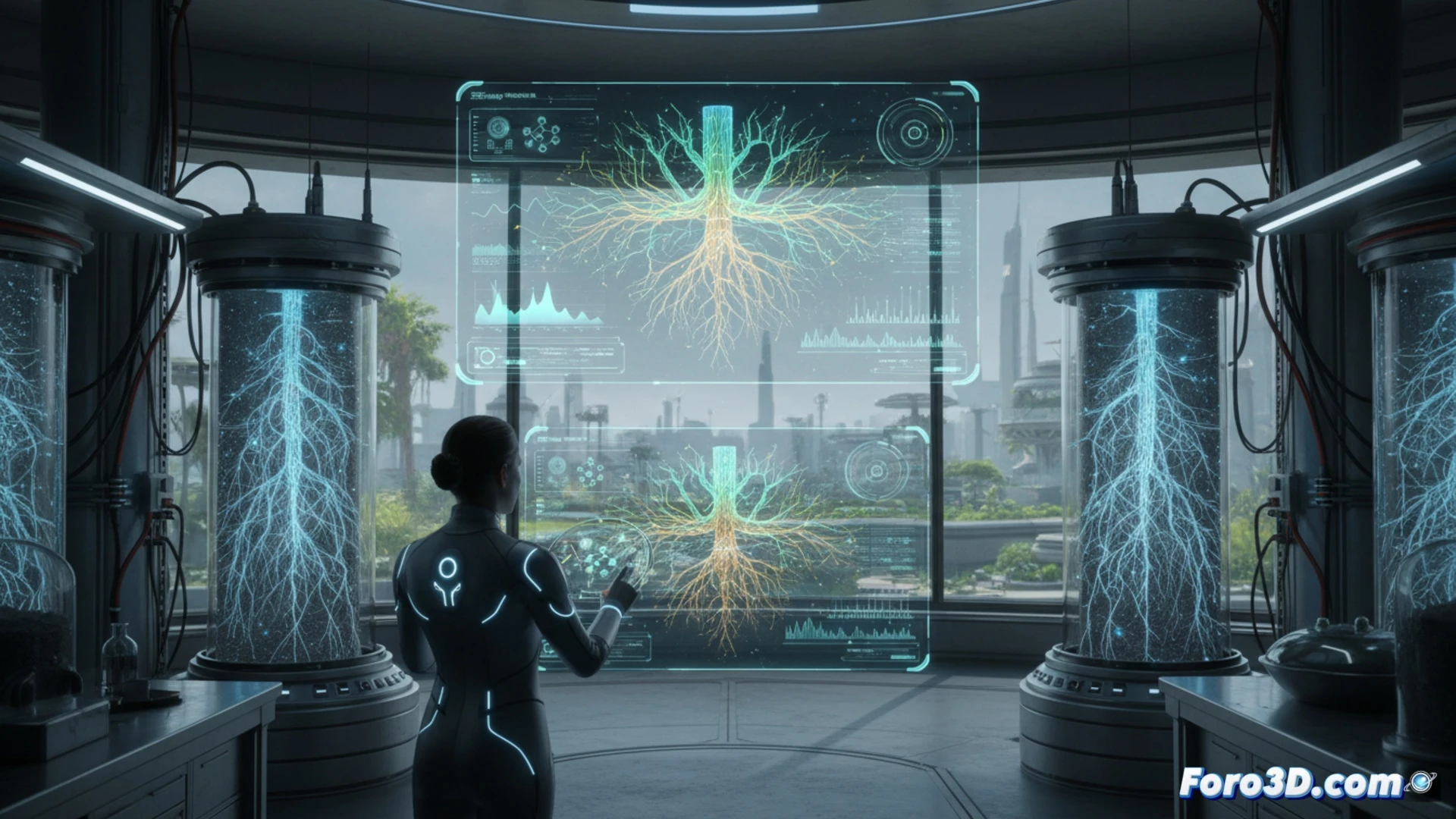
3D Tools to Analyze Bioelectronic Impact 🌱
True understanding of eSoil requires visualizing the invisible. Using 3D scanners and photogrammetry techniques, root systems developed with and without stimulation can be precisely reconstructed, creating comparative models that evidence differences in density, length, and branching. These 3D meshes can be animated to show growth over time. Additionally, simulations based on real data can model the interaction between electrical impulses, nutrient absorption, and cellular expansion. Quantitative results, such as biomass, could be integrated into interactive 3D dashboards, where the user explores correlations between electrical parameters and biological responses.
From Data to Outreach: a 3D Bridge 🌉
3D visualization acts as an essential bridge between the scientific complexity of eSoil and its public and academic understanding. An animation showing how electrical stimulation activates ion channels in the roots is infinitely more eloquent than a static graph. These models not only serve to validate hypotheses but also to impactfully communicate the potential of this technology in a context of sustainable agriculture and food security, making tangible an advancement that would otherwise remain buried in the substrate.
How can we use advanced 3D visualization and simulation techniques to model and analyze in real time the morphological and physiological changes in plants grown in eSoil?
(PS: fluid physics to simulate the ocean is like the sea: unpredictable and you always run out of RAM)