Mechnano has launched three pellet elastomers with ESD and EMI properties, designed for FFF and FGF. The innovation lies in its dCNT platform, which ensures an exceptionally uniform dispersion of carbon nanotubes in the polymeric matrix. This controlled microstructure is fundamental for providing consistent and reliable electrical performance, without sacrificing the inherent flexibility of the base elastomer, allowing functional prototypes of gaskets, housings, and management components.
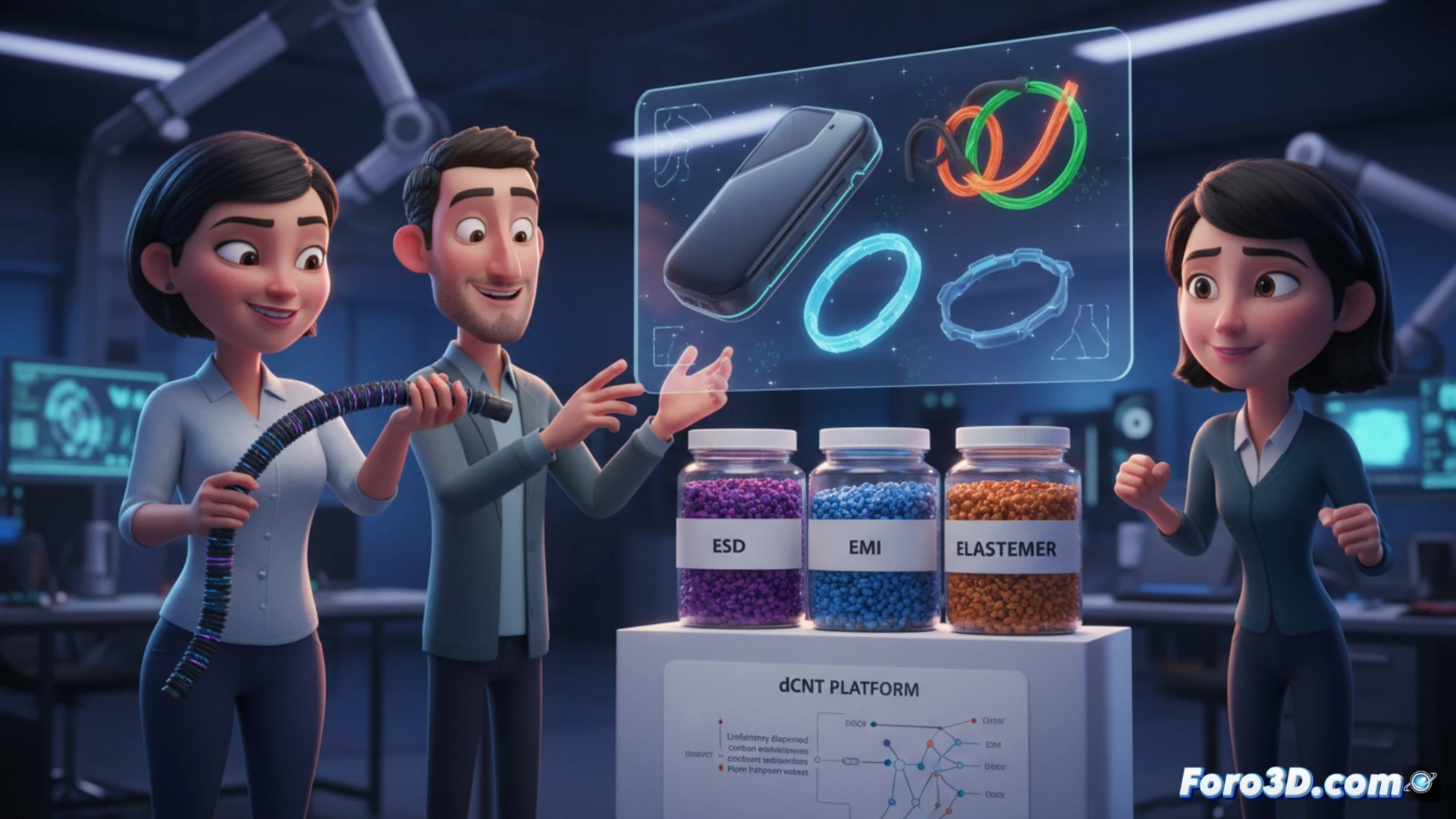
dCNT Dispersion: Visualizing the Uniformity that Defines the Properties 🔬
The success of these materials does not lie solely in adding nanotubes, but in avoiding their agglomeration. The dCNT technology enables a homogeneous distribution, creating an efficient percolated conductive network within the insulating polymer. This microstructure, visualizable through simulations and 3D models at the micro/nano scale, is directly responsible for protection against discharges and interference. With the nanotubes well separated and dispersed, the toughness and elasticity of the compound are maintained, as stress concentration points from agglomerates are minimized. Computational materials science is crucial for understanding and optimizing this structure-property relationship.
Beyond the Prototype: Digitally Designed Materials 💻
This launch underscores the transition toward functional and intentionally designed additive polymers. It is no longer just about geometric shape, but about engineering the internal microstructure for a specific function. The visualization and 3D simulation of nanoreinforcement dispersion becomes an essential design tool, allowing prediction of electrical and mechanical behavior before manufacturing. This brings additive manufacturing closer to final production of electronic components and specialized tools, where functionality is literally printed into the material.
How does the controlled microstructure of dCNT-loaded elastomers influence the efficiency of ESD/EMI protection for additive manufacturing applications?
(PS: Visualizing materials at the molecular level is like looking at a sandstorm through a magnifying glass.)