The Spanish company Qilimanjaro has launched EduQit, a DIY quantum computer kit that represents a milestone for education in microfabrication. For approximately one million euros, it includes a five-qubit superconducting chip, a dilution refrigerator, and control devices, allowing institutions to assemble their own system. This practical approach, although complex and with assembly that can take months, offers a tangible experience impossible to obtain solely with simulations, positioning itself as the quantum equivalent of a Raspberry Pi for the next generation of engineers.
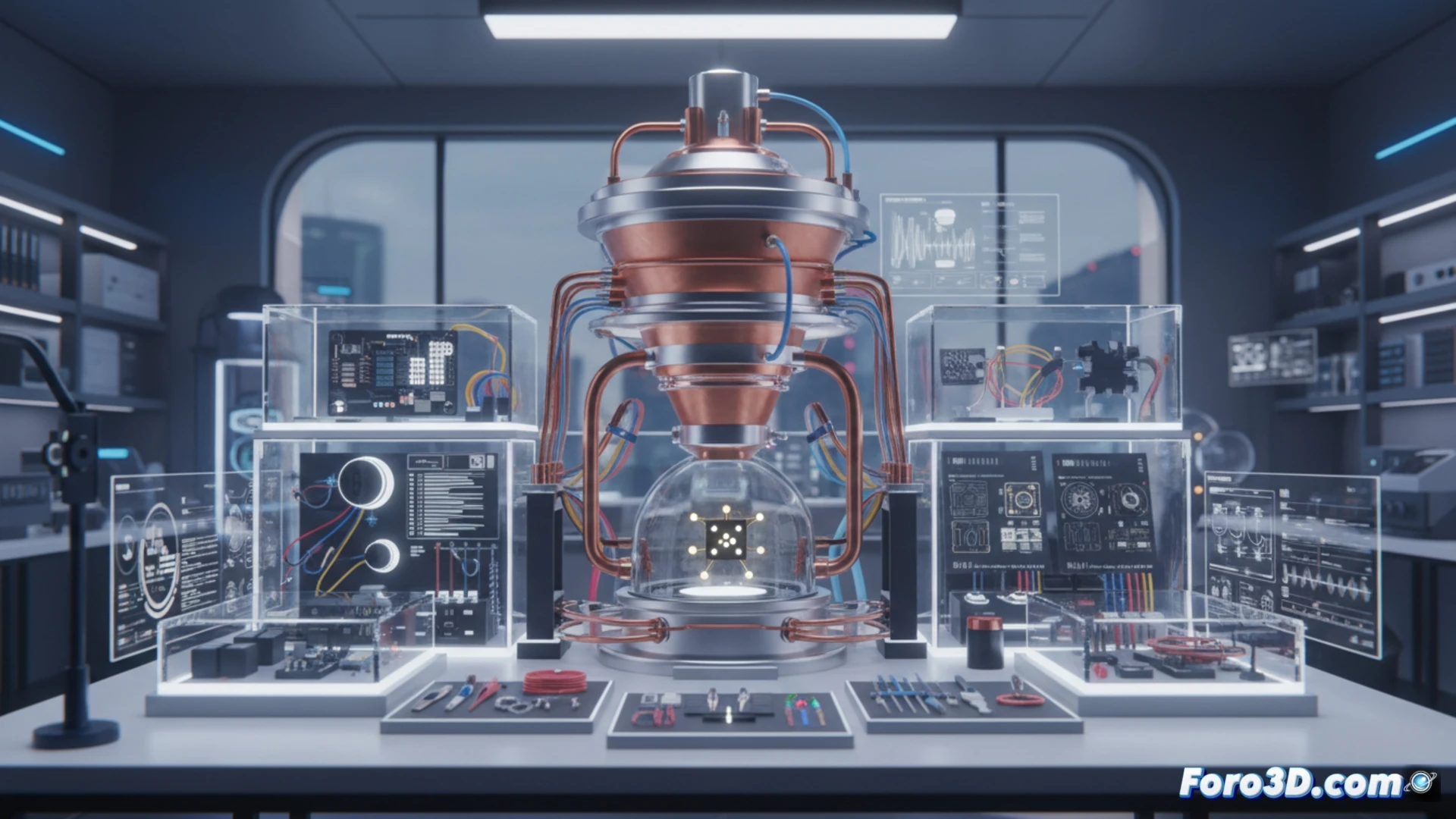
3D Visualization: Key to Understanding Physical Quantum Architecture 🔬
The true educational value of EduQit lies in demystifying the physical architecture of a quantum processor. This is where 3D visualization and modeling tools become indispensable. To understand and teach the assembly, it is crucial to visualize the system hierarchy: from the internal structure of the superconducting chip and its qubit pattern, through the integration of control and readout lines, to the mechanical and thermal coupling with the stages of the cryogenic refrigerator. Modeling this assembly in 3D allows planning the installation, understanding critical interference points, and teaching the principles of quantum component microfabrication in an intuitive and profound way.
A Fabrication Laboratory in a Box 🧪
EduQit transcends being a simple educational kit; it is a complete laboratory for fabrication and characterization of quantum hardware. By providing the real physical components, it forces students and researchers to face the practical challenges of cryogenic system integration, noise in control channels, and chip calibration. This direct experience with the raw materials of quantum computing closes the gap between theory and industrial reality, training experts with comprehensive knowledge, from chip design to its final operation, something vital for the advancement of this technology.
How can Qilimanjaro's EduQit quantum fabrication kit influence the training of the next generation of semiconductor engineers and the development of accessible 3D microfabrication techniques?
(P.S.: at Foro3D our favorite lithography is printing filament layers)