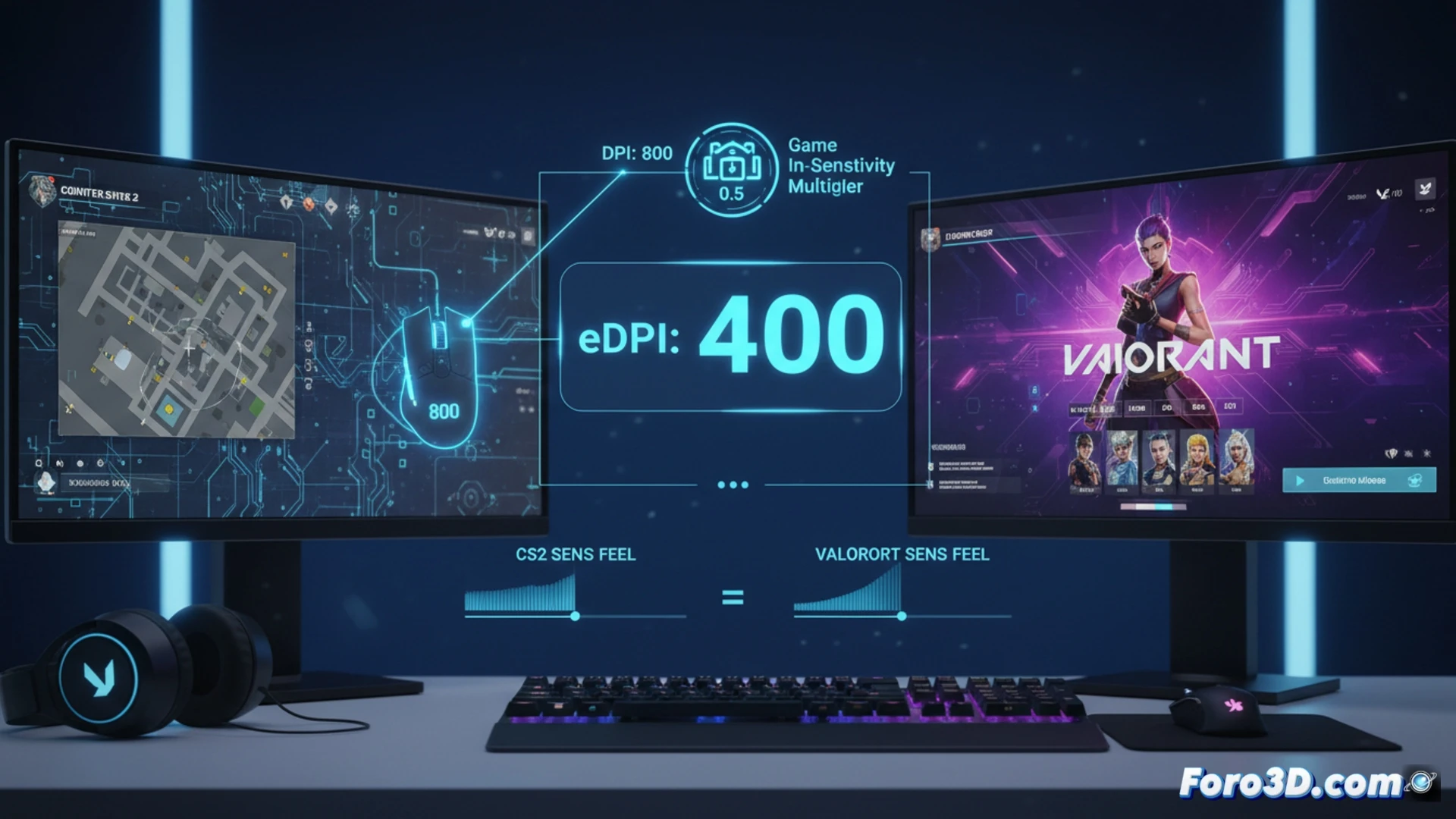
If you've ever tried to copy a player's sensitivity settings and the result doesn't feel the same, it's because a key piece is missing: eDPI. This value, which results from multiplying your mouse's DPI by the in-game sensitivity, represents the real sensitivity. It's the tool that allows you to precisely replicate others' settings, whether from a teammate or a professional. Without it, you're only copying half of the equation.
The Inconsistency of Graphics Engines in Sensitivity 🎮
Although eDPI is a useful standard, it is not universally consistent. The technical reason lies in how different graphics engines process mouse input. Games built on different engines, such as Source 2 (Counter-Strike 2) or Unreal Engine, can interpret sensitivity values unevenly. The same eDPI number can generate a slightly different view rotation in each environment, due to internal conversion and scaling calculations that are beyond the user's control.
My eDPI is 1600, why don't I shoot like a pro? 🤔
You meticulously copied your favorite player's eDPI, but your shots still fly to the sky. The harsh truth is that eDPI is just the starting point. Then come factors like screen resolution, FOV, mouse weight, mousepad, and, the most decisive, the operator's skill. You can have the perfect mathematical formula, but if your reflexes are those of a hibernating turtle, the cursor won't magically move to the enemy's head. The setup helps, but it doesn't work miracles.