The legend of the Bellver Castle Guard, with its footsteps and keys resounding in the early morning, is more than a ghost story. It is a cultural testimony rooted in the unique architecture of this 14th-century circular fortress. Instead of dwelling on the paranormal tale, we can use this narrative as an impetus for digital preservation. Digital archaeology offers us the tools to capture and safeguard this heritage in an innovative and enduring way.
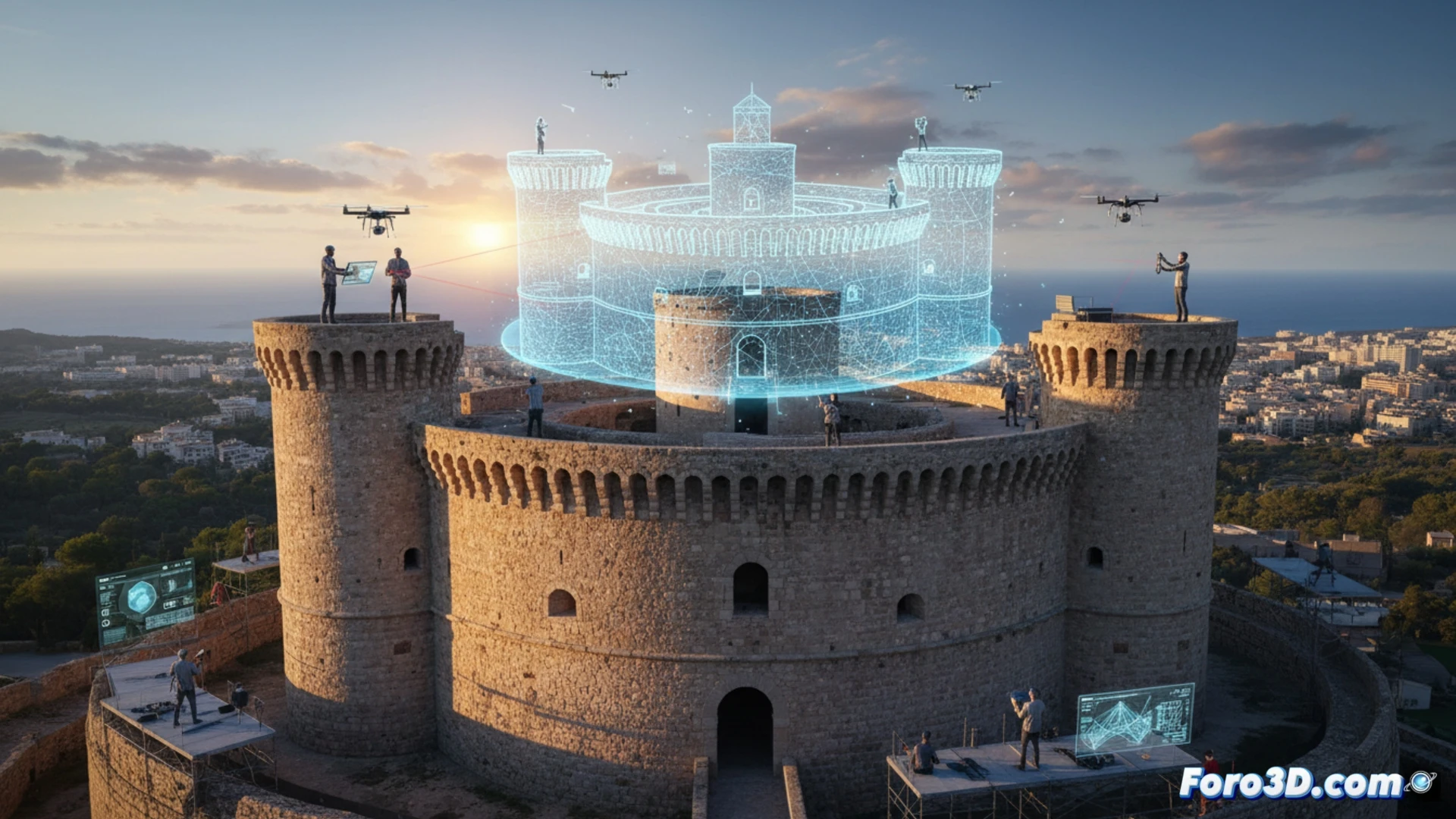
Photogrammetry and LiDAR: capturing every stone and shadow 🗿
The creation of an exact digital twin of Bellver Castle begins with massive data capture. Using drones equipped with high-resolution cameras, a comprehensive photogrammetry campaign would document every detail of the facades, the courtyard, and the claustrophobic passageways. To complement this, a terrestrial LiDAR laser scanner would penetrate the dungeons and shadowy areas, generating an accurate point cloud of the geometry even in the absence of light. This textured 3D model would be an invaluable resource for restorers, historians, and archaeologists.
From data to narrative: immersive preservation 🎧
The resulting model transcends mere documentation. It becomes a platform for immersive outreach. Over this faithful reconstruction, the sounds of the legend could be mapped, simulating the dragging of keys or footsteps in the courtyard in virtual reality. Thus, technology does not seek to validate the myth, but to enrich the heritage experience, allowing exploration of the castle and its history from a new dimension where architecture and oral tradition converge digitally.
How can digital archaeology, through the creation of a digital twin of Bellver Castle, help unravel whether the acoustic phenomena reported in its legend have an identifiable architectural origin?
(P.S.: and remember: if you don't find a bone, you can always model it yourself)