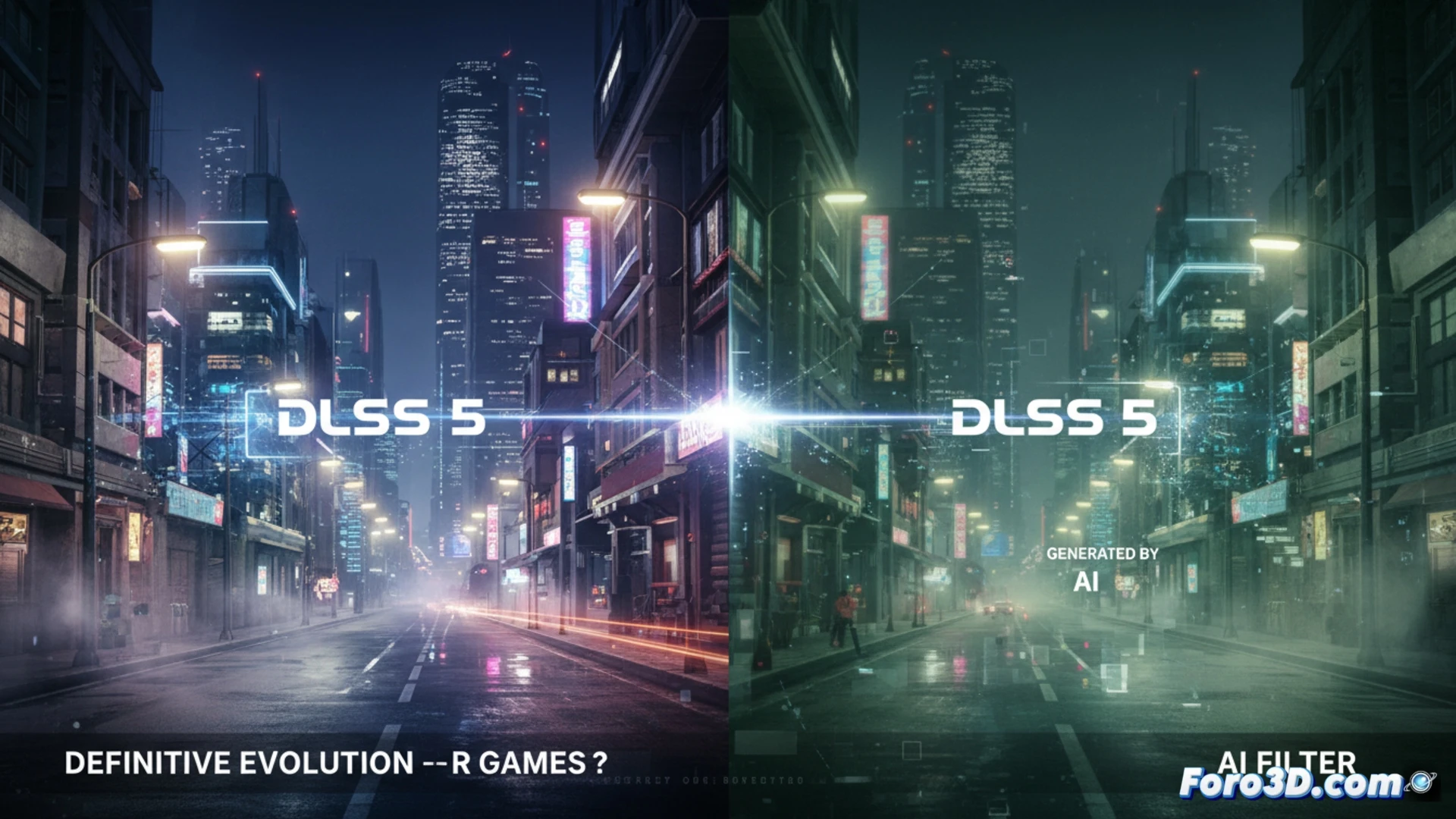
Nvidia has presented DLSS 5, an ambitious leap in its supersampling technology. It no longer limits itself to scaling resolution, but actively enriches the scene in real time. It analyzes each frame to add details in lighting, materials, and textures. The promise is more accessible realism, but the debate is on: many see an AI filter that could homogenize the original art.
How neural scene reconstruction works 🤖
The system uses trained neural networks that go beyond simple pixel interpolation. It analyzes the geometry, light sources, and materials of the frame rendered by the engine. Then, it synthesizes and adds detail information that was not originally calculated, such as complex reflections or roughness in textures. It is a neural post-processing process that seeks to achieve visual quality close to path-tracing, but with a fraction of the performance cost.
Welcome to the era of Nvidia Style 🎨
Soon games will have two graphics modes: Artistic and DLSS 5. Do you want that muted and atmospheric color palette chosen by the art director? Better activate AI mode so everything shines with a generic wet plastic finish. At least it will be a consolation to know that, no matter the game, all virtual worlds will share the same predictable neuronal Instagram filter. Authenticity is overrated.