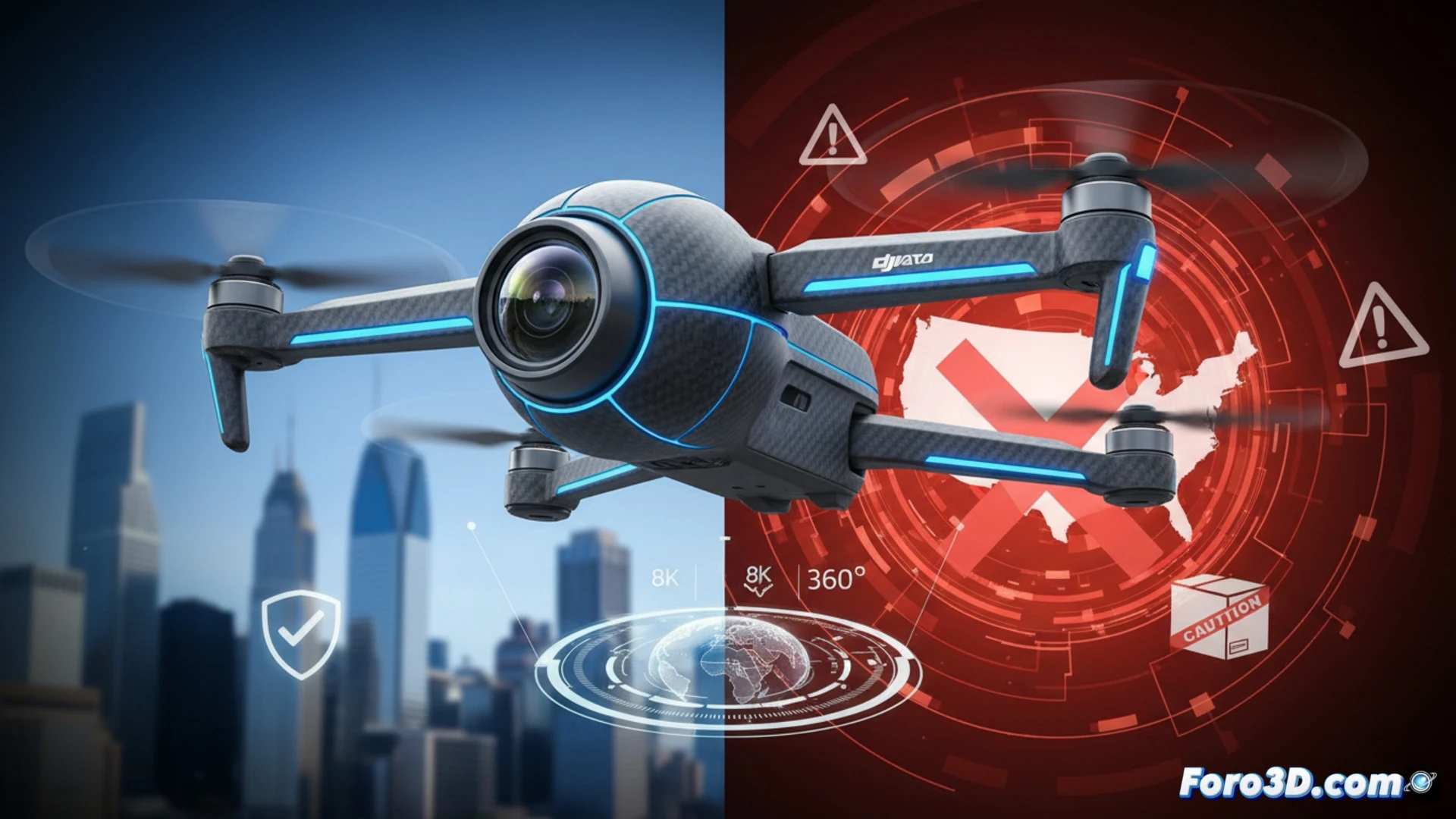
The launch of the DJI Avata 360, a drone with 8K spherical recording capabilities, clashes head-on with a geopolitical barrier. In December 2025, the U.S. Federal Communications Commission banned the import of new drones from foreign manufacturers, such as DJI, due to lack of security authorizations. This case illustrates how tensions between the United States and China abruptly disrupt the flow of advanced technology to the end consumer, reconfiguring the market through decrees and not just through innovation.
Visualizing the disruption of the global technology flow 🗺️
We can model this disruption in 3D: a product flow from factories in China to the U.S. market is cut off by a regulatory blockade. The map of affected trade relationships is extensive, impacting distributors, content creators, and professional users who depended on this technology. Simulations of subsequent scenarios show a forced reconfiguration, where brands from other countries or local developments attempt to fill the gap, but often with less integrated solutions or at higher costs, fragmenting the global supply chain into geopolitically aligned segments.
Technological dependence and digital sovereignty 🔒
The Avata 360 ban transcends a single vetoed product. It is a case study on the vulnerability generated by technological dependence on a single global actor and the growing instrumentalization of supply chains as a tool of foreign policy. For users, it means that access to consumer technology is no longer decided solely by features and price, but also by diplomatic relations between countries, accelerating technological fragmentation with profound long-term consequences.
Can technological innovation in products like the DJI Avata 360 overcome the barriers of geopolitical fragmentation in global supply chains?
(P.S.: at Foro3D we know that a chip travels more than a backpacker on a gap year)✈️