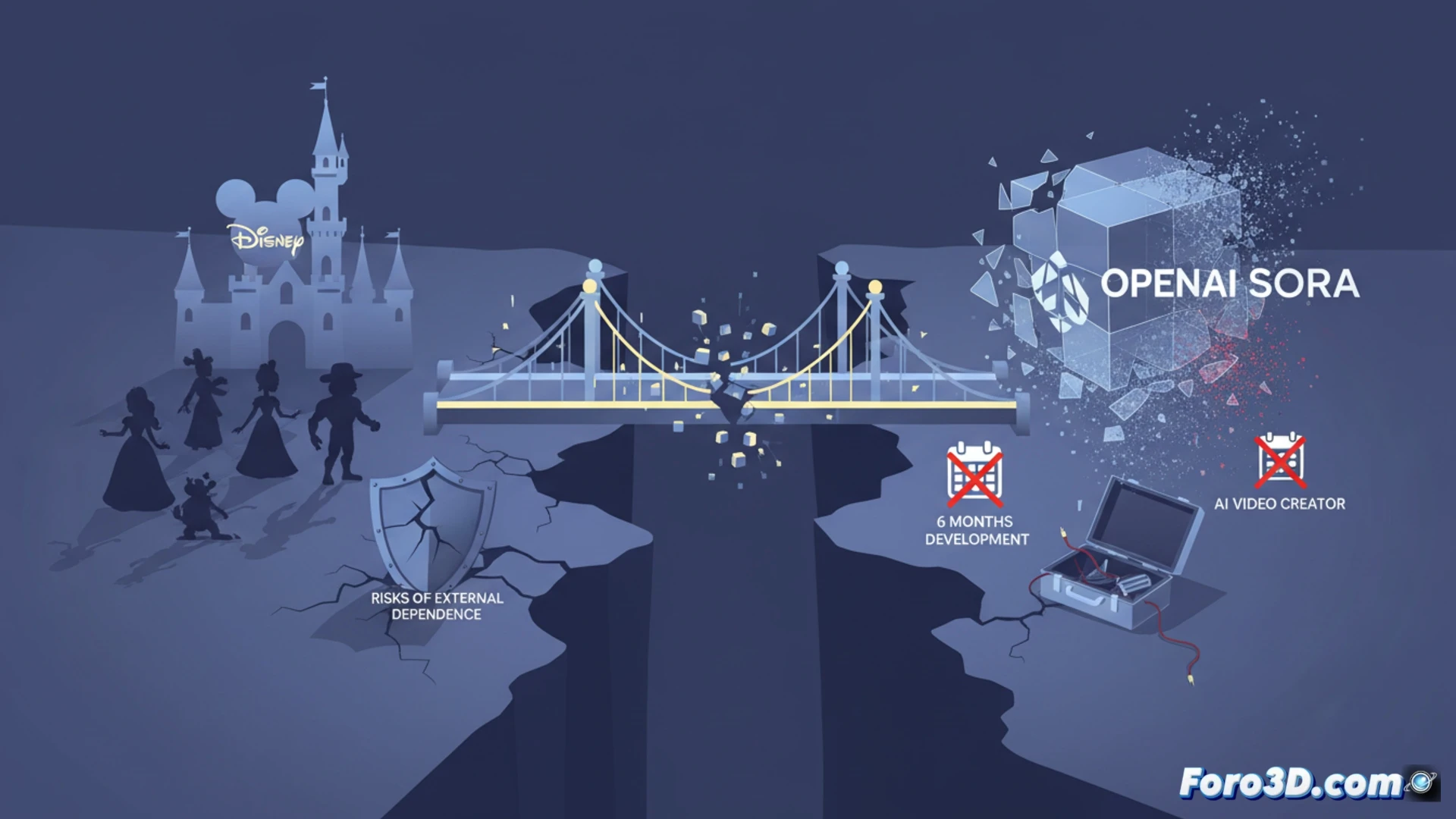
Disney's ambitious plan for its fans to create videos with over 200 characters using OpenAI's Sora AI has come to a screeching halt. OpenAI's shutdown of the platform has left the company without a partner and without the key tool of its strategy. This setback, which includes the loss of six months of development, crudely exposes the risks of depending on a single external provider in the volatile arena of generative artificial intelligence.🤖
A generative AI provider market with limited options🧩
After OpenAI's exit, Disney finds itself in a complex search for a new technology partner, but the ecosystem presents serious drawbacks. Google faces massive lawsuits over intellectual property related to its AI, which poses an unacceptable risk for a content giant like Disney. Other companies operate at an insufficient scale, and Meta is perceived as toxic to Disney's family brand. This situation leaves the company in a dead end, evidencing the concentration and legal problems of the sector, where the scarcity of stable providers severely limits corporate strategy.
The imperative lesson: technological sovereignty or diversified alliances⚖️
The Disney-OpenAI case leaves a clear strategic lesson for the industry. Entrusting core projects to external AI platforms carries too high an operational and intellectual property risk. The alternative lies in two non-exclusive paths: developing internal generative AI capabilities to maintain control, or building a diversified ecosystem of alliances to mitigate dependence on a single actor. In the AI era, innovation without strategic autonomy is a dangerous bet.
To what extent does the dependence of large corporations like Disney on proprietary AI models, such as OpenAI's Sora, threaten innovation and creative autonomy in the digital entertainment industry?
(P.S.: trying to ban a nickname on the internet is like trying to cover the sun with a finger... but digital)