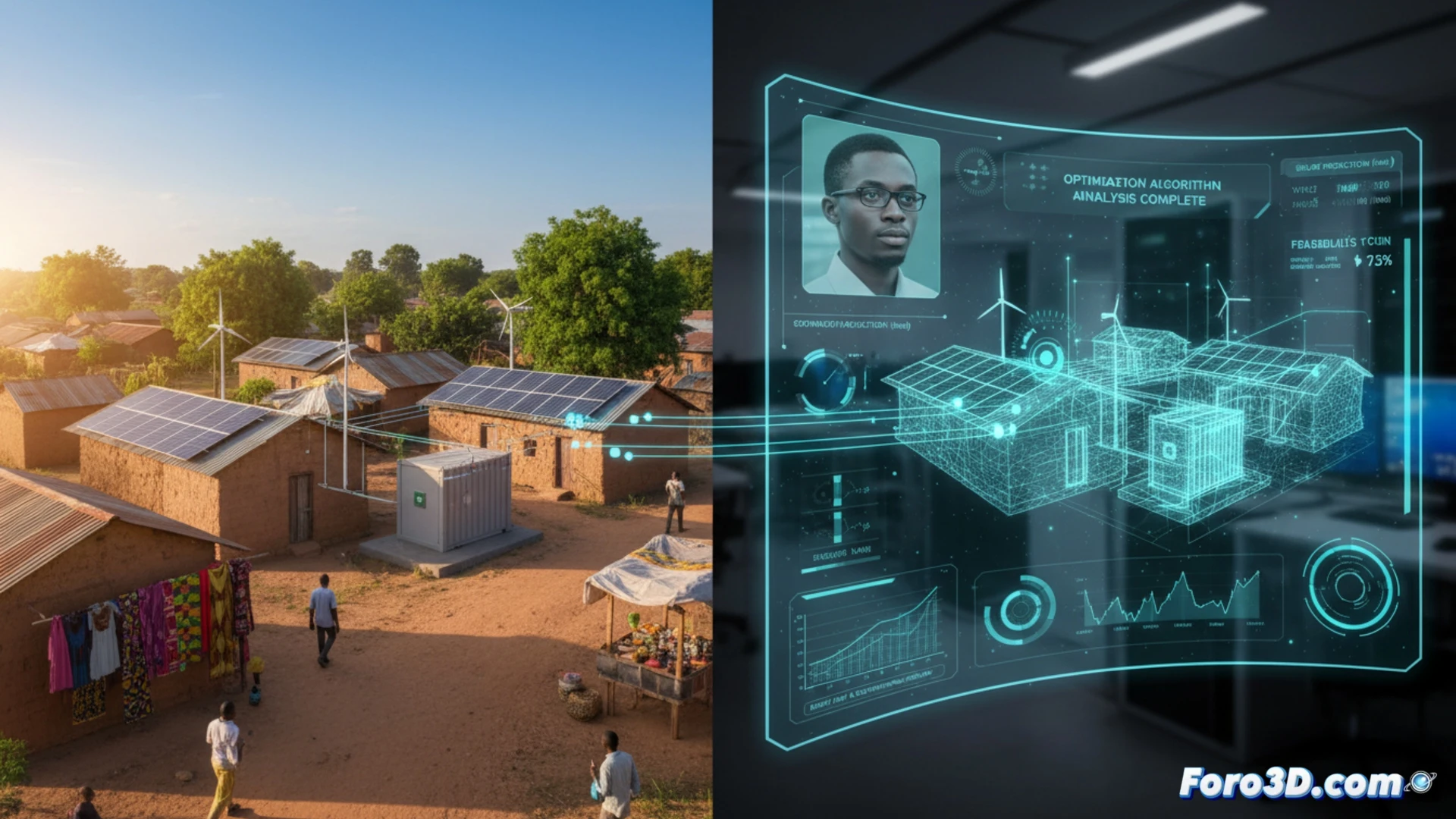
Timothy Asare, Ghanaian engineer at ETH Zurich, leads a research project to develop decentralized electrical microgrids in his country. Inspired by a pilot in Walenstadt, Switzerland, his work is based on the creation of a digital twin. This virtual model will simulate the behavior of a microgrid integrating renewable energies, electric vehicles as storage, and local data. The goal is to analyze its technical and economic viability before physical implementation, offering a scalable solution for sub-Saharan Africa.
Modeling and simulation of a hybrid energy system 🔋
The core of the project is a dynamic digital twin that replicates an isolated microgrid. The model integrates real data on solar irradiation, consumption patterns of rural communities, and electric vehicle mobility profiles. Through simulation, scenarios are evaluated with different photovoltaic generation capacities, EV charging strategies to stabilize the grid, and diesel generator backup. The twin allows quantifying energy autonomy, forecasting demand peaks, and optimizing component sizing. This goes beyond a static 3D model, serving as a planning tool for investment decisions and the design of regulatory frameworks that facilitate these decentralized solutions.
From simulation to local energy sovereignty 🌍
Beyond the technical aspect, this digital twin represents a bridge between cutting-edge research and its application with social impact. Asare, motivated by his personal experience with electricity shortages in Ghana, uses the model to transfer proven knowledge from Switzerland to a context with urgent needs. The simulation validates the hypothesis that entire regions could skip the development of traditional centralized grids, achieving energy sovereignty through community solutions. The digital twin thus becomes a key tool for a just and contextualized energy transition.
How can a digital twin optimize the integration of solar energy and batteries in a microgrid to ensure reliable and affordable electricity supply in rural communities in Ghana?
(P.S.: My digital twin is currently in a meeting, while I'm here modeling. So technically, I'm in two places at once.)