At the forefront of contemporary creation, Bauhaus University Weimar is redefining the boundaries of artistic production. Its latest research does not propose a substitution, but a strategic alliance between 3D printing and classical crafts. This project, located at the intersection between the digital and the manual, explores how additive manufacturing can act as an extension of the craftsman's tools, radically expanding the horizon of what is possible in design and material expression.
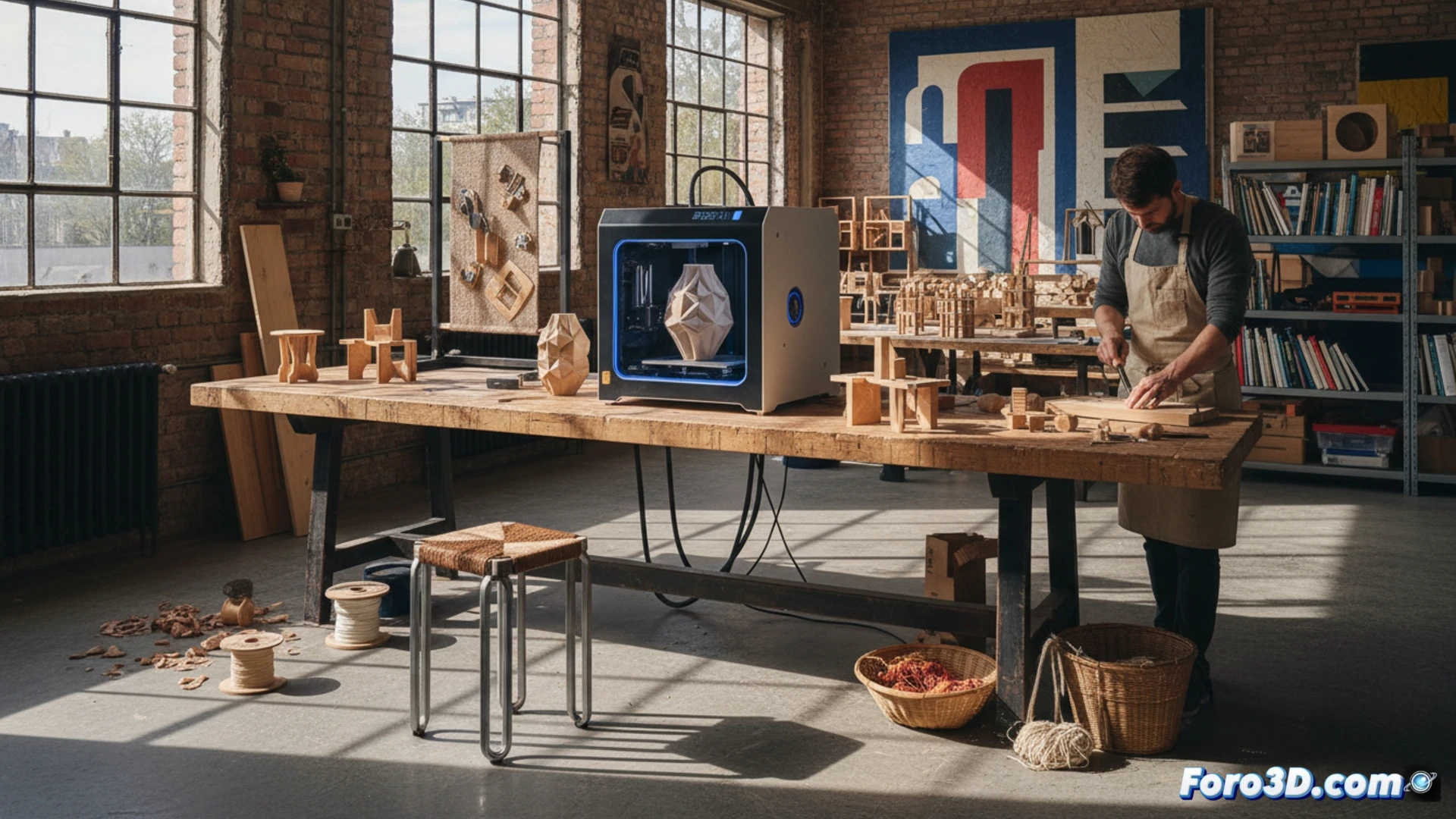
Technical Symbiosis: From G-Code to Manual Touch 🔧
The integration is not merely conceptual. Researchers work on workflows where the digital and manual processes intertwine. An object can begin its life as an algorithmic model and be 3D printed to obtain a complex base form or an internal structure impossible to carve. Subsequently, that substrate is intervened using traditional techniques such as carving, glazing, weaving, or manual finishing, adding warmth, valuable irregularity, and narrative. The robot's precision complements the hand's intuition, allowing series where each piece, starting from the same digital core, becomes unique thanks to the artisanal gesture.
The Activism of the Hybrid ⚖️
More than a technical experiment, this approach is a cultural reclamation. In a world obsessed with the new, it revalues the material wisdom of crafts. Instead of a disruptive replacement, it proposes a collaborative evolution. This digital craftsmanship empowers the creator, offering a wider spectrum of tools to materialize complex ideas. Thus, the Bauhaus updates its legacy, teaching that the future of art is not in the choice between technology or tradition, but in the conscious and critical fusion of both.
How is contemporary Bauhaus redefining artistic activism through the fusion of traditional artisanal techniques and 3D digital manufacturing?
(P.S.: at Foro3D we believe that all art is political, especially when the computer freezes)