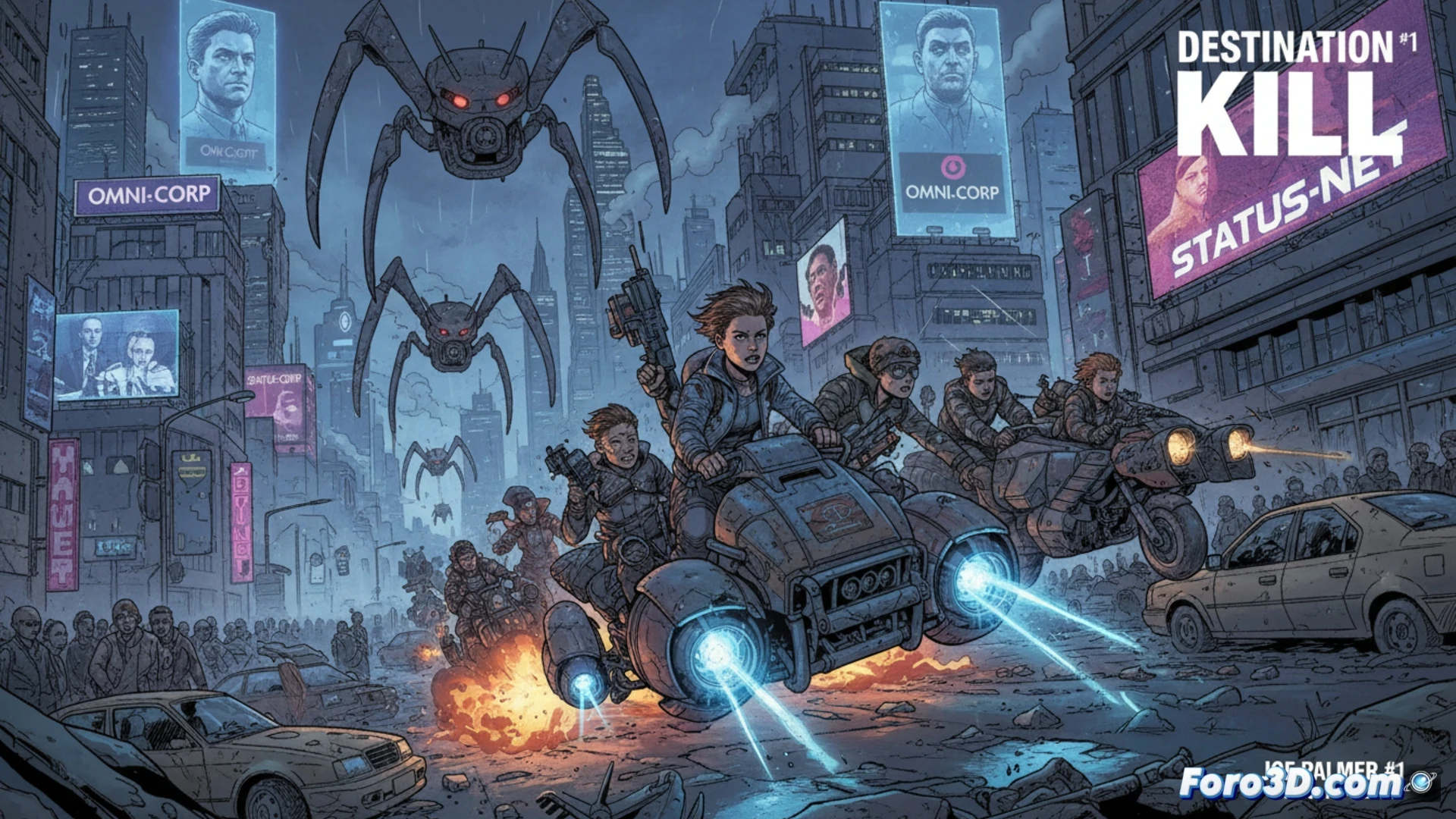
In the landscape of contemporary narrative art, comics emerge as a powerful tool for social critique. Destination Kill #1, by Joe Palmer for Oni Press, demonstrates this by constructing a futuristic and oppressive London where youth resistance is channeled through modified vehicles and hacked technology. This work is not just cyberpunk action entertainment; it is a visual manifesto that uses sequential art to explore the struggle for identity and freedom against corporate and state control, positioning itself at the key intersection between artistic creation and activist discourse.
Cyberpunk Aesthetics as a Language of Visual Resistance 🎨
Palmer employs the visual codes of cyberpunk and dystopia not as mere decoration, but as a technical language loaded with activist meaning. The decaying city, omnipresent surveillance, and modified technology are aesthetic elements that directly critique the authoritarian drift and the commodification of life. This methodology is parallel to that of digital art projects or 3D/VR installations that use immersive environments for political awareness. The comic, as a narrative 3D modeling project, builds a coherent world where every visual detail, from the graffiti on the walls to the vehicle designs, conveys a message of resistance and defines the group's identity against the oppressive system.
Graphic Narrative and Collective Political Consciousness 🤖
The true activist power of Destination Kill lies in its ability to generate identification and collective reflection. By narrating the rebellion of ordinary young people, it transfers the struggle from the fantastical realm to a near and plausible future, inviting the reader to question current power structures. This approach turns the comic into a cultural artifact that transcends the page, functioning as a conceptual model for action. In a world where digital activism employs avatars and virtual spaces, this work reminds us that traditional narrative art, loaded with deliberate aesthetics, remains a formidable vehicle for imagining alternative futures and sowing the seeds of resistance.
How does the comic Destination Kill #1 use dystopian aesthetics and sequential narrative to critically dismantle contemporary power structures and mobilize the viewer's consciousness?
(P.S.: pixels have rights too... or at least that's what my latest render says)