DESI instrument data shakes the foundations of modern cosmology. Its indications of dark energy weakening over time directly challenge the standard lambda-CDM model, where this force is an immutable constant. If confirmed, this finding not only redefines our universe but demands new ways to represent and communicate this changing reality. Scientific visualization becomes the key tool to navigate this revolution.
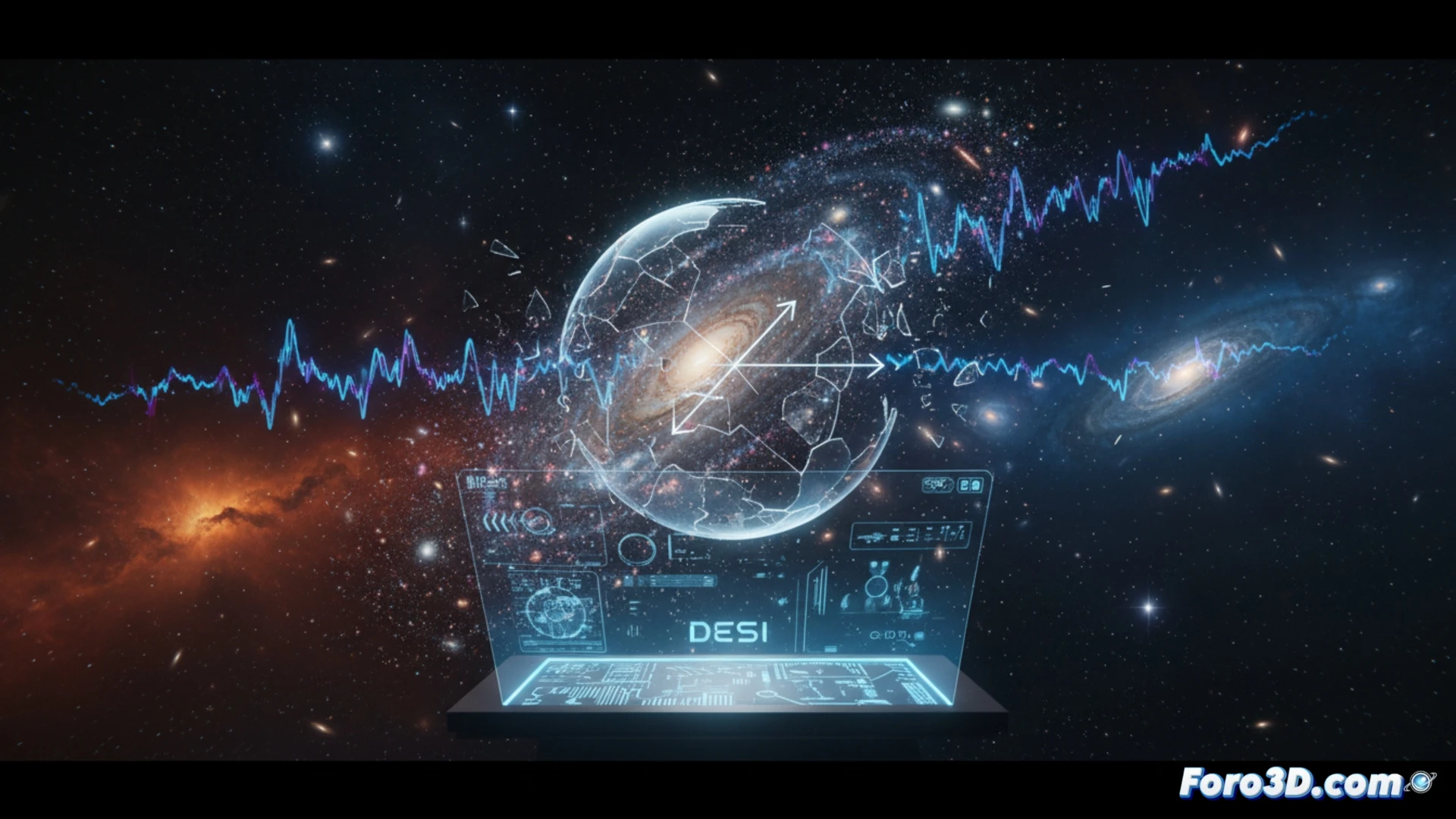
3D Modeling: from the lambda constant to dynamic energy 🔬
The power of visualization lies in making the incommensurable comparable. We can build interactive simulations that contrast, side by side, the evolution of the cosmos under the standard model and under one with variable dark energy. Visualizing the accelerated expansion of space-time in 3D, where the growth rate visibly changes over simulated eons, transforms an abstract mathematical parameter into a tangible visual narrative. These tools are crucial for researchers to explore the implications of DESI data and test alternative hypotheses.
Rendering a new paradigm: from the Big Bang to cosmic cycles 🌌
The crisis opens the door to previously marginal cosmologies. Visualization allows materializing concepts like the Steinhardt cyclic universe, showing not an eternal expansion, but a cycle of contractions and bounces. Rendering these transitions offers an intuitive understanding of complex theories. Beyond illustrating, 3D visualization becomes a laboratory to test the coherence of a new paradigm, making visible what could be the next great revolution in our understanding of the cosmos.
How would you animate the behavior patterns described in the study? 💡