Vision-Language-Action (VLA) models represent a key advancement for robotic manipulation, integrating linguistic instructions and visual perception to generate actions. However, their language core often acts as a black box, limiting understanding of how visual information is grounded. A recent analysis reveals that sensitivity to visual tokens decays in deep layers during action generation, a critical issue for precision tasks. This is where 3D simulation becomes indispensable, allowing these models to be trained and diagnosed in complex virtual environments before physical deployment. 🤖
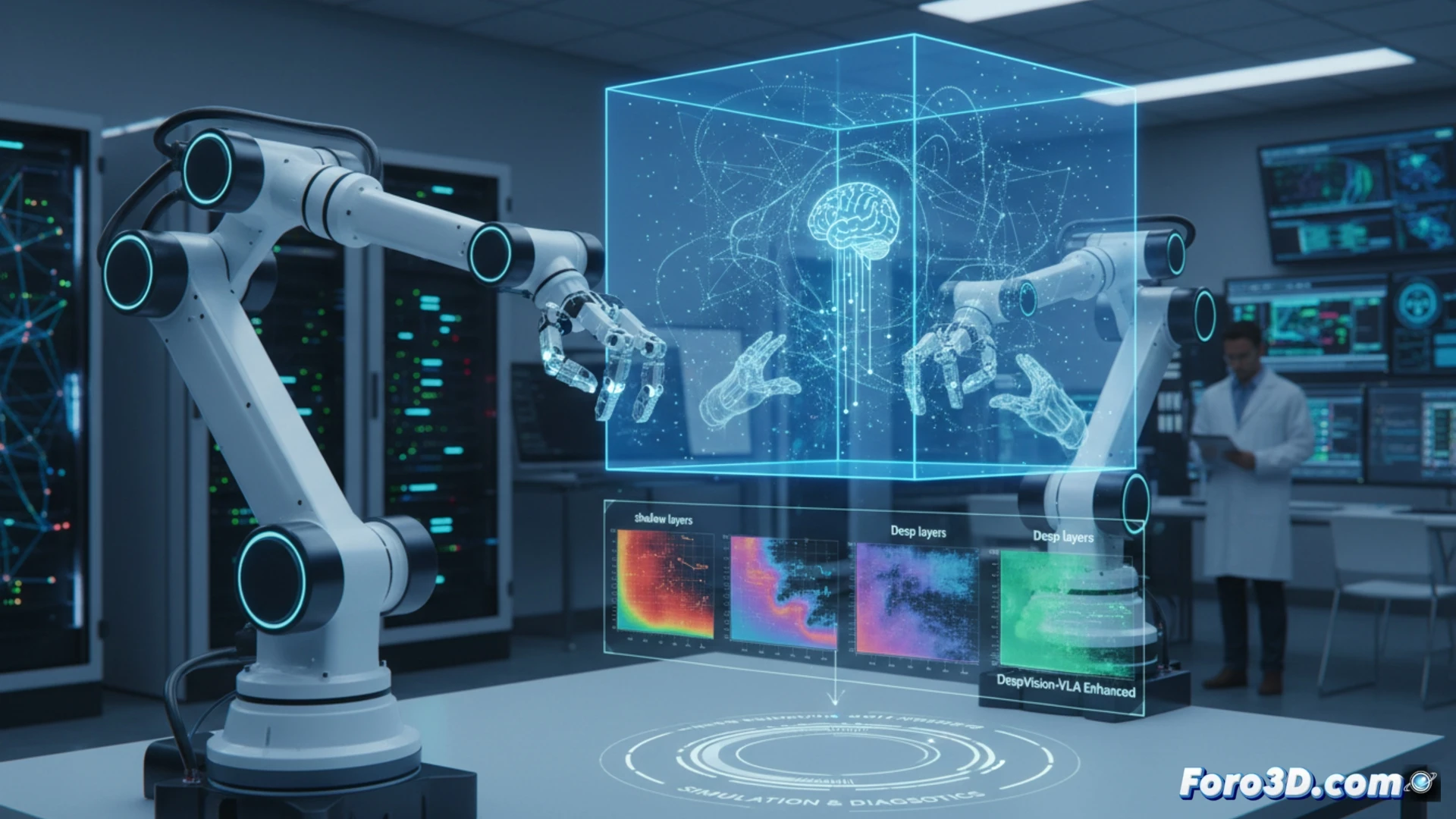
VL-MoT Architecture and Action-Guided Visual Pruning 🔍
To address this limitation, DeepVision-VLA is proposed, based on a Vision-Language Mixture-of-Transformers (VL-MoT) framework. This architecture enables shared attention between a specialized vision model and the VLA core, injecting multilevel visual features into the model's deeper layers. This strengthens visual representations for complex manipulations. In parallel, Action-Guided Visual Pruning (AGVP) is introduced, a technique that uses attention from shallow layers to prune irrelevant visual tokens, retaining only those key to the task with minimal computational overhead. Validated in realistic 3D simulations, this approach achieves a 9.0% improvement in simulated environments.
The Future of Robotics Lies in 3D Simulation 🚀
The success of DeepVision-VLA, with 7.5% greater efficacy in the real world, underscores the fundamental role of 3D simulation as a testing ground. These virtual environments allow generating diverse synthetic data, testing failure scenarios, and refining vision-action integration without risks. For the robotics and automation niche, this accelerates the development of robots capable of manipulating objects in unstructured environments, where robust and deep visual understanding, trained first in 3D, is key to autonomy.
How are Vision-Language-Action (VLA) models like DeepVision overcoming generalization challenges in robotic manipulation tasks in unstructured environments?
(P.S.: Simulating robots is fun, until they decide not to follow your orders.)