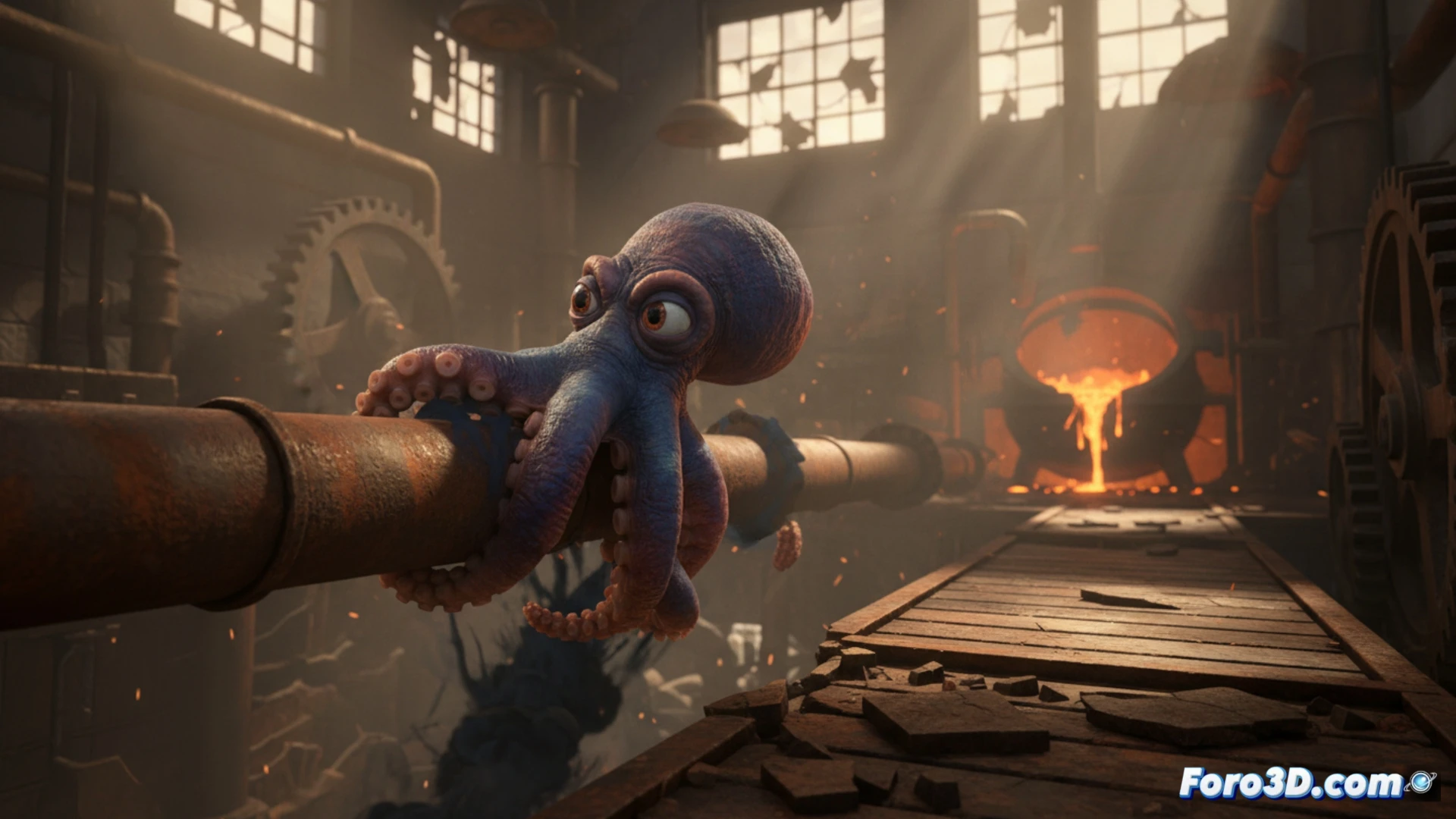
Darwin's Paradox emerges as a fascinating indie project that unites the most advanced technology with the sensitivity of the classics. Developed with Unreal Engine 5 by the French studio ZDT Studio, the game features a visual style of the highest quality, close to that of Pixar, but applied to a premise inspired by the PS1 era. Its protagonist is an octopus whose behavior and abilities are faithfully based on those of a real cephalopod, moving away from anthropomorphic representations. This bet combines a personal artistic concept, gestated for over a decade, with innovative gameplay mechanics.
Unreal Engine 5 and the Translation of Biological Abilities into Mechanics 🐙
The technical and creative core of Darwin's Paradox lies in how it uses Unreal Engine 5 to bring to life an organic gameplay system. It's not just about achieving cinematic rendering, but simulating the real capabilities of the octopus. Climbing, camouflage, and ink usage cease to be decorative animations to become central mechanics for progression and puzzle-solving. The challenge for ZDT Studio, formed by industry veterans, has been to translate complex animal behaviors into intuitive and satisfying controls. The industrial world explored by the protagonist serves as a contrast to highlight its natural abilities, creating a unique symbiosis between narrative, art, and gameplay.
The Indie Convergence of Personal Concept and Technology 🎨
This project exemplifies the maturity of current indie development, where a personal and prolonged artistic vision finds the technical tools to materialize without creative limits. The trajectory of its founders provides solidity, while the choice of UE5 demonstrates an ambition to compete in visual quality without losing a unique essence. Darwin's Paradox is not just a game about an octopus; it is a testament to how current technology allows small studios to explore high-risk concepts with high-level execution, redefining what is expected from an indie experience.
How can an authentic and stylized PS1 visual aesthetic be achieved using the latest generation rendering tools of Unreal Engine 5?
(P.S.: shaders are like mayonnaise: if they break, you start all over again)