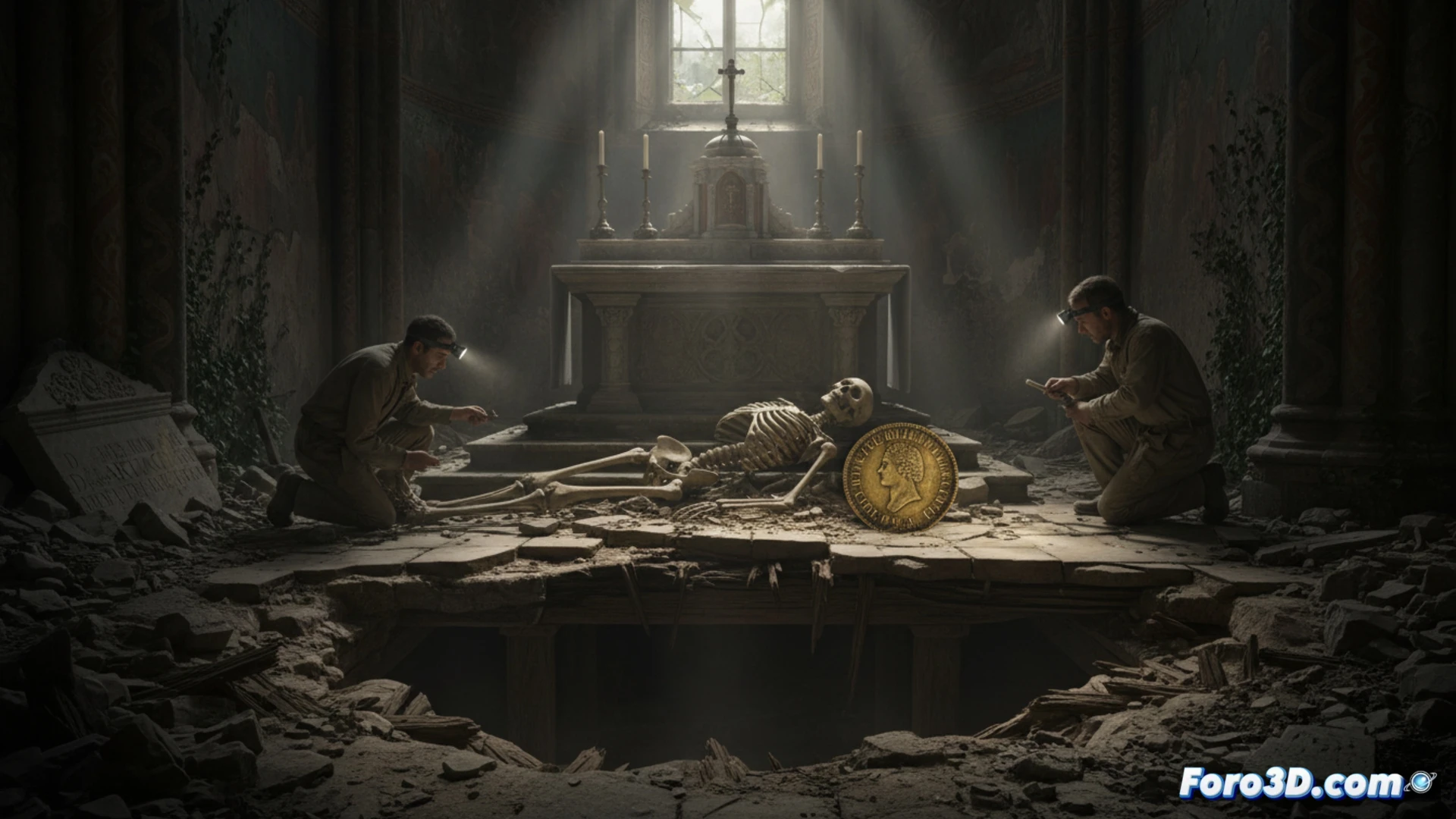
The possible discovery of the remains of Charles de Batz, the historical d'Artagnan, under a church in Maastricht, is a first-rate archaeological find. Beyond the pending DNA test, the skeleton with a musket ball in the chest offers a unique opportunity. This is where digital archaeology unleashes its potential, not to replace traditional forensic science, but to complement it and perpetuate the discovery with irreversible precision.
3D Documentation and Forensic Reconstruction: Beyond the Bone 🔬
Photogrammetry and 3D laser scanning of the burial context and the skeleton itself would create an exact digital model, preserving the state of the discovery forever. This model would allow non-destructive virtual analyses, such as the three-dimensional study of the bullet's trajectory. Additionally, from the scanned skull, forensic facial reconstruction techniques could generate a rigorous visual hypothesis of the face of the captain of the musketeers, a bridge between scientific data and the historical and literary figure.
Preserve and Disseminate the Myth Made Reality 📖
3D digitization goes beyond mere documentation. An interactive model of the burial or an animation of the facial reconstruction are powerful dissemination tools. They allow the public to understand the archaeological process and visualize the real character behind the myth, democratizing access to a heritage that has literally come out of the pages of a novel to reveal itself under our feet.
How can digital archaeology validate or refute the identification of the remains attributed to the historical d'Artagnan against the literary legend?
(P.S.: If you dig at a site and find a USB, don't plug it in: it could be Roman malware.)