In 2022, NASA's DART mission made history by crashing into the asteroid Dimorphos. Its goal was to test planetary defense, but the result was more profound. Recently confirmed, the impact not only altered Dimorphos's orbit around Didymos, but also the heliocentric trajectory of the entire binary system. For the first time, humanity has consciously modified the gravitational configuration of the solar system. This milestone, with complex data and astronomical scales, cries out to be analyzed and communicated through 3D scientific visualization.
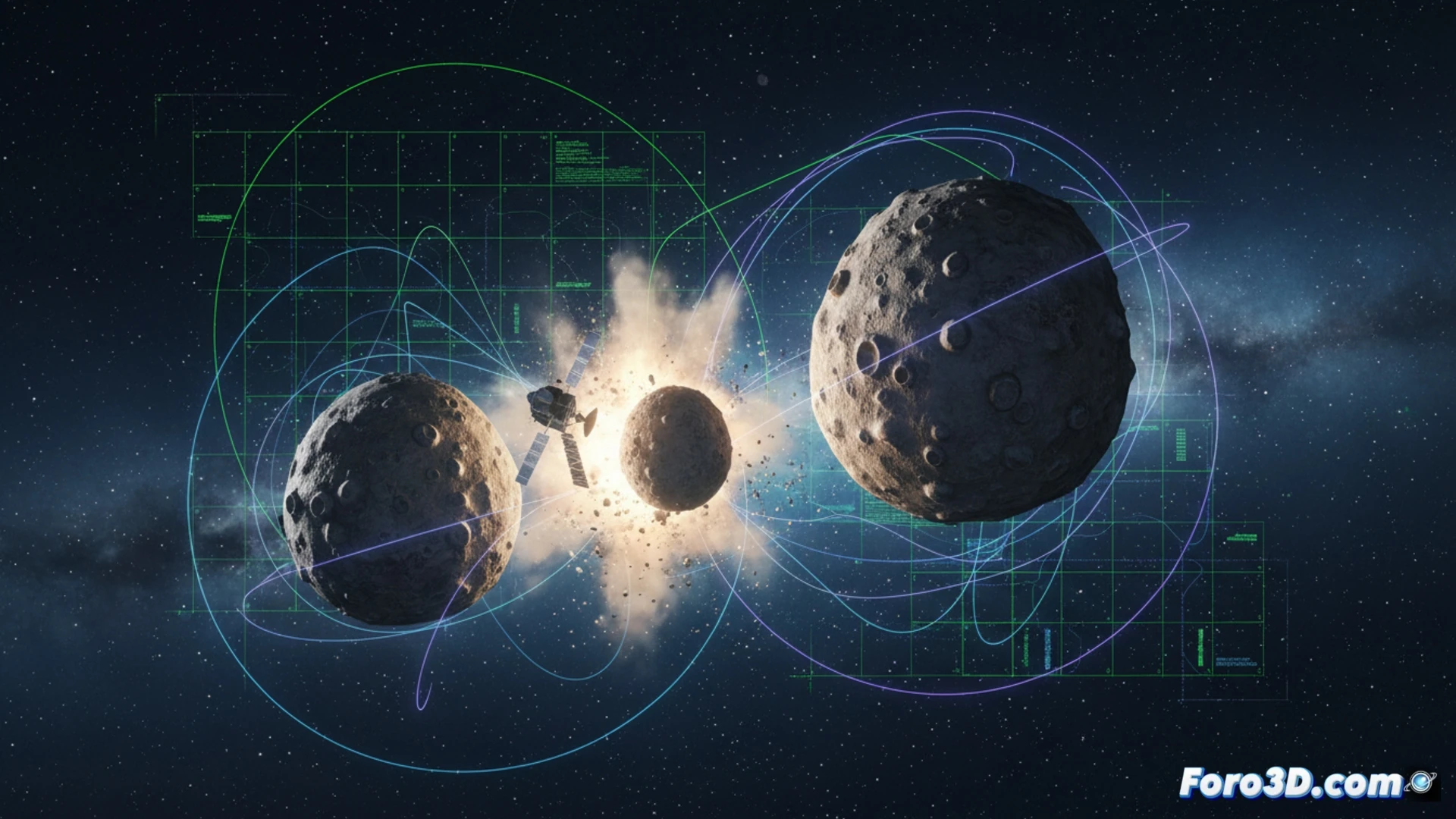
3D Modeling: Key to Understanding the Orbital Alteration 🛰️
The true magnitude of the DART achievement is only appreciated with computational simulations. An interactive 3D model is essential to visualize the two key alterations. First, the change in the binary orbit, where Dimorphos's orbital period around Didymos was reduced by minutes. Second, and more transcendental, the modification of the orbital parameters of the entire Didymos-Dimorphos system around the Sun. Visualization tools allow superimposing predicted and actual trajectories, showing that minimal but measurable reduction in speed and orbital radius. This transforms abstract data into an understandable spatial narrative.
A Visual Precedent for the Future of Exploration 🚀
DART sets a precedent: our ability to influence celestial mechanics. 3D visualization ceases to be just an analysis tool to become a crucial record of this new chapter. Modeling this event lays the foundation for simulating future planetary defense missions or orbital engineering. By creating an accessible representation of how a local impact alters a system on a solar scale, we not only document an achievement, but visualize the birth of a new era in which our gravitational footprint is already a variable to consider.
How were scientific visualization techniques used to analyze and communicate the change in Dimorphos's orbit after the DART mission impact?
(P.S.: if your manta ray animation doesn't excite, you can always add documentary music from the 2)