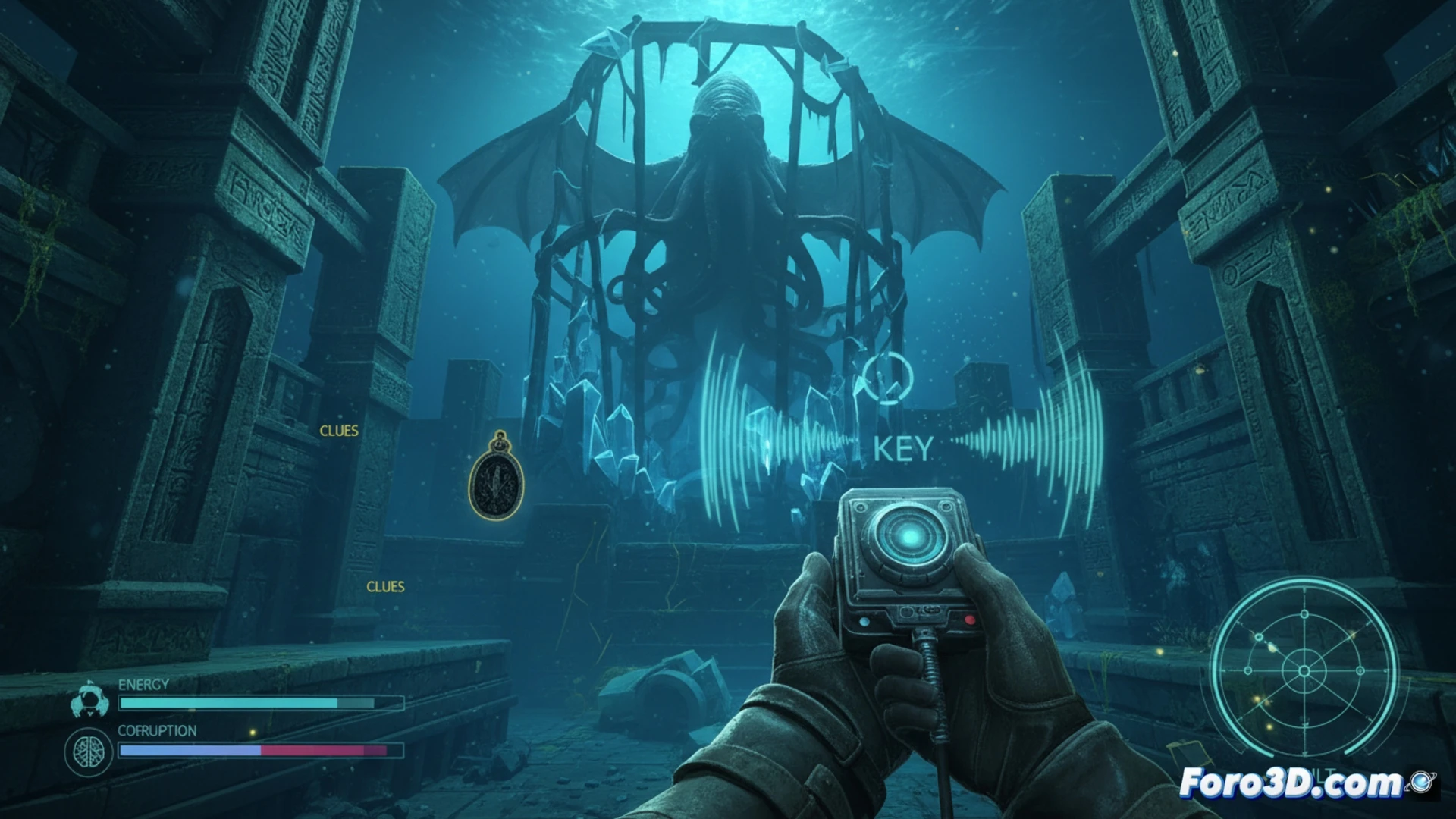
Nacon and Big Bad Wolf Studio have unveiled the trailer for Cthulhu: The Cosmic Abyss, a first-person narrative thriller scheduled for April 16 on PS5, Xbox Series, and PC. The game places the player in the role of Noah, an occult investigator who, accompanied by the AI KEY, searches for a missing team in the submerged city of R'lyeh. The proposal stands out for gameplay centered on pure investigation, where analyzing clues consumes energy and managing that resource is key to avoiding succumbing to corruption and madness.
Corruption Mechanics and Resource Management as Narrative Engine 🔄
The design of Cthulhu The Cosmic Abyss proposes an interesting system of constant tension. Energy, necessary for critical actions like analysis, acts as a scarce resource that the player must manage. The risk of increasing the corruption meter adds a layer of psychological pressure, turning every decision into a balance between progressing and maintaining sanity. Technically, implementing this risk-reward loop smoothly is a challenge, ensuring that the sense of threat is palpable without frustrating the player. The vault for linking clues suggests a structured deduction system, while corruption affecting tool upgrades adds strategic depth and permanent consequences, moving away from mere accumulation of advantages.
AI as Companion and Immersive Environment Building 🤖
The inclusion of KEY as an AI assistant is not just a narrative resource, but a possible design tool to guide the player without breaking immersion in a hostile and dark environment. From a development perspective, creating the city of R'lyeh for next-generation consoles and PC involves exploiting lighting techniques, spatial sound, and level design that encourage exploration and environmental terror. The sonar to reveal the invisible is a successful mechanic that solves the visibility problem in the darkness, transforming it into an active skill with possible costs, integrating gameplay with the Lovecraftian atmosphere of the indescribable.
How can the systemic design of a narrative video game enhance the sense of cosmic horror and helplessness, beyond programmed jump scares?
(P.S.: shaders are like mayonnaise: if they curdle, you start all over again)