Chevrolet revives the legendary Grand Sport name sixty-two years after its triumph at Sebring. The new Corvette C8 Grand Sport 2027, presented by Roger Penske, inherits a racing DNA. Its heart is a naturally aspirated 6.7-liter LS6 V8 with about 550 HP, while a future X hybrid version promises 721 HP. This launch is not just a homage; it is a modern engineering exercise where 3D modeling plays a fundamental role.
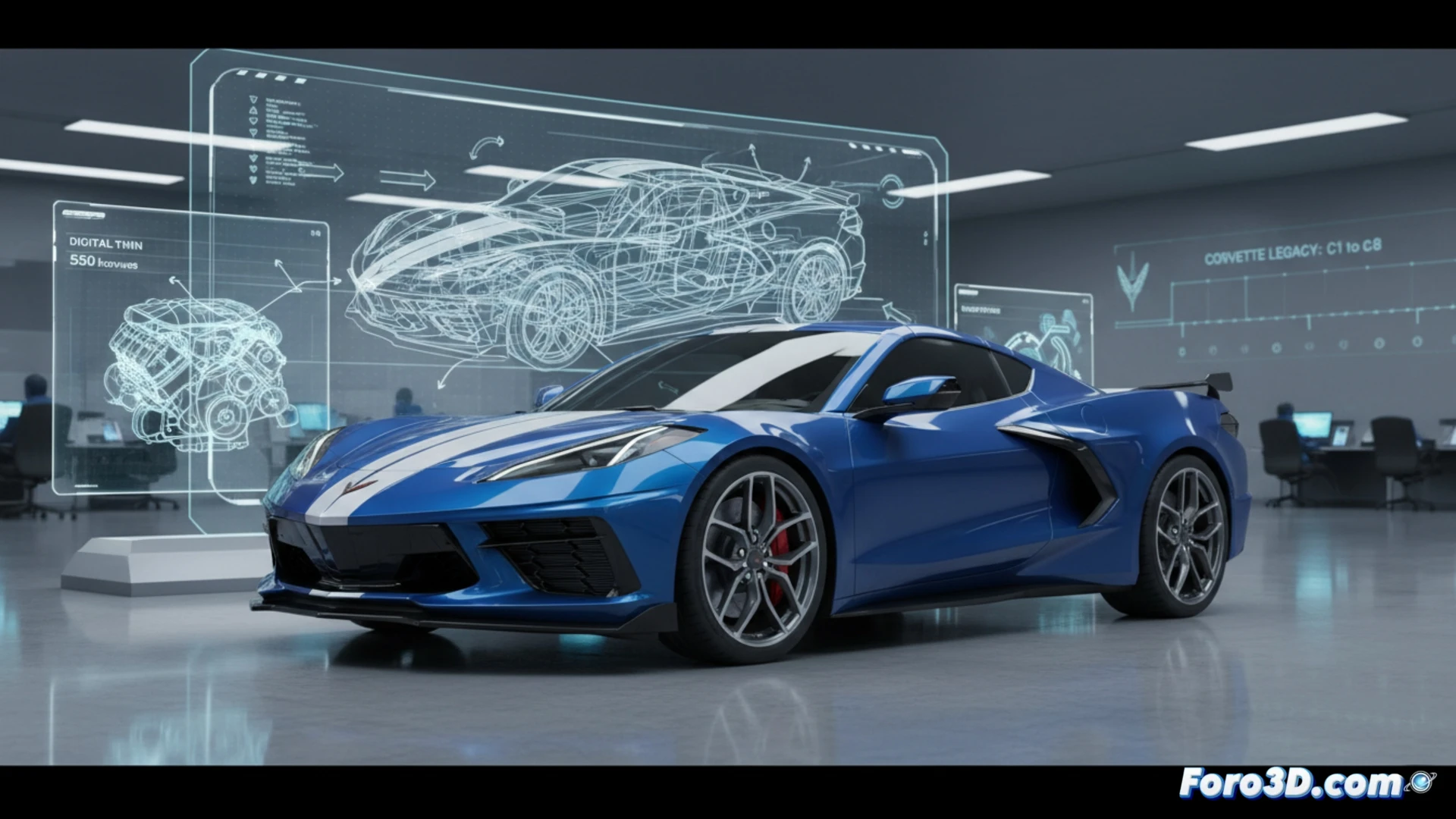
CFD Simulation and Digital Twins in Chassis and Aerodynamics Development 🌀
The development of the C8 Grand Sport critically depends on 3D-assisted design technologies. Aerodynamics, crucial for high-speed stability and cooling, is optimized through CFD (Computational Fluid Dynamics) simulations that model airflow over every virtual surface before manufacturing a single component. The chassis and integration of the complex hybrid system in the X version, with an electric motor on the front axle, are validated using digital twins. These 3D models enable virtual stress tests, thermal dynamics, and dynamic behavior testing, reducing costs and development time while maximizing performance and safety.
3D Visualization: From Technical Design to Legacy Communication 👁️
Beyond engineering, 3D modeling is key to communicating the essence of the Grand Sport. Photorealistic renders and technical animations break down its mechanical architecture for marketing and training. Visualizing in 3D the evolution from the original 1964 model to this C8 allows tangible appreciation of the technical heritage. Thus, 3D tools not only build the car but also model and perpetuate its legacy, connecting innovation with history in a visually powerful way.
How has 3D modeling and computer simulation evolved to enable the perfect integration of the original Grand Sport's aerodynamic legacy into the modern mid-engine Corvette C8 platform?
(P.S.: modeling a car is easy, the hard part is making sure it doesn't turn into a box with wheels)