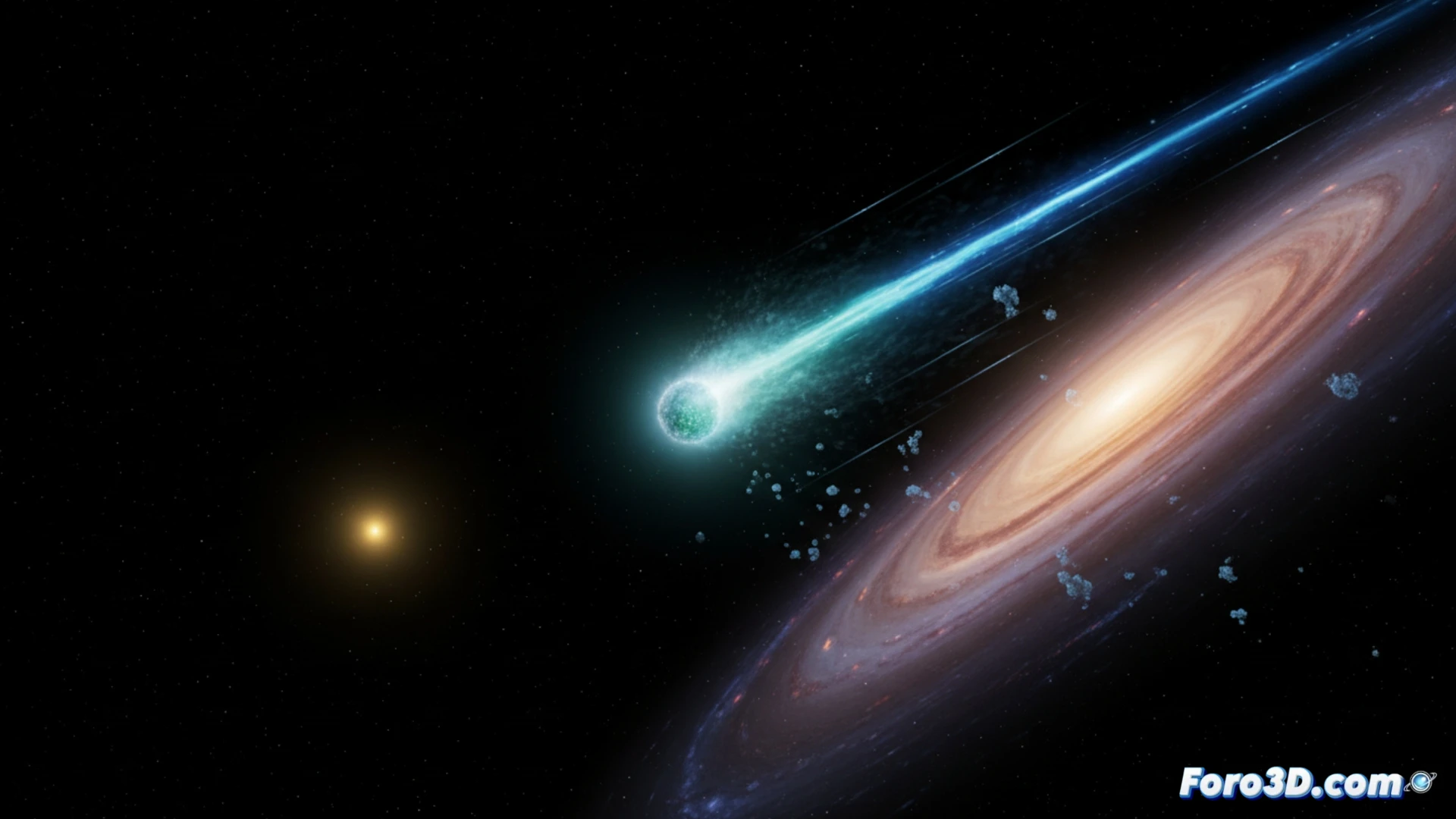
The analysis of the interstellar comet 3I/ATLAS shows a chemical composition that does not fit the patterns of our solar system. Its water and CO2 levels are high, but the key data is its deuterium ratio, ten times higher than in local comets. This points to an origin in the cold outskirts of a foreign stellar system.
Spectrometry to decipher interstellar isotopic signatures 🔍
The key to the discovery lies in high-resolution spectrometry applied to the comet's coma. The instruments precisely measured the deuterium/hydrogen and carbon-12/carbon-13 ratios in the released gases. The low presence of carbon-13, an isotope linked to supernovas, is as significant as the high deuterium. This combination of data is only obtained with technology capable of detecting weak isotopic signatures in fast-moving objects.
A galactic tourist that makes us look like novices 👽
While our local comets are like products from a relatively standard assembly line, 3I/ATLAS is the equivalent of a galactic artisan from another era. It comes from a stellar neighborhood so ancient that, when it formed, the periodic table here was probably still taking notes. Its chemistry is so distinct that it seems to carry the label Made in a place where your supernovas hadn't even premiered yet. A reminder that, in the galaxy, our solar system may be the newcomer.