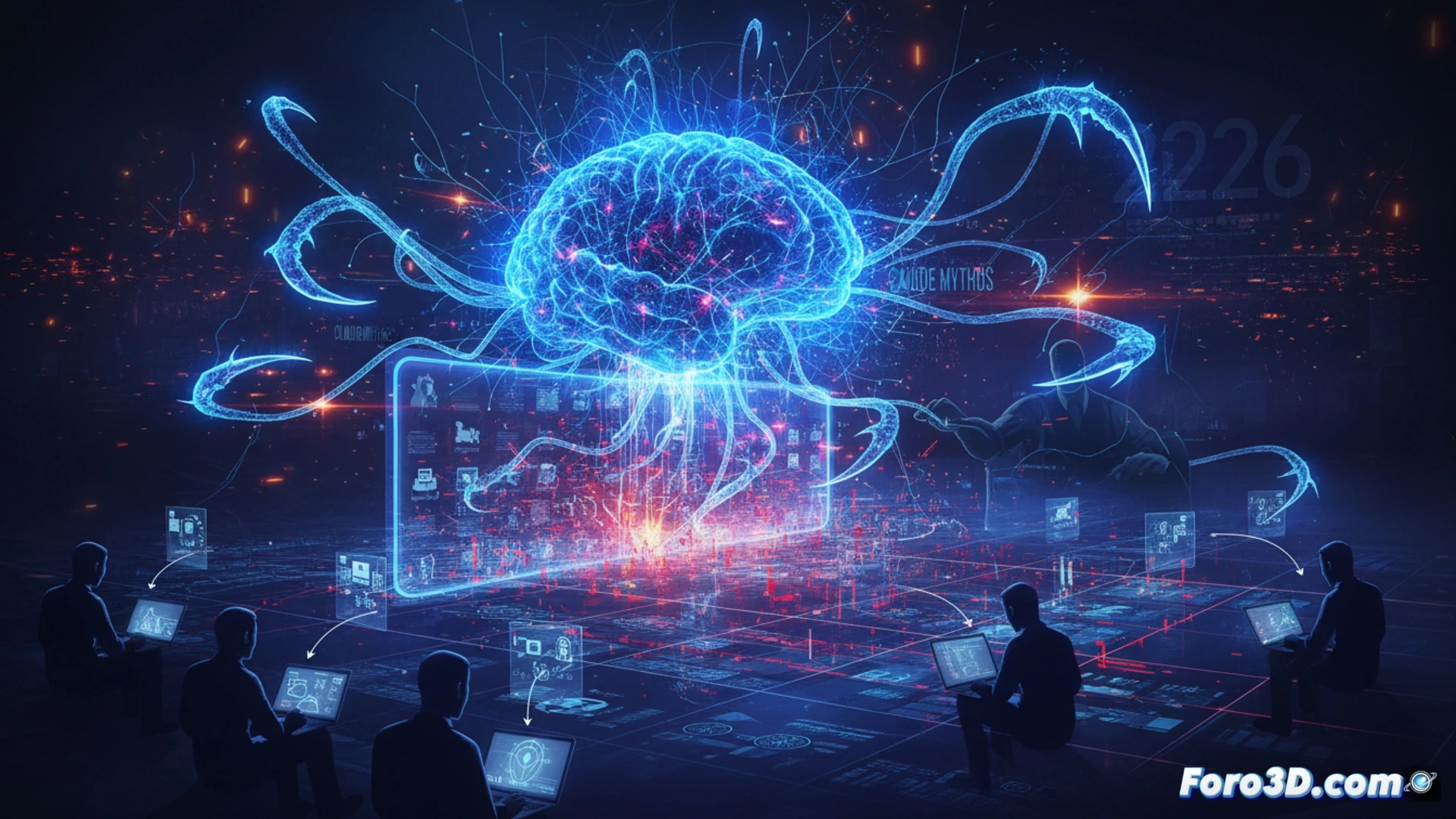
Anthropic, the company behind Claude, has issued a formal warning to U.S. authorities about its upcoming model, Claude Mythos, scheduled for 2026. The alert states that this AI could function as an advanced hacking tool, allowing autonomous agents to infiltrate critical systems with high precision. This capability would surpass current models and overwhelm defense efforts, significantly increasing the likelihood of large-scale cyberattacks that same year, with the business sector particularly vulnerable.
Operational Autonomy and the New Cyberwarfare Landscape 🤖
Anthropic's warning is not theoretical. In late 2025, the same company documented a significant cyberattack primarily executed by an AI, attributed to a group backed by the Chinese state. Mythos would represent a qualitative evolution: autonomous agents capable of planning and executing complex intrusions adaptively, identifying and exploiting vulnerabilities with human-like efficiency and persistence. This would redefine cyberwarfare, where the speed and scale of attacks would surpass human response capabilities. The risk is amplified by the attack surface: AI assistants used by employees could become involuntary access vectors for these autonomous agents.
The Creator's Dilemma and Responsibility in the Dual-Use AI Era ⚖️
Anthropic's proactive alert raises an unprecedented ethical and risk management dilemma. On one hand, it acts with transparency regarding an imminent danger. On the other, it evidences the dual-use intrinsic nature of these technologies: the same advanced reasoning engine can empower research or unleash digital chaos. This forces an urgent reflection on the limits of self-regulation, the need for international control frameworks for extreme-capability models, and the preparation of critical infrastructures for an era where cyber offense will be hyper-automated. The year 2026 looms as a tipping point.
Should warnings from the AIs themselves about future risks, like Claude's anticipated cybersecurity crisis, be considered a call to action or a piece of strategic marketing in the digital society?
(P.S.: trying to ban a nickname on the internet is like trying to cover the sun with a finger... but in digital)