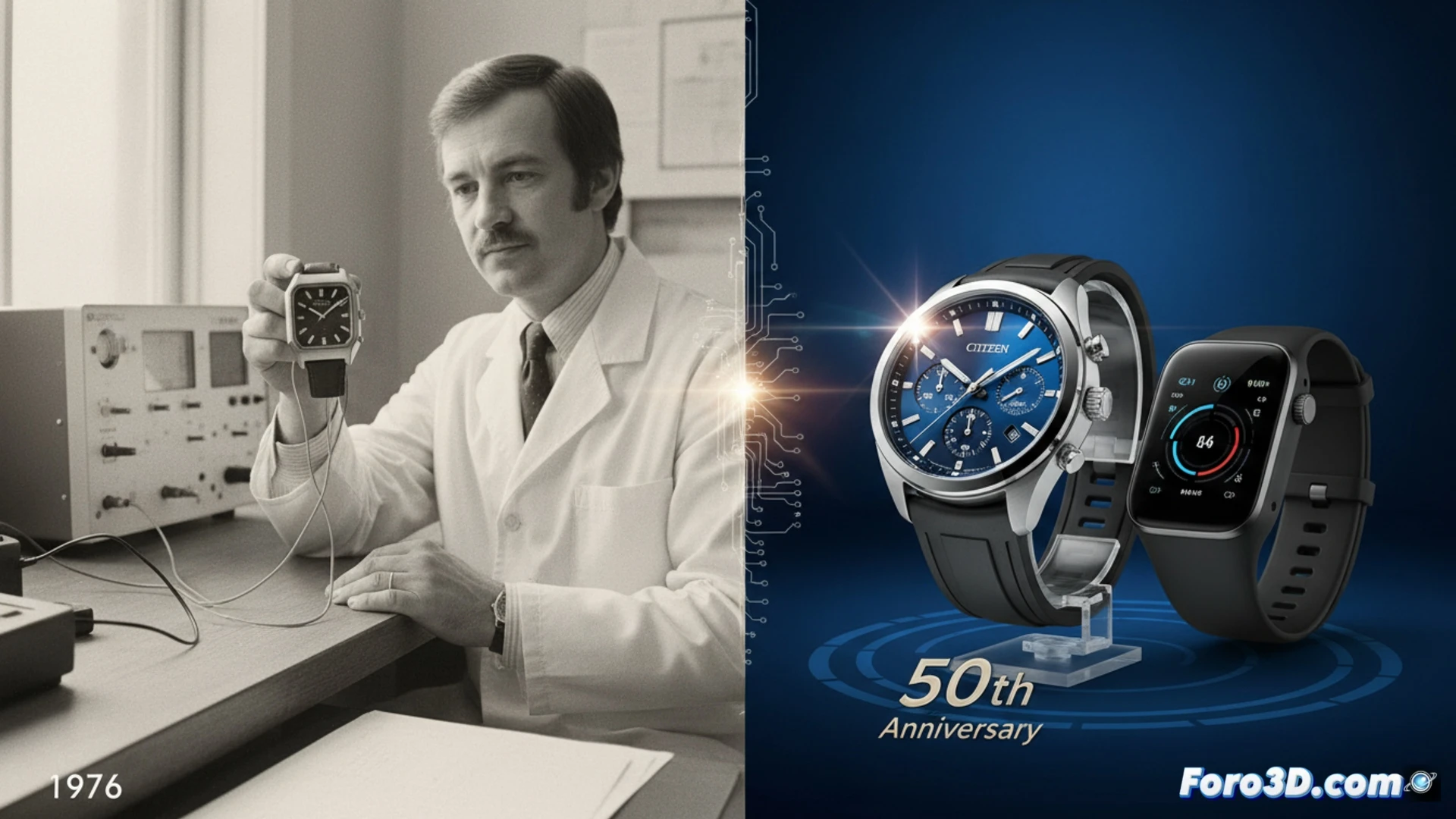
Half a century ago, Citizen introduced the first analog solar watch, a milestone that transcended watchmaking. That 1976 Crysotron, with its eight cells and slow charging, demonstrated that it was possible to power a complex device with ambient light. Today, celebrated with the limited edition Eco-Drive Photon, this legacy is a perfect case study in miniaturization and autonomy. For 3D hardware users, where stability and energy consumption are critical in long renders or on the go, the principles behind this technological evolution offer valuable insights.
From the Solar Cell to the Embedded System: A Path of Optimization 🔋
Current Eco-Drive technology is the antithesis of its predecessor: nearly invisible solar cells, batteries with extremely long duration, and hyper-efficient power management circuits. This leap, from a rudimentary prototype to an autonomous and precise system, was achieved through extreme integration and optimization of every nanowatt. In 3D hardware, similar challenges demand parallel solutions. Consider workstations: they need to maximize autonomy without sacrificing performance, requiring thermal and electrical management as intelligent as that of these watches. Citizen's philosophy, extracting energy from alternative sources and managing it with maximum efficiency, is directly applicable to the design of mobile workstations or even render farms that could integrate sustainable energy sources to reduce their operational footprint.
Autonomy and Precision: Common Goals for Different Technologies ⚙️
The final parallelism lies in the shared goal: devices that operate reliably and autonomously for as long as possible. An Eco-Drive watch must not stop; a 3D render or simulation cannot be interrupted. The pursuit of lower-consumption components, uninterruptible power systems, and designs that dissipate heat effectively follows the same logic as that pioneering invention. The miniaturization and efficiency that allow a watch to function for years on ambient light inspire thinking about a future where professional 3D hardware is even more portable, silent, and sustainable, without compromising its computing power.
How can the energy efficiency and autonomy principles of Citizen Eco-Drive technology inspire the design of the next generation of 3D hardware, such as printers and scanners?
(PS: remember that a powerful GPU won't make you a better modeler, but at least you'll render your mistakes faster)