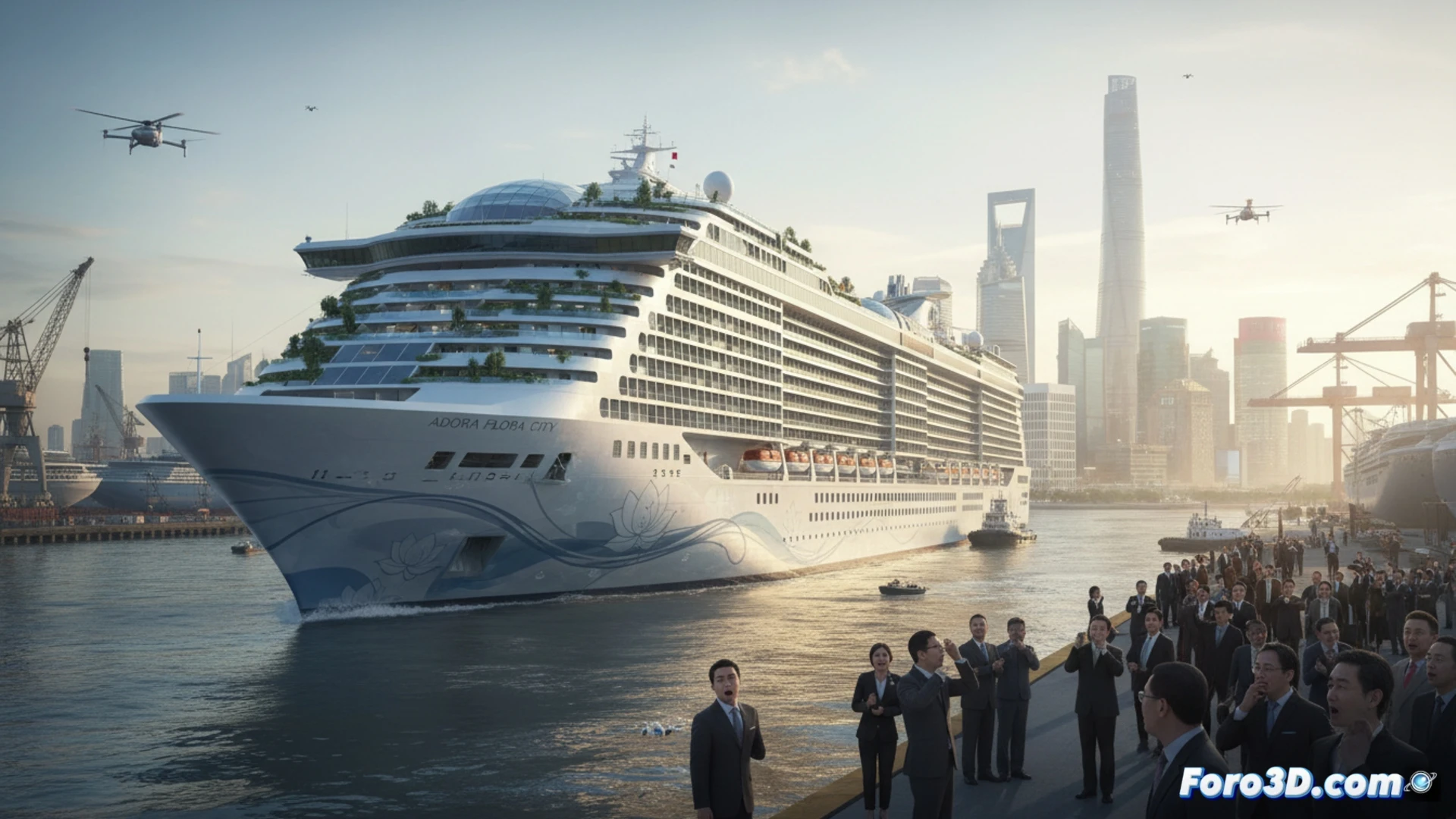
The luxury cruise industry, a historic technological and economic bastion controlled by European shipyards in Italy, Germany, and France, has just recorded a seismic shift. China has delivered the Adora Flora City, a megacruise ship for over 5,000 passengers built in Shanghai in record time. This milestone is not only an industrial achievement but a clear signal of a profound reconfiguration in the global naval supply chain, where high-value knowledge and production capacity are irreversibly migrating eastward.
Modeling the new naval supply chain flow 🗺️
A 3D visualization of this chain makes it evident. The historical model shows a unidirectional flow: design and critical technology from Europe to Asian shipyards for cargo ships, but never for cruise ships. The new model, after the joint venture and subsequent withdrawal of Carnival, reveals a self-sufficient hub in Shanghai. The simulation illustrates how China has internalized entire links: from the engineering of complex hotel systems to the integration of propulsion and entertainment. This drastically shortens timelines, reduces external dependence, and creates a new supply route that competes directly in costs and scale with traditional European channels, pressuring the entire industry.
A reconfigured maritime future ⚓
China's entry as a full competitor alters the naval geopolitical balance. Future simulations project two main scenarios: an intense price and efficiency war that could revitalize global demand, and greater concentration of supply risk in a new dominant pole. The industrial dependencies map is redrawn, positioning China not as a subcontractor, but as a critical and decisive hub. The technological autonomy achieved in this emblematic sector announces a capacity to transform other high-end markets, redefining the concept of industrial sovereignty in the 21st century.
How will China's entry into luxury cruise ship construction affect the resilience and geopolitical balance of global supply chains in the naval industry?
(P.S.: simulating technological dependence is easy, the hard part is not depending on coffee while doing it)