The Lercaro House, current Museum of History of Tenerife, is an icon of La Laguna. Its most famous legend, the tragic story of Catalina, has sometimes overshadowed its immense architectural and historical value. Beyond the paranormal tale, the building itself is the true protagonist: a material piece of Canary history that requires precise documentation and preservation. This is where digital archaeology unleashes its full potential, transforming stone and wood into immortal data.
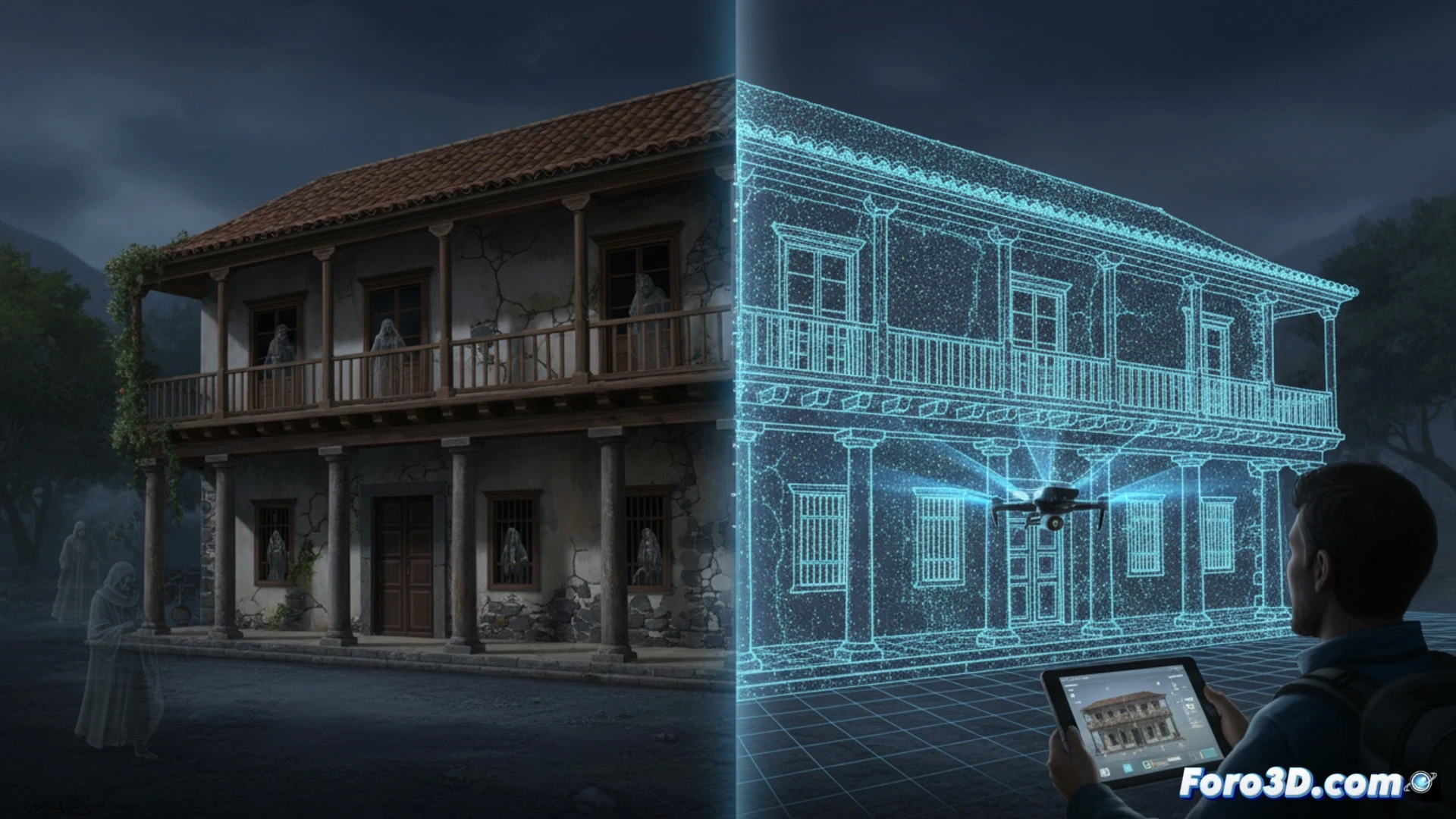
Photogrammetry and laser scanning: creating the digital twin of a monument 🏛️
3D documentation techniques, such as close-range photogrammetry and terrestrial laser scanning, are ideal for a building like the Lercaro House. A systematic scan captures with millimeter precision the geometry of facades, patios, staircases and, yes, even the old well. This digital twin serves as a scientific record against any deterioration, enables non-invasive architectural analyses, and facilitates restoration planning. Additionally, the resulting point cloud can reveal structural alterations and construction phases invisible to the human eye.
Beyond documentation: outreach and immersive narrative 🎥
The 3D model is not an end, but a starting point. With this faithful geometric base, virtual tours accessible to the general public can be generated, the historical evolution of the rooms can be reconstructed, or even narrative experiences can be created that contextualize the legend within its real architectural framework. Technology allows us to separate myth from stone, preserving both with rigor: the building as scientific data and the story as an immersive cultural narrative, all from a technical and patrimonial perspective.
How can the 3D digitization of a historical building like the Lercaro House contribute to archaeological research and to demystifying its legends through material evidence?
(P.S.: If you dig at a site and find a USB, don't plug it in: it might be Roman malware.)