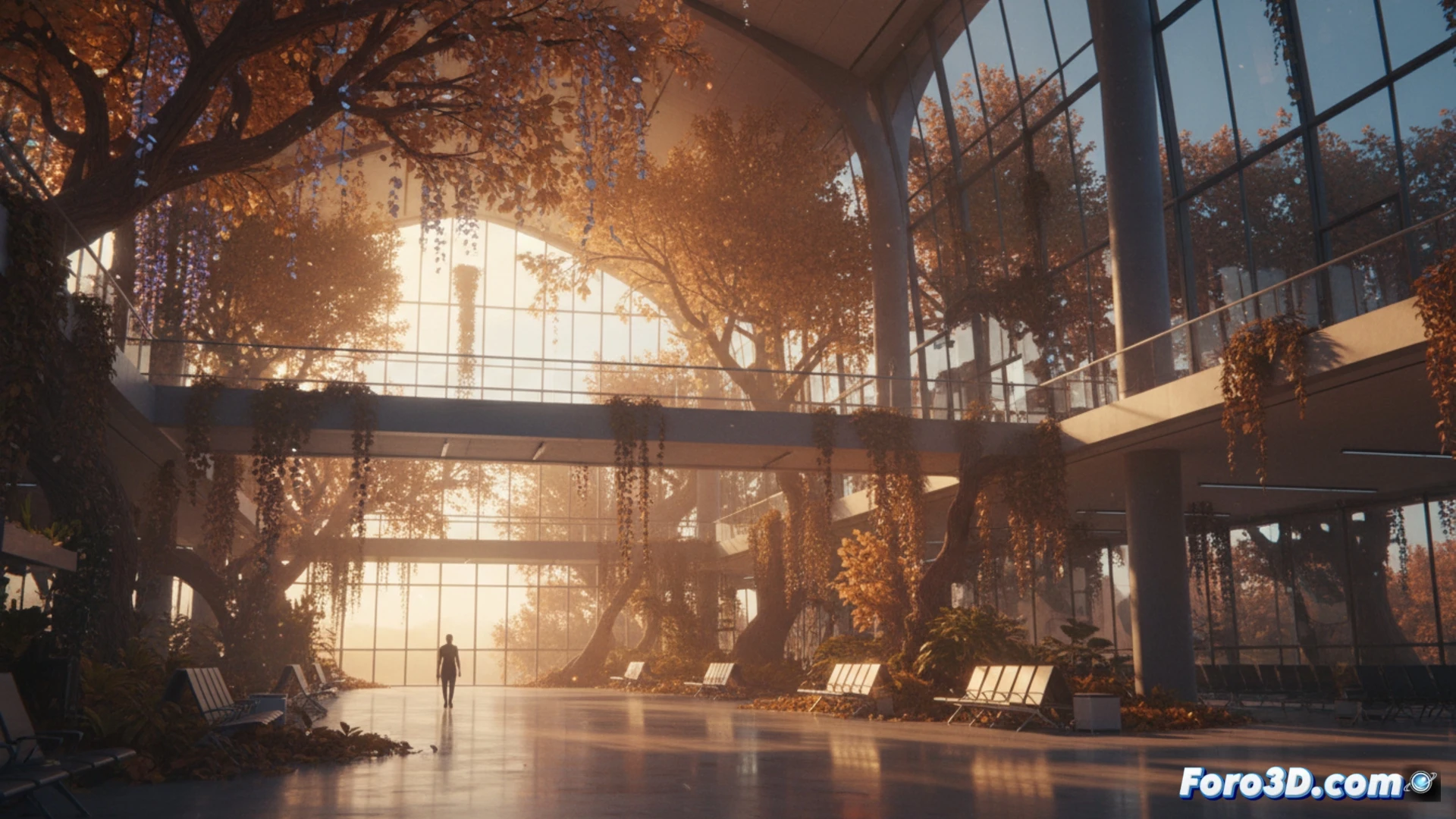
The short film The Untranslatable Forest, created by Ivan Miguel and Andy Camou with Blender, is a fascinating exercise in purely visual storytelling. For the International Day of Multilingualism, the filmmakers transform an airport into a poetic space where nature invades the artificial. This approach demonstrates how 3D can evoke abstract concepts, such as the essence of language, without resorting to dialogue, instead using atmosphere, metaphor, and movement.
Technical pipeline for a meditative atmosphere 🛠️
Achieving the meditative and poetic tone required a very defined 3D pre-production and previsualization pipeline. In Blender, the modeling of the airport's modern architecture contrasts with particle systems and soft body simulations for the invasive leaves and branches. The lighting, key to the atmosphere, plays with the warmth of nature and the coldness of artificial interiors. The composition of each shot was planned to guide the gaze and emotional rhythm, replacing literal translation with a cohesive sensory experience, where every technical element serves the central metaphor.
3D as an emotional language 🎨
This project affirms that 3D software, beyond a technical tool, is a language in itself. Blender is used here not for spectacular realism, but for poetic suggestion. The work invites reflection on how modeling, animation, and post-production can convey the texture and cadence of complex concepts, demonstrating that the most powerful visual narrative often lies in what is felt, not in what is explained.
How can free software, like Blender, become the ideal tool for exploring and communicating complex narrative concepts that defy literal translation into verbal language?
(P.S.: Previz in cinema is like the storyboard, but with more chances for the director to change their mind.)