Black State positions itself as a technical benchmark by taking photorealism and interactivity to new levels. Developed with Unreal Engine 5, the game not only leverages Lumen and Nanite for high-density lighting and geometry, but also integrates two disruptive pillars: a real-time portal system that alters physics and light, and environments with nearly total physical destruction. This analysis breaks down the key software pipeline that makes this feat possible.
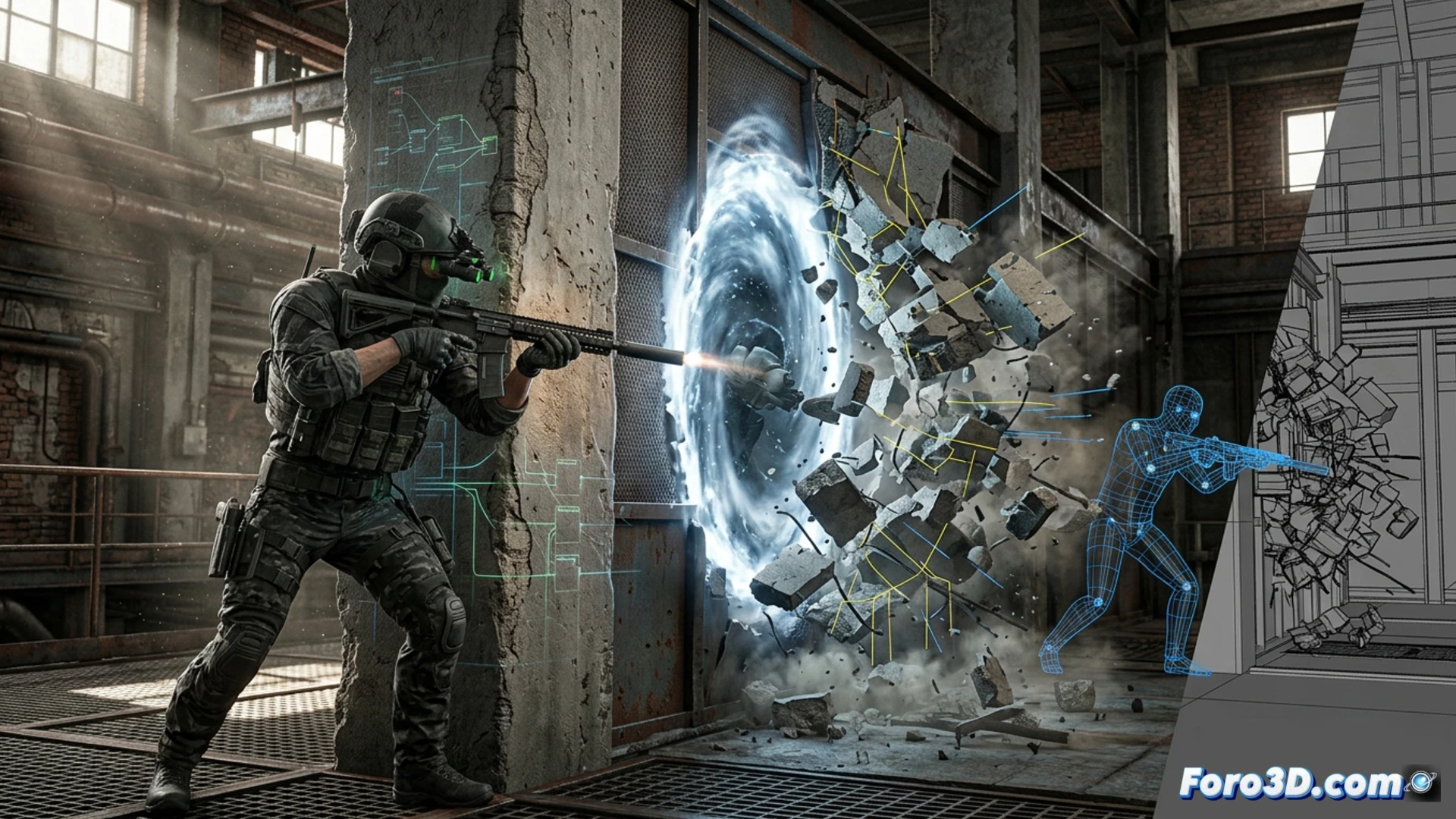
Technical Pipeline: From Simulation in Houdini to Integration in UE5 🛠️
The workflow begins in Maya, where assets are modeled with the necessary topology and segmentation for destruction. These models are passed to Houdini, the core of the simulation. Here, material physical properties are defined, and procedural fractures and debris are generated, creating complex and optimized destruction systems. Assets textured with Substance 3D, with high-precision maps, and Houdini's precalculated simulations are imported into Unreal Engine 5. Within UE5, Nanite handles the immense geometry, Lumen reacts to changes from portals and destruction, and the gameplay system activates destruction simulations, unifying everything into an interactive and coherent world.
A New Standard for Photorealistic Interaction 🚀
Black State is not just a visual demonstration, but a redefinition of physics as a central mechanic. The combination of this specialized software establishes a pipeline where destruction ceases to be a pre-fixed effect to become a systemic and believable consequence. This project sets a path to follow, where the boundary between cinematic simulation and real-time interactive gameplay blurs, demanding new skills from developers and technical artists.
How has Black State integrated Houdini's procedural destruction simulations into the Unreal Engine 5 pipeline to achieve interactive and dynamic photorealism without compromising real-time performance?
(P.S.: 90% of development time is polishing, the other 90% is fixing bugs)