A radical astrophysical theory suggests that black holes could be the origin of dark energy. The proposal indicates that the absorbed matter is transformed into radiation in the singularity, exerting pressure on space. The cumulative effect of all black holes would explain the accelerated expansion of the universe. Scientific visualization is key to exploring and communicating this complex idea, transforming equations into comprehensible models.
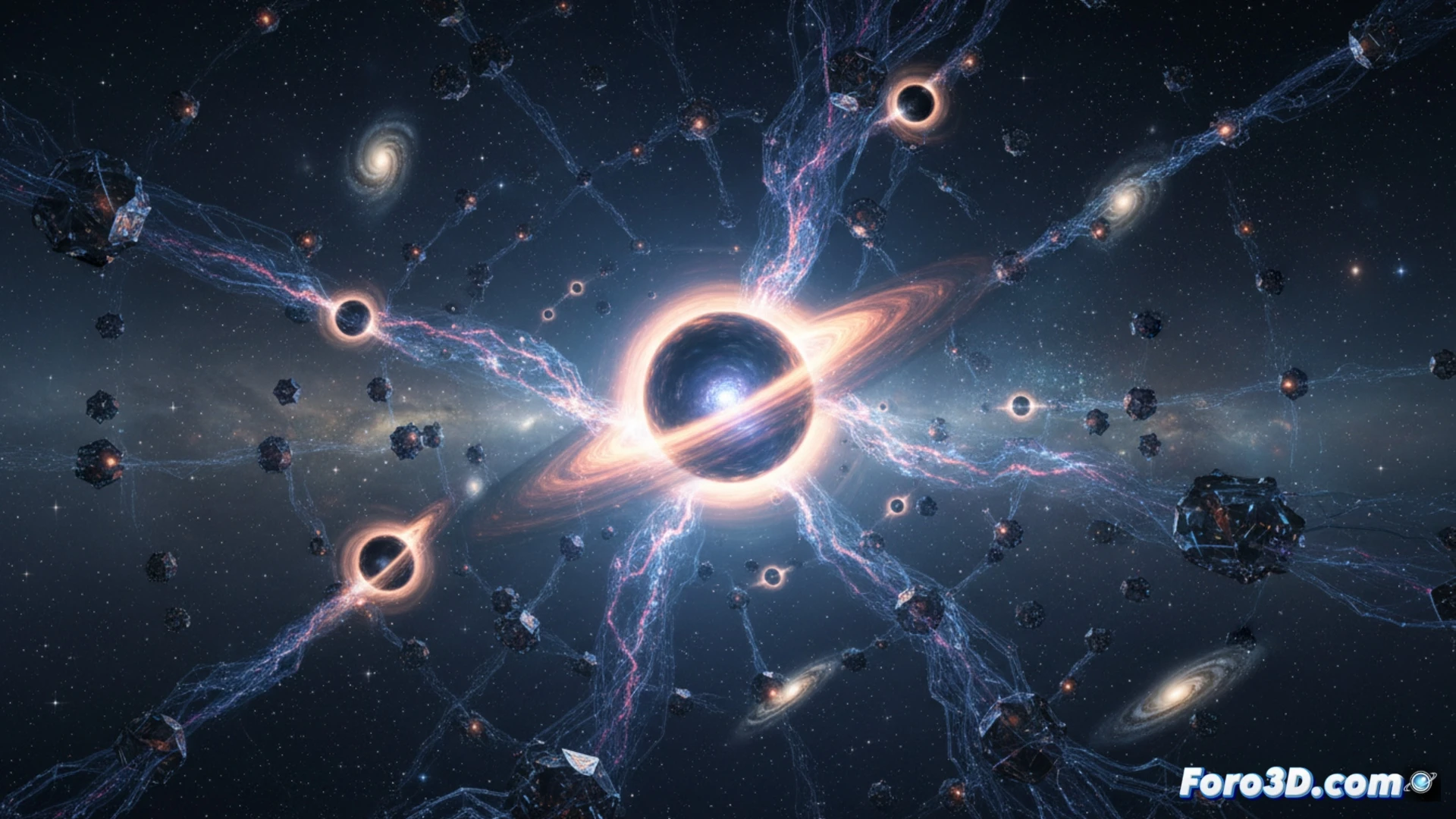
3D Modeling of the Transformation in the Singularity 🌀
To understand this theory, advanced simulations are required. An interactive 3D model could show the fall of an accretion disk toward the event horizon, and visualize the hypothetical conversion of matter into radiation in the singularity region, represented as a domain of unknown physics. Another crucial tool would be a 3D infographic at a cosmological scale, where each luminous point represents a black hole contributing a tiny push to the expansion of the spatial fabric, illustrating the cumulative effect.
Visualize to Validate and Disseminate 👁️
These visualizations are not just illustrative. They allow researchers to identify inconsistencies and compare the theoretical influence of black holes with observational data, such as galaxy maps. For dissemination, a navigable model makes an abstract concept tangible. In Foro3D, we can discuss the techniques to create these representations, using fluid simulations and spatiotemporal deformations, bringing the frontier of cosmology closer to our community.
How can we visualize and represent the hypothesis that dark energy is generated inside black holes, considering the limitations of our current simulations and the unobservable nature of these phenomena?
(P.S.: fluid physics to simulate the ocean is like the sea: unpredictable and you always run out of RAM)