Nature remains the most efficient engineer. Researchers from the City University of Hong Kong have demonstrated this principle by developing a new series of 3D-printed smart materials, modeled after the unique structure of sea urchin spines. These possess a porous and segmented internal architecture that achieves an exceptional combination of lightness, strength, and impact absorption. By replicating this biological design through additive manufacturing, the team has created materials with a very high strength-to-weight ratio, opening up a wide range of applications in high-tech sectors.
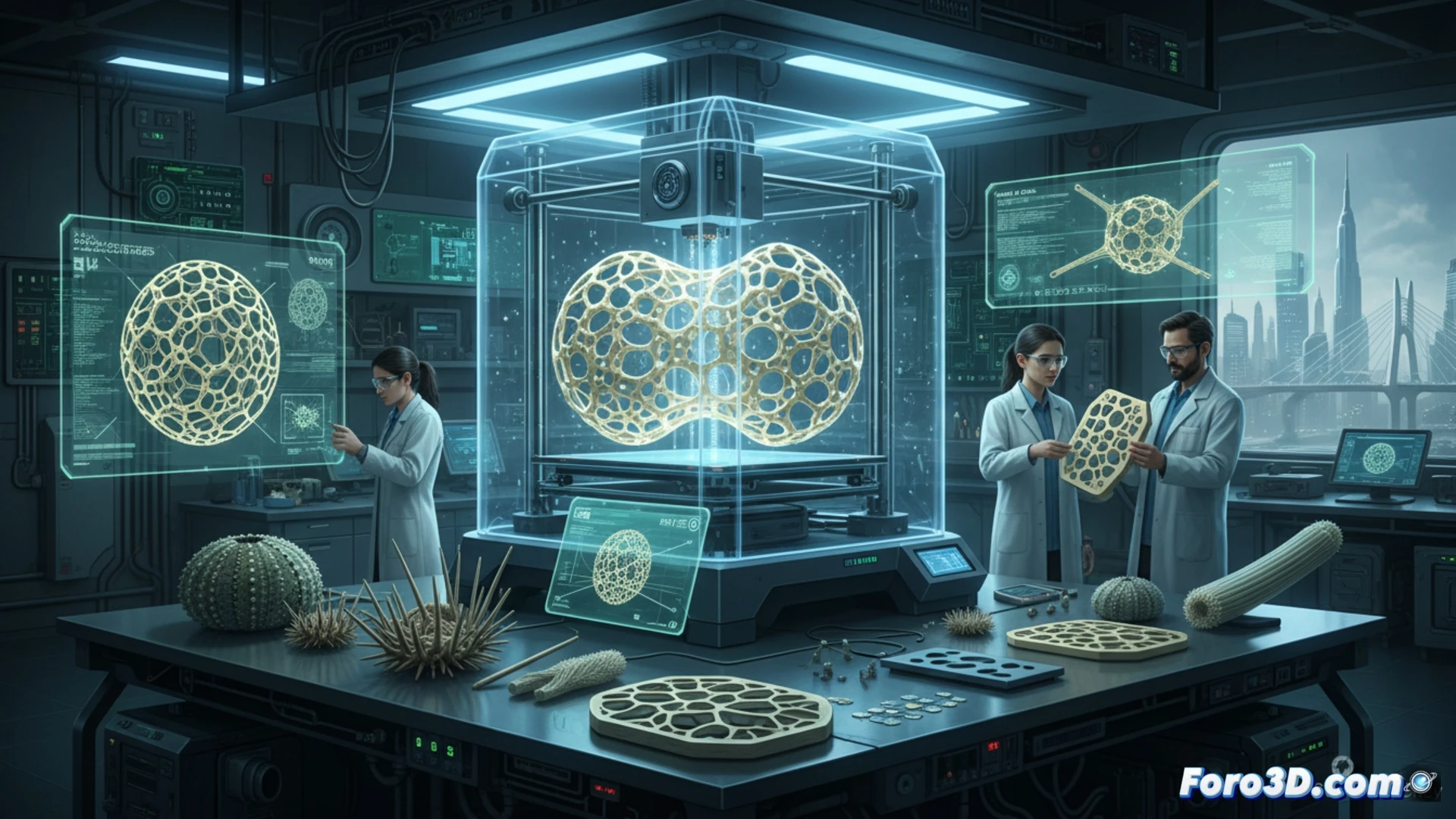
From biological structure to functional material: design, simulation, and manufacturing 🔬
The key process lies in the transition from biomimicry to manufacturing. First, the complex internal architecture of the spine is studied and digitally modeled, characterized by its pores and segments that optimize load distribution and energy absorption. Then, through finite element simulation, the mechanical properties of the virtual design are analyzed and predicted. Finally, 3D printing, particularly techniques that allow high control over porosity and internal geometry, materializes these complex models. This convergence not only allows replicating the structure but also parametrically modifying it to adjust specific properties such as stiffness or impact absorption capacity, subsequently experimentally validating the performance of the manufactured material.
The convergence of disciplines as a driver of material innovation ⚙️
This advance is a paradigmatic example of how the intersection of biology, materials science, and digital manufacturing engineering drives innovation. 3D printing acts as an essential bridge, enabling the translation of biological principles optimized by millions of years of evolution into functional and applicable materials. The result is custom-made materials, with microarchitectures designed for specific functions, from lighter and more biocompatible biomedical prostheses to structural components in aeronautics or more effective personal protective equipment. The future of materials design lies in this integration of natural observation, computational modeling, and precision additive manufacturing.
How can the microscopic structure of sea urchin spines inspire the design of new 3D-printed composite materials with superior mechanical properties?
(P.S.: Visualizing materials at the molecular level is like looking at a sandstorm through a magnifying glass.)