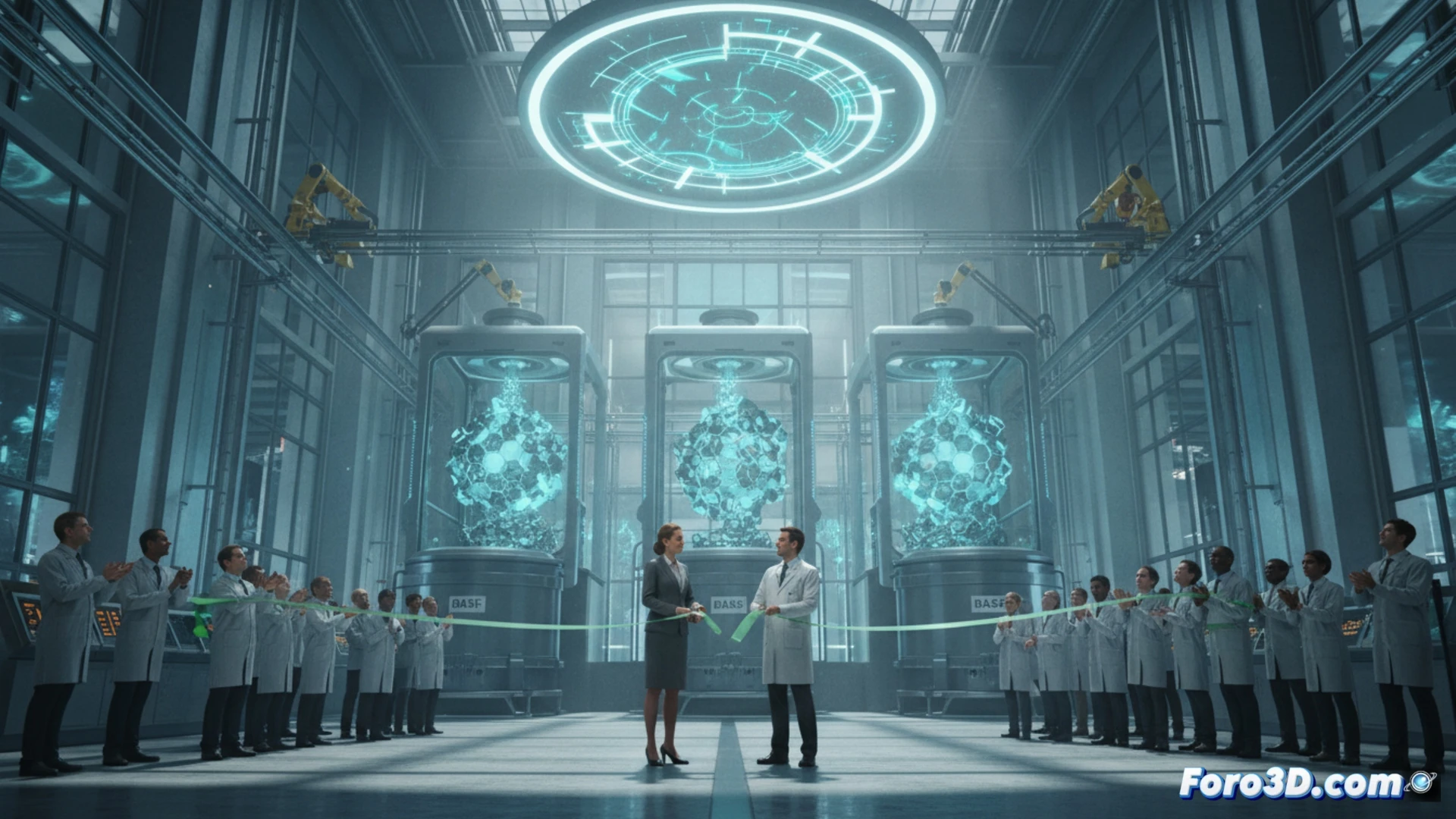
BASF has marked a milestone at the intersection between additive manufacturing and chemical engineering by inaugurating in Ludwigshafen the world's first industrial plant to produce catalysts using 3D printing. This initiative scales its patented X3D technology, transferring the digitally optimized design directly to the manufacturing of final components. It is no longer about prototyping, but about large-scale production of a critical element for industrial processes, demonstrating the maturity of this technology for high-performance applications.
Geometric optimization for process efficiency: beyond shape 🧠
The core of the innovation lies in how 3D printing enables catalyst geometries impossible to achieve with conventional methods. These digitally optimized structures offer two key advantages for process simulation and operation. First, they significantly reduce pressure drop in reactors, decreasing energy consumption. Second, they maximize the active surface area available for chemical reactions, improving performance and efficiency in raw material use. The case of An Hui Jintung, with production records in sulfuric acid, validates this approach. It is the digital twin made real: a parametrically optimized design in simulation materializes into a physical component that transforms process efficiency.
From digital model to industrial plant: a new paradigm 🏭
This advance symbolizes a paradigm shift in process engineering. The ability to manufacture on-demand catalysts with customized geometries radically shortens development and commercialization time. For simulation specialists, it represents the culmination of the cycle: no longer just modeling to predict, but to manufacture optimally. BASF demonstrates that industrial additive manufacturing is a viable tool for the continuous optimization of complex chemical processes, where each reactor can have its unique solution, accelerating the transition to a more efficient and adaptable industry.
How can industrial-scale 3D printing of catalysts optimize chemical processes and revolutionize reactor design? 🔬
(P.S.: Simulating industrial processes is like watching an ant in a maze, but more expensive.)